Abstract
Employee experience has emerged as a defining factor in organizational success, directly influencing productivity, retention, and workplace culture. Despite this, many Human Resources (HR) systems continue to operate reactively—responding to issues only after they have escalated into dissatisfaction, disengagement, or attrition.
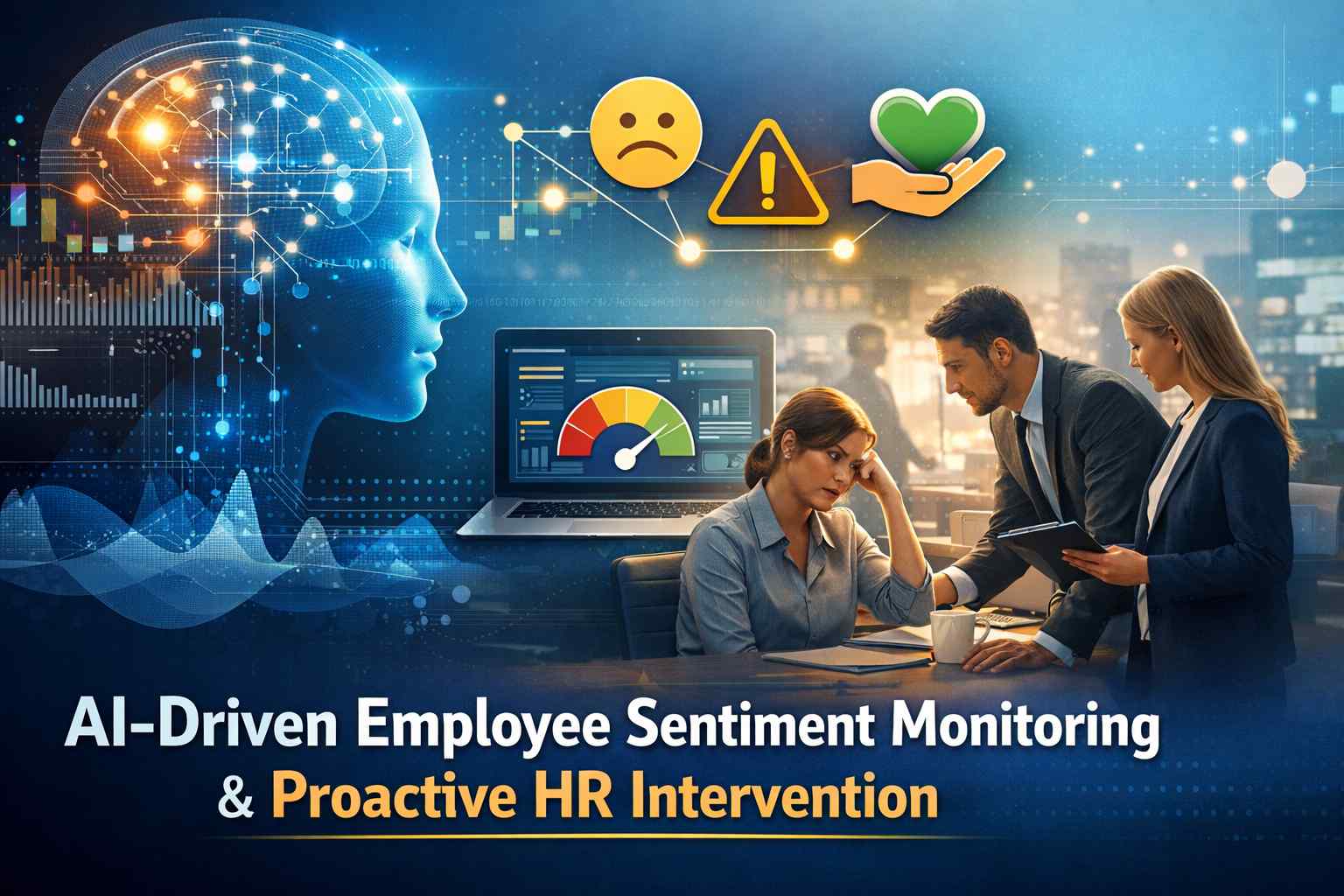
AI-driven employee sentiment monitoring introduces a transformative shift by enabling continuous analysis of employee interactions, emotional signals, and behavioral patterns within HR Service Delivery (HRSD) workflows. By identifying early indicators of frustration, burnout, or disengagement, organizations can intervene proactively and provide timely support.
This article presents a vendor-neutral framework for integrating sentiment intelligence into HR workflows, demonstrating how AI can transition HR from a reactive support function into a predictive, empathetic, and strategic capability.
1. Introduction
Organizations today are navigating a complex landscape shaped by hybrid work environments, increased employee expectations, and a growing emphasis on wellbeing and engagement. Employees interact with HR systems more frequently than ever—raising requests, asking questions, and reporting concerns that often carry underlying emotional signals.
However, traditional HR service models are designed primarily for transactional efficiency, not emotional understanding. Cases are routed, resolved, and closed—but the sentiment behind the interaction is rarely captured or analyzed. This creates a critical blind spot.
An employee who repeatedly raises concerns about payroll discrepancies may not simply be seeking resolution—they may be expressing frustration, loss of trust, or disengagement. Without mechanisms to detect these patterns, HR teams remain unaware of underlying risks until they manifest as serious outcomes such as attrition or escalation.
AI-driven sentiment monitoring addresses this gap by embedding emotional intelligence into HR workflows, enabling organizations to move from reactive response to proactive care.
2. The Shift from Reactive HR to Predictive Employee Experience
Historically, HR organizations have relied on delayed feedback mechanisms such as annual engagement surveys, exit interviews, manager escalations, and compliance reporting. While useful, these methods are inherently lagging indicators. By the time insights are gathered, employee dissatisfaction has often already escalated.
Modern organizations require real-time visibility into employee experience. AI enables this transformation by continuously analyzing employee language in HR cases, sentiment trends across interactions, behavioral patterns such as repeated requests, and escalation frequency alongside unresolved issues.
This shift represents a new paradigm. Traditional HR is reactive, periodic, and transaction-focused, whereas AI-driven HR is proactive, continuous, and experience-focused. Instead of manual interpretation, organizations gain automated intelligence that supports timely and informed decision-making. The result is an HR function that not only resolves issues—but anticipates them.
3. Architecture of AI-Driven Sentiment Monitoring in HRSD
A modern sentiment monitoring system within HR Service Delivery operates as an interconnected, intelligence-driven pipeline that transforms raw employee interactions into meaningful insights and actionable interventions. At its foundation lies the continuous capture of employee communication across multiple channels, including HR portals, case submissions, emails, and conversational interfaces. These interactions represent more than transactional requests—they contain implicit emotional signals that reflect employee experience.
Once captured, these inputs are processed through a natural language understanding layer capable of interpreting not only the explicit intent of the request but also the contextual meaning embedded within the language. Unlike traditional keyword-based approaches, advanced NLP techniques analyze sentence structure, semantic relationships, and contextual cues to derive a deeper understanding of the employee’s concern.
This understanding is further enriched by sentiment analysis, which evaluates the emotional tone of each interaction. Rather than simply categorizing messages as positive or negative, the system identifies gradients of emotional intensity and tracks how sentiment evolves over time. A single negative interaction may not be significant; however, a pattern of declining sentiment across multiple interactions signals a more serious underlying issue.
To enhance this perspective, the system incorporates behavioral analysis, examining patterns such as repeated case submissions, unresolved issues, and escalation frequency. These behavioral signals provide critical context, allowing the system to distinguish between isolated incidents and systemic dissatisfaction.
All of these inputs converge within a risk assessment layer, where sentiment and behavioral data are synthesized into a comprehensive risk profile. This profile enables the system to identify employees who may be experiencing frustration, disengagement, or burnout. Once risk thresholds are exceeded, alerts are generated and routed to HR stakeholders, enabling timely and informed intervention. This architecture transforms HR workflows from reactive case management into proactive experience monitoring.
4. Interpreting Employee Sentiment in Context
Understanding employee sentiment requires more than detecting isolated expressions of dissatisfaction. Emotional signals are often subtle, evolving gradually across interactions rather than appearing as explicit statements. Employees rarely declare disengagement directly; instead, they communicate it through patterns of language, tone, and repetition.
For instance, an employee who repeatedly references unresolved issues or expresses concern about delays may be signaling frustration that extends beyond the immediate request. Over time, these expressions can intensify, shifting from neutral inquiries to more emotionally charged language. This progression provides a valuable indicator of underlying dissatisfaction.
Equally important is the context in which these signals occur. Certain topics inherently carry higher emotional weight, such as compensation discrepancies, workplace conflicts, or policy-related concerns. When negative sentiment is associated with these contexts, the potential impact on employee engagement is significantly amplified.
By combining linguistic interpretation with contextual awareness, AI systems can distinguish between routine requests and interactions that require deeper attention. This capability allows HR teams to move beyond surface-level understanding and gain insight into the emotional dynamics that influence employee experience.
5. From Detection to Proactive HR Intervention
The true value of sentiment monitoring lies not in detection alone but in the ability to translate insights into meaningful action. Identifying at-risk employees is only the first step; the effectiveness of the system depends on how organizations respond to these signals.
When elevated risk is detected, HR teams are equipped to engage proactively rather than reactively. This often begins with direct outreach, where HR professionals initiate conversations to better understand the employee’s concerns. Such engagement demonstrates attentiveness and reinforces trust, signaling to employees that their experiences are being actively monitored and valued.
In parallel, case prioritization mechanisms ensure that high-risk interactions receive immediate attention. By accelerating resolution timelines and reducing delays, organizations can address issues before they escalate further. In more complex scenarios, cases may be escalated to senior HR partners who possess the experience and authority to manage sensitive situations effectively.
Proactive intervention also extends beyond individual cases. Insights derived from sentiment analysis can inform broader organizational strategies, enabling HR teams to identify recurring issues, adjust policies, and implement preventive measures. In this way, sentiment monitoring becomes a catalyst for continuous improvement rather than a standalone capability.
6. Organizational Impact of Sentiment-Driven HR
The integration of AI-driven sentiment monitoring into HR workflows delivers significant organizational benefits, extending beyond operational efficiency to influence overall workplace culture. By identifying dissatisfaction early, organizations can reduce employee attrition, addressing concerns before they lead to disengagement or turnover.
Employee experience is also enhanced through more responsive and empathetic interactions. When employees feel heard and supported, their trust in the organization increases, contributing to higher levels of engagement and productivity. This improvement is not limited to individual interactions but extends across the organization as consistent communication standards are established.
From an operational perspective, HR teams benefit from reduced manual effort and improved decision-making capabilities. Instead of spending time analyzing individual cases, professionals can focus on higher-value activities such as strategic planning and employee development. The availability of real-time sentiment data further enables leadership to make informed decisions based on current workforce dynamics.
Ultimately, sentiment-driven HR fosters a culture of transparency and responsiveness, where employee concerns are addressed proactively and organizational support is visible and consistent.
7. Ethical and Governance Considerations
As organizations adopt AI-driven sentiment monitoring, it is essential to ensure that these systems are implemented responsibly and ethically. Employee data represents sensitive information, and its use must be governed by strict privacy and security standards. Transparency is equally important, as employees should have a clear understanding of how their interactions are analyzed and how insights are utilized.
Bias mitigation is another critical consideration. Language interpretation models must be designed to account for variations in communication styles, cultural differences, and contextual nuances. Without careful evaluation, there is a risk of misclassification, which could lead to inappropriate conclusions or actions.
Human oversight remains a fundamental requirement in this process. While AI provides valuable insights, final decisions must be guided by HR professionals who can interpret context, apply judgment, and ensure fairness. The goal of sentiment monitoring is not to replace human empathy but to enhance it, providing HR teams with the tools needed to support employees more effectively.
By balancing technological capability with ethical responsibility, organizations can build systems that are both powerful and trustworthy.
8. Future Directions in AI-Driven HR
The next evolution of HR intelligence includes predictive wellbeing analytics, real-time emotional dashboards, AI-generated HR recommendations, multi-agent HR orchestration systems, and cross-channel sentiment correlation. These advancements will enable HR to become a predictive and strategic function, deeply integrated into organizational success.
9. Conclusion
AI-driven employee sentiment monitoring represents a fundamental shift in HR Service Delivery. By embedding emotional intelligence into workflows, organizations can identify risks earlier, respond faster, and support employees more effectively. The future of HR is not reactive—it is anticipatory, empathetic, and intelligent.