
Business operations depend heavily on legacy software, but legacy software is typically built on old designs and contains hidden complexities. Therefore, they usually impede innovation.
With the introduction of AI tools like Claude Code in 2026, teams will be able to move forward by modernizing their software incrementally instead of through a risky complete rewrite; Claude Code will analyze the existing application codebase (including the dependencies) and provide suggestions on the safest way to refactor portions of the application to help teams deliver applications faster with fewer regressions.
Why Legacy Modernization Still Fails
Legacy modernization efforts fail because of a lack of proper planning, even with better tools available. Teams tend to think that business logic is not as deep within each system as it actually is and they sometimes make an attempt to rewrite a legacy application without having a complete understanding of edge case scenarios first. This creates expensive and unanticipated delays in the phase-out of legacy applications. One way to help alleviate these issues is to utilize a tool like Claude Code that can evaluate the application’s behavior prior to proposing any modification.
Another problem frequently encountered during legacy modernization is the lack of sufficient test coverage. Most legacy systems either do not have, or have very limited, test coverage and/or have out-of-date tests, making it difficult to ensure that any modernization of the legacy application is effective. Claude Code generates meaningful test cases based upon the observed behavior of the legacy application, rather than on unwarranted assumptions. This allows the modernizing team to move from a process based upon guesswork to a process based upon data-driven engineering principles.
In real-world settings, internal engineering activities and external consultants frequently work together on a modernization initiative. Legacy software modernization providers like Cleveroad have usually engaged with clients on assessing technical debt; defining their modernization strategy and reducing the risk of complex system transformation.
What Makes Claude Code Different
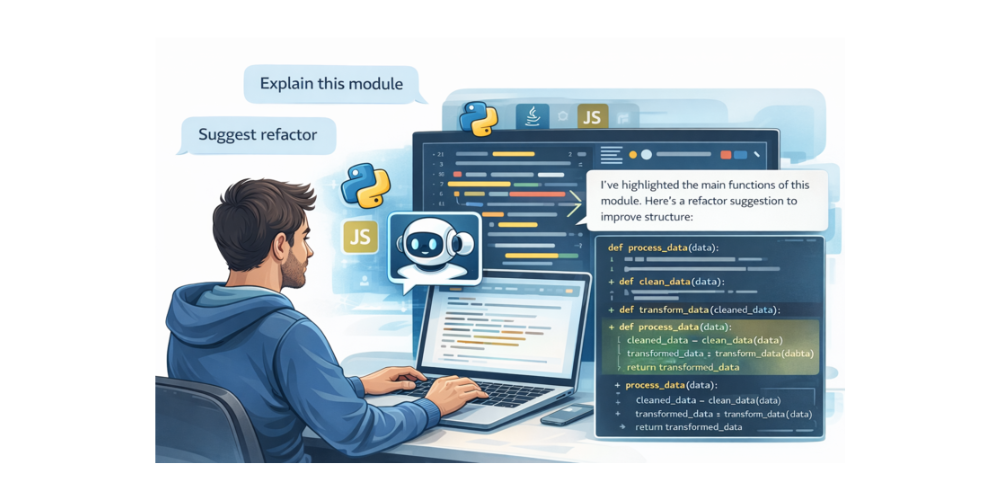
Claude Code is innovative because it uses a conversational process to help Developers understand Modules, Dependencies and Plan Modernization one Step at a time. The capability goes beyond Code Generation, providing reasoning, Trade-Offs and Migration Paths. Claude can accommodate Multi-Language/Multi-Technology Stacks, allowing Incremental Improvements to be made without causing Disruption.
Step 1: Know Before You Change
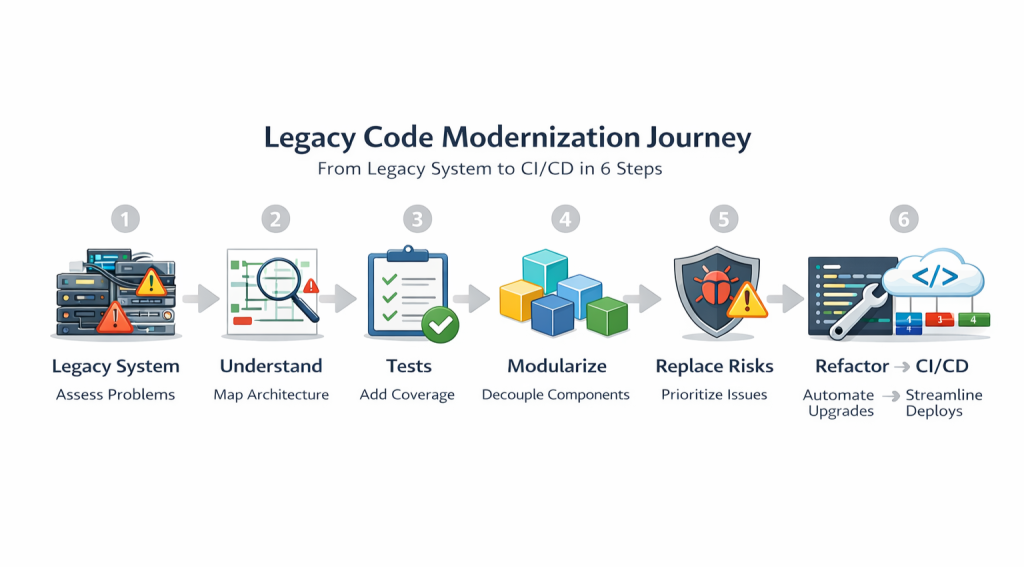
In order for you to modernize, you need to first develop an extensive understanding of the existing application system. The documentation produced by Claude Code can provide architectural overviews, highlight boundaries of key modules, and point out areas that might be risky (i.e., those that have high levels of uncertainty, complexity, and/or interdependencies). Additionally, Claude Code is capable of identifying unused code, duplicated logic, and high levels of coupling, allowing for a clear mapping of what needs to be preserved, refactored, or removed.
Changes should not be made immediately; instead, teams should first use Claude Code to simulate what may happen to the system if changes are made. For example, you may want to know how your decision to replace a database layer will impact the systems that consume data from it. By using these simulation capabilities, you greatly reduce the likelihood of causing any unintended consequences (i.e., you turn modernization into a controlled process instead of an act of faith).
Step 2: Test Stability
Prior to structural modifications, it’s vital that the system is in a state of stability. With Claude Code the ability to produce unit, integration, and regression tests based on current state is possible. These tests will also serve as safety net to make sure that ongoing modifications of a system will not degrade the previous working functionality of that system. Even if there are little or no documentation on the system, you would still be able to quickly gain good test coverage.
It is important to perform validation on the generated tests with an appropriate business subject matter expert(s). Although AI may infer system behaviour, business rules can represent many subtle variations. By combining the speed of Claude Code with the validation of a human expert, there should be a high level of reliable coverage. After gaining test coverage for any system, the team that is performing the refactoring would be able to do so with assurance.
Step 3: Modularize Using an Incremental Approach
The common approach for upgrading legacy applications is to do a complete re-write. However, Claude Code recommends using an incremental modularizing approach. This allows you to be able to define service boundaries, pull out reusable pieces of code, and find candidates for microservices or APIs as part of a new architecture as you do not need to stop current development while continuing to improve architecture.
Incremental Changes Also Lower Your Risk Rather than replace an entire application at once, you can make incremental modernization of one module at a time. Claude Code provides tools to ensure the old and new pieces work together as they are gradually replaced. Over time you will have transitioned your application into a cleaner more maintainable system.
Step 4: Replace the Risky Parts First
Not all the components of a legacy system are equally risky. By helping to identify the most risky components, Claude Code will help you better focus on areas that need urgent attention during your modernization efforts. Outdated libraries, security vulnerabilities, or bottlenecks are examples of high-risk components. Fixing these areas will yield immediate benefit.
A narrowed focus on a small number of reason areas to fix creates momentum within the program as well. Early successes will prove to stakeholders and management the benefits of modernizing and will provide Claude Code with the ability to produce a before and after comparison (e.g., performance improvements or maintainability improvements). This will make it easier to continue to secure resource allocations for your modernization efforts.
Step 5: Automate Refactoring and Documentation
It is a tedious and error-prone process to refactor legacy code; however, using Claude Code automates much of this process through the automated creation of cleaner implementations that maintain behavior. It also helps to standardize names, increase readability, and remove dead code, which drastically reduces the amount of manual work involved.
In addition to being able to automate the process of refactoring, Claude Code also automates generating up-to-date technical documentation directly from the codebase, which will include API descriptions, architectural diagrams, and onboarding guides. Creating good documentation will support the long-term sustainability of your modernization efforts.
Step 6: Integrate with CI/CD Pipelines
Modernization is more than just changing code; it also involves integrating with current processes. Claude Code can help you implement CI/CD pipelines that include automated testing and deployment as well as provide you with insight on best practices for version control and release management, which allows for ongoing verification of improvements.
Integrating Claude Code into the entire development lifecycle helps to maintain efficiency and allows teams to build new features on top of modernized components without reintroducing legacy issues. As such, you will create a virtuous cycle of continuous improvement.
The Future of Legacy Modernization
By 2027, transitioning legacy systems will be significantly less time-consuming and costly as compared to how it is viewed in today’s landscape; with technology like Claude Code, this process is now a systematic and well-defined process. Technologies will enable much faster delivery of solutions while continuing to enable teams to deliver reliable systems – which was previously an extremely difficult thing to accomplish, but now both will occur together due to the new emphasis placed on both culture and technology.
Organizations that are willing to utilize AI-supported development processes will see a real advantage over their competitors; they will be able to respond quickly through reduced reliance on technical debt, while also providing the ability to innovate without being impacted by legacy technology barriers. Claude Code is not just another tool – it will serve as a true change agent for companies worldwide.
Author bio
Yuliya Melnik is a technical writer at Cleveroad, a software development company. She is passionate about innovative technologies that make the world a better place and loves creating content that evokes vivid emotions.