
Business Intelligence has always promised faster, better decisions. Yet in many enterprises, BI still looks like a familiar loop: build dashboards, debate metrics, export to spreadsheets, and ask analysts for “one more cut.” The problem isn’t a lack of data. It’s the friction between data and action because of semantic ambiguity, slow iteration cycles, and insight bottlenecks that turn operational questions into multi-day ticket queues.
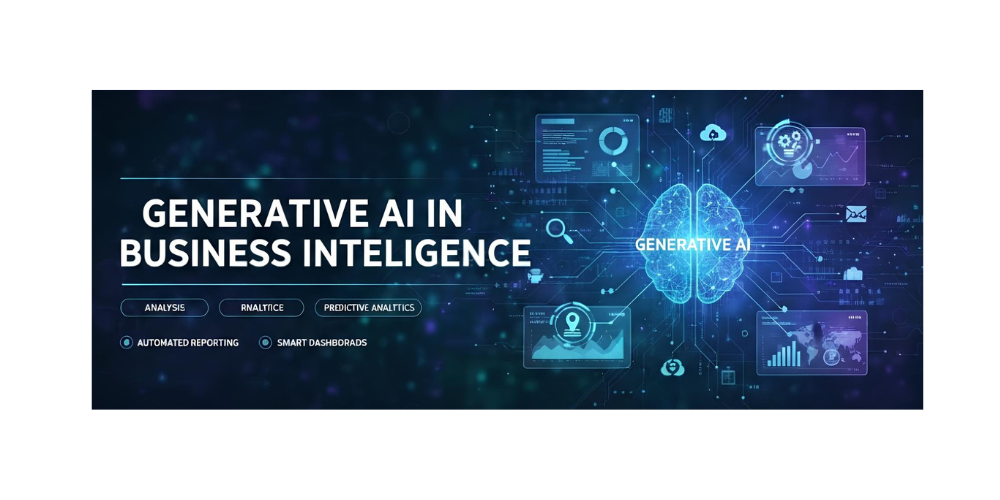
Generative AI in business intelligence is not a cosmetic upgrade to dashboards. Properly applied, it changes the interface, the workflow, and more importantly, the economics of insight generation. It enables Natural language BI that feels conversational, AI-driven data insights that surface “why” and “what next,” and generative AI analytics that can draft narratives, explore hypotheses, and propose next-best actions.
But there’s a catch. In most organizations, the constraint is not model capability. The constraint is trust: trust in metric definitions, data lineage, access controls, and the governance required to let AI touch decision-making. This is where the shift from traditional BI to Enterprise AI analytics becomes both exciting and uncomfortable.
What follows is a forward-looking, vendor-neutral view of what’s changing, what’s real, and what must be architected deliberately.
Why BI Needed a Reset
Classic BI optimized for reporting, not reasoning. Most systems excel at answering known questions:
“How did revenue trend by region?”
“What is the conversion rate by channel?”
“Which product line is underperforming?”
These are valuable, but they assume the question is already well-formed, the user understands the data model, and the correct metric definition is agreed upon.
Modern decision-making rarely satisfies these assumptions. Teams need to navigate ambiguous questions (“Why did churn spike?”), incomplete context (a promotion ran in one region), and fast-changing business logic (new pricing plans, new attribution models, new segments). BI teams are asked to be translators and arbiters while data grows and timelines compress.
Generative AI introduces a new possibility of shifting from querying data to interrogating decisions.
What Generative AI Actually Adds to BI (Beyond “Chat with Data”)
The popular mental model is a chat box on top of a dashboard. That is the smallest, least interesting part of the change. The bigger shift is that AI-powered business intelligence can help with the parts humans struggle with at scale:
- Translating Intent into Computation
Most business questions are expressed in language that is vague by engineering standards:
- “Active users” (daily? monthly? authenticated? engaged?)
- “Revenue” (gross? net? recognized? billed?)
- “Pipeline” (created? weighted? closed-won?)
Generative AI can propose interpretations, ask clarifying questions, and map user intent to metric logic if it is grounded in a governed semantic layer. Without that foundation, Natural language BI becomes a high-confidence hallucination machine.
- Narrative and Explanation, Not Just Numbers
Humans don’t decide based on tables. They decide based on stories supported by evidence.
Generative AI analytics can draft narrative summaries:
- what changed,
- where it changed,
- likely drivers,
- confidence levels,
- recommended next checks.
This is not “auto-writing.” It is a new interface for synthesis, especially useful for executives and frontline teams who want decisions, not charts.
- Hypothesis Generation and Guided Exploration
Traditional BI is reactive: you ask, it answers.
An Intelligent BI solution can be proactive:
- “Churn rose most in Segment B; it correlates with longer onboarding time and lower feature adoption.”
- “This anomaly aligns with a payment gateway incident window.”
- “If you exclude campaign X, the trend normalizes.”
Done responsibly, AI becomes an exploration partner that compresses the search space.
- Predictive and Prescriptive Layers Become More Accessible
Enterprises have used forecasting for years, but deployment is uneven because the expertise is scarce.
With Predictive analytics with AI, the barrier drops:
- forecasting demand or revenue by segment,
- predicting churn risk,
- identifying likely lead conversion,
- anticipating inventory shortfalls.
Generative models can also explain predictions in plain language and translate “model signals” into action steps if explanations are anchored to transparent features and quality data.
The Architecture Reality: Generative AI Is Only as Good as Your Semantics
Most BI failures are semantic failures, not technical ones. Two teams look at “revenue” and argue, because they’re using different definitions.
Generative AI magnifies this. If the model is asked to answer fast, it will. But speed without semantics produces confident inconsistency.
The foundation for Enterprise AI analytics is the semantic and governance layer:
- Metric definitions as canonical contracts (e.g., “Net Revenue = …”)
- Entity resolution (customer, account, user, device)
- Data lineage and freshness signals
- Access controls aligned to roles and sensitivity
- Human-in-the-loop approvals for high-impact outputs
In practice, the organizations seeing real gains are treating AI-assisted BI as a product: with reliability targets, evaluation metrics, and change management.
Trust, Risk, and the “Decision Surface Area” Problem
BI influences decisions. Decisions move money, change pricing, cut budgets, and shift operations. When you introduce generative AI into that loop, you increase what can be called the “decision surface area” which is the number of people who can act on analysis quickly.
That is good for agility and dangerous for control.
Key risks that must be addressed explicitly:
Hallucinations and False Precision
A fluent explanation is not the same as a correct explanation. GenAI can produce plausible narratives even when underlying evidence is weak.
Mitigation: enforce citations to underlying data, show query logic, display confidence indicators, and prefer “I don’t know” over invented certainty.
Metric Drift and Silent Redefinitions
If a semantic model changes and downstream AI behaviors shift, you can get decision drift.
Mitigation: version metrics, log interpretations, and create “semantic change alerts” for high-impact definitions.
Data Leakage and Over-Permissioned Answers
Natural language interfaces can accidentally surface sensitive data if policy controls are weak.
Mitigation: strict row-level security, attribute-based access control, and redaction rules that operate before the model sees data.
Automation Bias
When AI speaks confidently, humans can stop validating.
Mitigation: training, UX patterns that encourage verification, and governance rules for “high-stakes decisions” (pricing changes, compliance reporting, financial disclosures).
This is why AI-powered business intelligence must be built as a governed capability, not a convenience tool.
Where Generative AI Delivers the Highest BI ROI
Not all BI workflows benefit equally. In most enterprises, the highest value appears in three bands:
Band 1: Decision Communication (Fast Wins)
- Executive summaries and weekly business reviews
- Narrative reporting with supporting metrics
- Automated anomaly write-ups with recommended next checks
This improves alignment and reduces analyst time spent on presentation.
Band 2: Self-Serve Exploration (Break the Ticket Queue)
- Conversational BI for non-technical users
- “Explain this change” workflows
- Guided drilldowns: cohort breakdowns, segment analysis, driver decomposition
This is the core promise of AI-driven data insights: more people answering more questions without waiting.
Band 3: Predictive Workflows Embedded in Operations (Compounding Value)
- Churn risk surfaced in customer success workflows
- Demand forecasts tied to procurement and staffing
- Lead scoring and conversion likelihood in CRM contexts
Here, Predictive analytics with AI stops being a reporting tool and becomes part of operating cadence.
The New BI Skill Stack: Analysts Become “Decision Engineers”
As generative systems become part of the BI interface, the analyst role evolves.
Less time writing repetitive SQL for known questions and building dozens of slight dashboard variants. More time curating semantic layers, validating metric definitions, designing decision workflows, building evaluation harnesses, and monitoring data quality and model behavior.
In other words, analysts become decision engineers responsible for making the “truth pipeline” usable, explainable, and safe.
This is a cultural shift as much as a technical one. Teams that treat Intelligent BI solutions as a cross-functional product (data + security + operations + business owners) will outperform those that treat it as a data team experiment.
A Practical Governance Framework for Generative AI in BI
I’d suggest starting with a governance model that matches the risk level.
- Classify BI Use Cases by Decision Risk
Low risk: internal exploration, operational dashboards, non-regulated metrics
Medium risk: budget allocations, sales incentives, operational planning
High risk: financial reporting, compliance, customer eligibility decisions
Then apply progressively stronger controls.
- Require Explainability and Evidence
For medium and high-risk workflows, show source tables and filters, show metric definitions used, require citations to underlying queries, and store model outputs for audit.
- Establish an “AI Analytics Evaluation Loop”
Measure answer accuracy vs ground truth, consistency with semantic definitions, latency and usability, leakage risk events, and user correction frequency.
This is how Enterprise AI analytics becomes manageable rather than magical.
The Forward View: BI Becomes an Adaptive Decision Layer
If the next five years go the way current trends suggest, BI will look less like dashboards and more like an adaptive layer that:
- understands organizational metrics and context,
- surfaces anomalies and drivers proactively,
- supports natural language exploration safely,
- embeds predictive insights into workflows,
- documents decisions with evidence trails.
This is a move from business intelligence to decision intelligence.
The organizations that win will not be the ones with the “best model.” They will be the ones who build trust into the stack: clean semantics, governed access, transparent logic, and a culture that treats AI outputs as decision support.
Generative AI in Business Intelligence is a leverage multiplier that multiplies the value of good data foundations as well as the cost of weak ones. That is the real inflection point for modern AI-powered business intelligence!