
When Hurricane Katrina struck the Gulf Coast in August 2005, the storm’s winds and surge tore through New Orleans and beyond with catastrophic force. Much of the discussion since has focussed on government coordination failures and reduced lifesaving capacity, rather than on meteorological warning. In fact, the National Hurricane Center has proven forecasting was accurate, being issued some 56 hours before landfall according to the UNISDR.
Despite providing a critical view of Katrina’s trajectory, however, the satellite technologies used to provide insight at the time also suffered from gaps, outages, and constraints that become strikingly avoidable with modern advances. The 2005 tragedy took more than 1,800 lives, according to the University of Colorado at Boulder. Over a million people were alsodisplaced, according to the CRS, whilst billions were lost in economic costs. Katrina has likewise had lasting physical and mental health impacts extending to this day. It’s time we assessed how 2005-era tech limitations compounded an already systemic tragedy, to betterprotect populations moving forward.
Eyes in the sky, feet on the ground
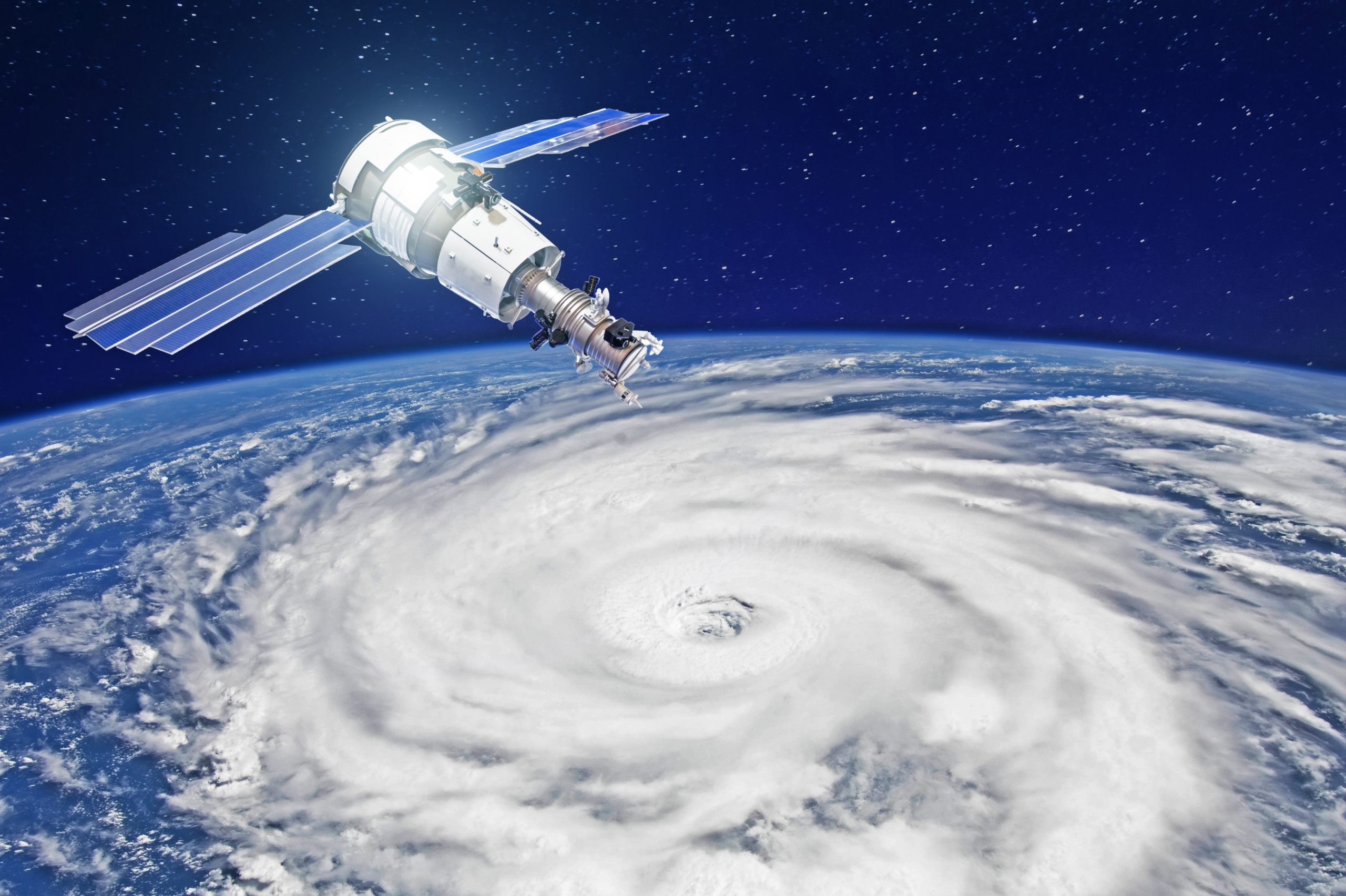
In 2005, the US relied on a combination of geostationary and polar-orbiting satellites. GOES-12, orbiting 22,236 miles above the equator, provided continuous five-minute updates on Katrina’s evolution from the Bahamas to the Great Lakes, according to NESDIS, whilst polar-orbiting NOAA satellites – such as the newly launched NOAA-18 – passed overhead every 12 hours, capturing global snapshots according to CIMSS.
This complementary system was innovative for its time – yet, constrained by a fundamental trade-off. NESDIS has admitted that geostationary satellites had temporal coverage but poor spatial detail, whilst polar satellites had sharper resolution but infrequent revisits. This ultimately resulted in a fragmented picture of a rapidly changing storm.
Sensor payloads told a similar story. Optical and infrared imagers captured cloud structures and temperatures, as the Tropical Rainfall Measuring Mission (TRMM) introduced microwave instruments that peered beneath cloud tops to reveal rainfall and flooding potential, as explained by NASA SVS. These were significant steps, but still partial. GOES-12 even went blind during a critical two-hour eclipse outage on the 28th of August – just as Katrina intensified into a Category 5 hurricane. It was a known design flaw, with satellites of that era notoriously lacking the battery capacity needed for continuous coverage.
Post-disaster, satellites and aircraft helped to map flooding, the 200+ hazardous spills that ensued, and Katrina’s extensive structural damage. Landsat, QuickBird, and IKONOS provided imagery, as NOAA aerial photography produced 7,000 high-res images in the days following landfall (NOAA; Purdue University). Geographic Information Systems then linked this data to 911 calls, guiding rescuers to more than 25,000 survivors according to PMC. Nevertheless, these efforts remained ad hoc, improvised by government agencies, universities, and volunteers – a patchwork of goodwill rather than an integrated systemic response.
A new era of clarity
Fast forward twenty years and the satellite intelligence ecosystem has transformedconsiderably, in revolutionary leaps – not just incremental steps.
Modern sensors have freed disaster monitoring from the physical limitations of 2005 tech, carrying Synthetic Aperture Radar (SAR), hyperspectral, and microwave instruments that enhance their previous optical and infrared capacities. SAR operates day and night, through cloud and rain, delivering imagery in much more difficult conditions at resolutions as fine as 16 cm, too (ICEYE; XRTech Group). The microwave sensors on polar systems like JPSS have likewise made it much easier to reveal storm structure beneath cloud cover, removing the obstacle of poor visibility to facilitate all-weather warnings.
Meanwhile, other modernised predictive intelligence tools like the Sentinel-6B track sea surface height, making it possible to pinpoint the deep warm waters that drive rapid storm intensification: one of the most dangerous hurricane behaviour there is.
Revisit rates have also improved dramatically, with GOES-R satellites now providing one-minute or even 30-second updates, for example. The plethora of commercial constellations that has emerged since 2005 supports this further, with many refreshing imagery up to 25 times per day. From Planet’s EO and multi-spectral constellations to Starlink’s resilient communications, the shift from government monopolies to public-private systems has made satellite data much more abundant, redundant, and commercially accessible – with quantity ultimately rendering the two-hour eclipse that blinded GOES-12 during Katrina a thing of the past.
Of course, with AI now in orbit, too, we’ve also seen a marked cognitive shift, with it now being possible to process data directly on board satellites, as opposed to on the ground as in the past. This eliminates the latency of ground-based analysis, allowing real-time insights to be delivered without former hours or days of delay.
The result of all of this is not just more images at slightly higher quality, but continuous, actionable intelligence.
If Katrina struck today
Had Katrina struck in 2025, the story might have been different. Instead of a two-hour blind spot, continuous microwave and radar coverage would have tracked the storm’s intensification in real time, as confirmed by NESDIS. Machine learning models integrating sea-surface data from Sentinel-6B would likewise have predicted intensification with greater confidence, according to NASA JPL, giving officials both earlier warning and stronger evidence to enforce evacuation orders. With more time to move the most vulnerable, provided responsible, equitable action were prioritised as it should be, both the fatalities and scale of displacement could have been reduced.
Indeed, high-res SAR could have provided live updates on flooded roads, dynamically rerouting evacuation paths, as resilient satellite communications from LEO constellations ensured responders and citizens alike stayed connected even as ground-based networks collapsed. With these tools, the chaos of people being stranded might have been impactfully reduced.
The benefits extend into recovery, too. Rather than relying on cloud-dependent optical imagery and manual surveys, AI-powered SAR analysis could map destruction within hours, comparing pre- and post-event images to automate building-by-building damage assessment according to the WEF. Relief resources could then be distributed precisely, eliminating waste, with insurers processing claims much faster as fraudulent claims are screened out.
In short, modern intelligence could have saved lives and spared communities prolonged displacement, economic devastation, and years of unresolved trauma and claims. What was reactive in 2005 could be proactive in 2025 – sparing lives and losses.
Calm after the storm?
Katrina taught us that disaster often moves beyond what nature delivers to include what society and governments fail to prevent. It’s vital that we extend improvements to information and decision-making structures as well as improving levees and evacuation plans if we are to prevent a catastrophe like Katrina from happening again. The difference we’ve seen in satellite intelligence over the past two decades is profound. And if governments, insurers, and communities embrace these improvements responsibly and proactively, the next storm need not be remembered for preventable loss.