
Abstract
Audit and compliance readiness remain critical pillars of Governance, Risk, and Compliance (GRC) frameworks. However, traditional audit processes are often manual, time-intensive, and retrospective, relying on periodic reviews and static evidence collection. This approach limits an organization’s ability to maintain continuous compliance and respond effectively to evolving risks.
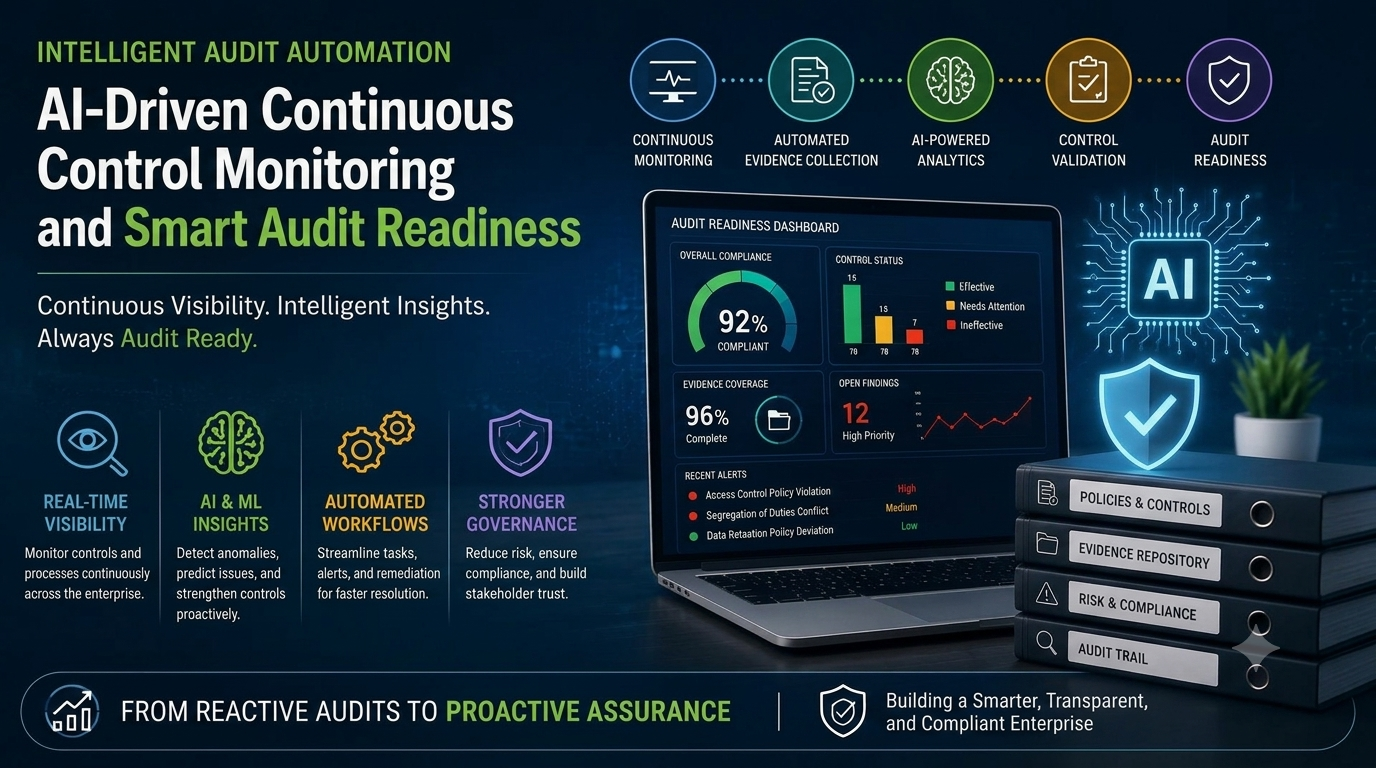
AI-driven audit automation introduces a transformative model by enabling continuous control monitoring, intelligent evidence validation, and proactive audit readiness. By leveraging machine learning, anomaly detection, and workflow automation, organizations can ensure real-time compliance visibility and reduce audit friction.
This article presents a vendor-neutral framework for intelligent audit systems, demonstrating how enterprises can transition from periodic audit preparation to continuous audit readiness, improving efficiency, transparency, and governance outcomes.
1. Introduction
In modern enterprises, audits are not merely compliance exercises—they are critical mechanisms for ensuring operational integrity, regulatory adherence, and risk mitigation. Yet, despite their importance, audit processes often remain inefficient and reactive.
Traditional audit workflows depend on manual data collection, fragmented documentation, and last-minute preparation. Compliance teams frequently scramble to gather evidence, validate controls, and address gaps only when audits are imminent. This reactive approach introduces inefficiencies, increases operational stress, and exposes organizations to compliance risks.
As enterprise systems become more complex and interconnected, the limitations of traditional audit models become increasingly apparent. Organizations require a more dynamic and intelligent approach to audit readiness—one that operates continuously rather than periodically.
Artificial intelligence provides this capability. By embedding intelligence into audit workflows, organizations can automate evidence collection, monitor controls in real time, and ensure continuous compliance readiness. This marks a shift from reactive audit preparation to proactive governance.
2. The Shift from Periodic Audits to Continuous Audit Readiness
Historically, audits have been conducted at fixed intervals, often annually or quarterly. These audits rely on static snapshots of organizational data, which may not accurately reflect current conditions.
This model presents several challenges. First, it creates gaps between audit cycles, during which compliance issues may go undetected. Second, it requires significant manual effort to collect and validate evidence. Third, it often results in delayed identification of control failures.
AI-driven audit systems address these challenges by enabling continuous monitoring of controls and processes. Instead of waiting for audit cycles, organizations can evaluate compliance in real time.
This shift introduces a new paradigm:
- Audits become ongoing rather than periodic
- Evidence is collected automatically rather than manually
- Compliance is monitored continuously rather than retrospectively
As a result, organizations achieve a state of continuous audit readiness, where they are always prepared for evaluation.
3. Architecture of AI-Driven Audit Automation Systems
A modern intelligent audit system is built on a multi-layered architecture that integrates data, analytics, and workflow automation.
At the foundation is the data ingestion layer, which collects information from enterprise systems such as transaction platforms, control systems, and operational workflows. This data provides a comprehensive view of organizational activity.
The analytics layer processes this data using machine learning models. These models identify patterns, detect anomalies, and evaluate control effectiveness. Unlike traditional rule-based systems, AI models adapt over time, improving their accuracy and relevance.
A validation layer ensures that evidence is complete, accurate, and aligned with compliance requirements. This layer automates the verification process, reducing the need for manual intervention.
Finally, the workflow layer orchestrates audit activities. Alerts are generated when control deviations are detected, and tasks are assigned to relevant stakeholders for remediation. This ensures that issues are addressed promptly and efficiently.
This architecture enables organizations to maintain continuous visibility into compliance status and ensures that audit processes are both efficient and scalable.
4. Intelligent Control Monitoring and Evidence Management
One of the most significant challenges in audit processes is evidence management. Traditional methods rely on manual collection and documentation, which are prone to errors and inconsistencies.
AI-driven systems transform this process by automating evidence collection and validation. Data is continuously captured from enterprise systems and mapped to relevant controls. This ensures that evidence is always up to date and readily available.
Control monitoring is also enhanced through AI. Systems continuously evaluate control performance, identifying deviations and anomalies in real time. This allows organizations to detect issues early and take corrective action before they escalate.
By integrating control monitoring with evidence management, organizations create a unified audit ecosystem that supports continuous compliance.
5. Proactive Audit Readiness and Risk Mitigation
The ultimate goal of intelligent audit systems is to enable proactive audit readiness. This means that organizations are always prepared for audits, with minimal need for last-minute preparation.
AI-driven systems achieve this by continuously assessing compliance status and identifying potential gaps. When issues are detected, automated workflows trigger remediation actions, ensuring that gaps are addressed promptly.
This proactive approach reduces audit risk and improves overall governance. Instead of reacting to audit findings, organizations can prevent them.
Additionally, predictive analytics can be used to forecast potential audit issues based on historical trends and behavioral patterns. This allows organizations to take preventive measures and strengthen controls proactively.
6. Organizational Impact of Intelligent Audit Systems
The adoption of AI-driven audit automation delivers significant benefits across multiple dimensions.
Operational efficiency is improved as manual processes are reduced and workflows are streamlined. Compliance teams can focus on strategic initiatives rather than routine tasks.
Risk exposure is minimized through continuous monitoring and early detection of control failures. This reduces the likelihood of regulatory penalties and operational disruptions.
Decision-making is enhanced through real-time insights and data-driven analysis. Leadership gains visibility into compliance performance, enabling more informed decisions.
Furthermore, intelligent audit systems foster a culture of transparency and accountability, where compliance is integrated into everyday operations rather than treated as a periodic requirement.
7. Ethical and Governance Considerations
As organizations adopt AI-driven audit systems, ethical considerations become increasingly important. Data privacy and security must be maintained, particularly when handling sensitive information.
Transparency is essential to ensure that stakeholders understand how audit decisions are made. Explainable AI models help build trust and accountability.
Bias mitigation is also critical. AI systems must be designed to ensure fairness and accuracy in audit processes.
Human oversight remains a key component. While AI enhances efficiency and insight, final decisions must be guided by experienced professionals who can interpret context and ensure appropriate action.
8. Future Directions in AI-Driven Audit Automation
The future of audit automation lies in deeper integration of AI capabilities across enterprise systems.
Predictive audit models will enable organizations to anticipate compliance issues before they arise. Real-time dashboards will provide continuous visibility into audit readiness.
Multi-agent systems will coordinate across different governance domains, creating a unified compliance ecosystem.
As these technologies evolve, audit processes will become increasingly intelligent, adaptive, and strategic, supporting long-term organizational resilience.
9. Conclusion
AI-driven audit automation represents a significant advancement in governance and compliance. By enabling continuous control monitoring, intelligent evidence management, and proactive audit readiness, organizations can transform audit processes from reactive exercises into strategic capabilities.
In an era of increasing complexity, organizations that embrace intelligent audit systems will be better positioned to manage risk, ensure compliance, and achieve sustainable growth.