
Artificial intelligence has dramatically increased the value of enterprise data, but it has also exposed one of the industry’s oldest architectural assumptions. Most customer data platforms are built around a simple idea: every entity has one primary identifier.
A customer has a customer ID. A merchant has a merchant ID. A driver has a driver ID. Orders, devices, campaigns, and transactions each receive their own unique key, allowing engineers to join datasets, generate analytics, and power downstream applications with relative simplicity.
For many businesses, this model works remarkably well — until it doesn’t. As digital platforms evolve, businesses rarely operate through isolated entities. Modern marketplaces, advertising ecosystems, financial services, logistics platforms, and fraud detection systems depend on relationships between multiple participants.
Customers interact with merchants. Merchants work with fulfillment partners. Devices are shared across accounts, marketing campaigns span multiple organizations, and fraud investigations connect seemingly unrelated identities across dozens of signals.
These relationships are no longer edge cases. They have become the business itself, and supporting them requires a fundamental shift in how enterprise data platforms are designed.
The Limits of the Single-Key Architecture
The original generation of customer data platforms prioritized simplicity. Each entity maintained one canonical identifier. Data pipelines merged records based on that identifier before distributing standardized datasets to downstream consumers. The architecture minimized ambiguity while simplifying storage, indexing, and query optimization.
The challenge emerges when an entity no longer has a single source of truth. Consider a marketplace transaction: a single order may simultaneously belong to a customer, a merchant, a courier, a payment account, a promotion, a geographic market, and multiple advertising campaigns. Each participant owns part of the overall business context, yet none independently represents the complete entity.
Attempting to force this ecosystem into a single-key model inevitably creates duplication, inconsistent ownership rules, and increasingly complex transformation logic. Eventually, the platform begins modeling exceptions rather than business reality.
Relationships Become First-Class Citizens
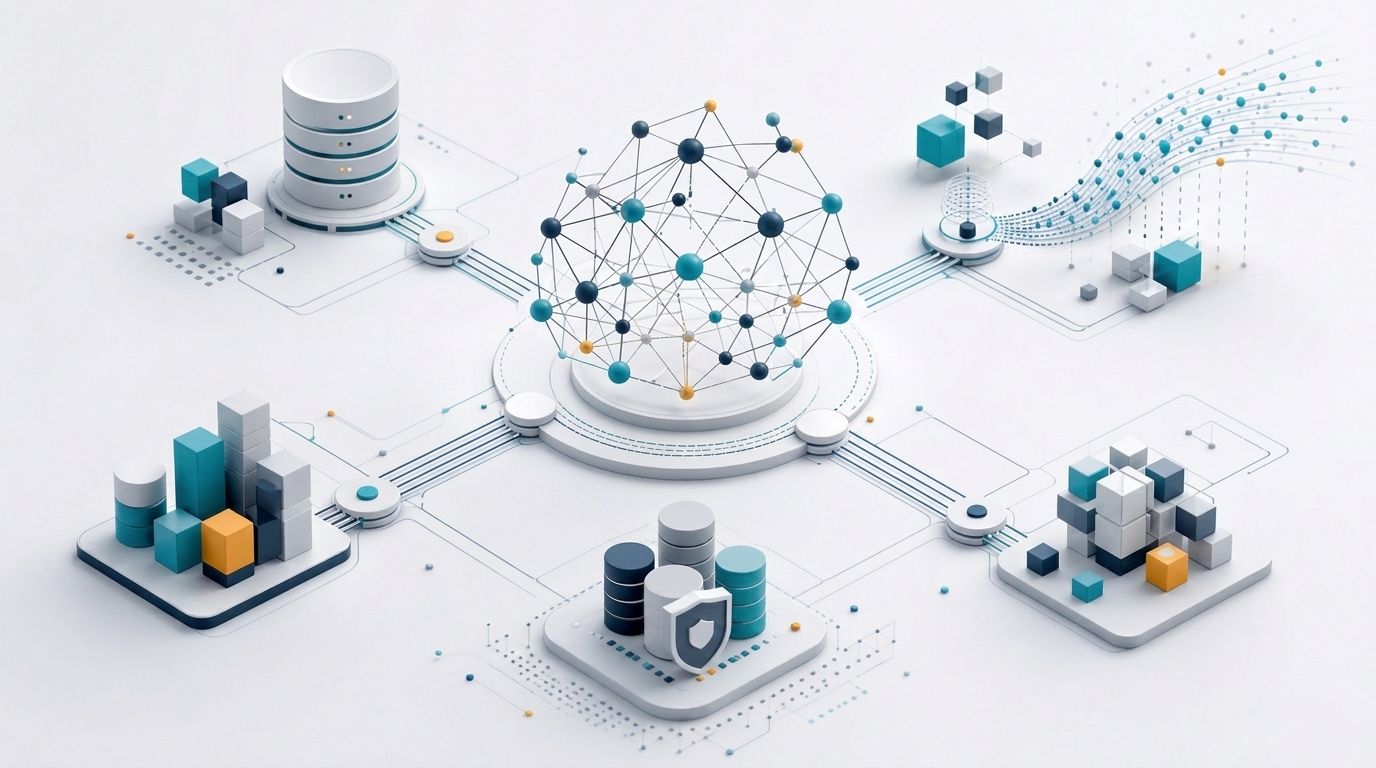
Traditional platforms treat relationships as attributes attached to entities. Modern platforms increasingly reverse that perspective. Relationships become first-class objects that carry their own lifecycle, ownership rules, governance requirements, and operational characteristics. Rather than asking which customer owns an order, platforms begin modeling how customers, merchants, payments, fulfillment systems, and marketing events interact over time.
This distinction may appear subtle, but architecturally it changes almost everything. Entity resolution becomes graph construction rather than record matching, and identity management evolves into relationship management. Analytics shift from describing individual objects toward understanding connected systems.
Why Multi-Key Models Are More Than Identity Resolution
Many discussions around entity management focus exclusively on identity resolution. Matching duplicate customer profiles is certainly important, but multi-key architectures introduce challenges that extend far beyond record matching.
Attribute ownership becomes significantly more complex. If several entities contribute information about the same business object, determining which system owns each attribute becomes an architectural decision rather than a technical implementation detail.
Version management also becomes considerably harder. Independent services often update related entities at different frequencies, creating temporary inconsistencies that downstream systems must interpret correctly. Serving infrastructure must preserve these relationships while maintaining low latency for operational workloads. What begins as a schema redesign ultimately reshapes nearly every layer of the platform.
Hidden Assumptions Surface Everywhere
Perhaps the greatest surprise during architectural transitions is discovering how deeply the single-key assumption has propagated throughout the ecosystem. ETL generation frequently assumes deterministic ownership, and snapshot pipelines often expect one authoritative record per entity.
Streaming infrastructure may partition event streams using identifiers that no longer uniquely define ownership. Materialized views frequently rely on assumptions that relationships never change, and caching strategies optimize around immutable identifiers. Even monitoring dashboards may calculate data quality metrics under the expectation that entities have only one canonical representation.
Moving toward multi-key architectures requires identifying and redesigning each of these assumptions individually. The complexity lies less in creating new capabilities than in carefully removing invisible constraints embedded throughout years of engineering decisions.
Streaming Systems Must Preserve Consistency
Real-time platforms amplify these architectural challenges. Batch systems can often reconcile conflicting updates through scheduled processing windows, but streaming environments rarely have that luxury.
Events arrive continuously from multiple producers operating independently, and relationship changes must propagate immediately without introducing inconsistent downstream states. Maintaining consistency requires carefully coordinated event ordering, deterministic merge logic, idempotent processing, and resilient replay mechanisms. Without these guarantees, downstream consumers may observe contradictory versions of the same business relationship. As organizations increasingly rely on streaming data for operational decision-making, consistency becomes a platform capability rather than an application responsibility.
Designing for Evolution Instead of Stability
Data models have historically been optimized for stability, and engineers expected schemas to change gradually. Business relationships now evolve far more rapidly.
New products introduce additional participants. New regulatory requirements redefine ownership, and acquisitions integrate previously independent systems. Machine learning introduces new identity signals, and advertising platforms continuously create new associations between customers, campaigns, and conversion events.
Architectures built around fixed assumptions quickly become difficult to extend. Future-ready platforms instead emphasize adaptability: relationship models become configurable, and merge policies become declarative. Serving contracts isolate downstream consumers from internal implementation details, allowing organizations to evolve their business models without repeatedly rebuilding foundational infrastructure.
Data Quality Becomes Relationship Quality
Most data quality programs focus on completeness, freshness, and accuracy. Those metrics remain essential, but multi-key architectures introduce another equally important dimension: relationship quality. A perfectly accurate customer profile provides little value if it connects to the wrong merchant, payment account, campaign, or household.
As organizations build increasingly interconnected platforms, validating relationships becomes just as important as validating individual records. Quality frameworks must continuously verify graph integrity, ownership consistency, cardinality expectations, and propagation correctness across distributed systems. This broader perspective transforms data quality from record validation into ecosystem validation.
Building Platforms That Reflect Business Reality
Every successful data platform eventually reaches the same inflection point: the business becomes more interconnected than the architecture originally anticipated. Organizations can continue layering increasingly complex exceptions onto single-key foundations, or they can redesign the platform to model relationships directly. The second path requires considerably more engineering discipline.
Merge logic must evolve, streaming infrastructure must mature, governance models must expand, and serving contracts must be redefined. Yet the payoff extends well beyond technical elegance.
Platforms built around rich entity relationships provide a more faithful representation of how modern businesses actually operate. As artificial intelligence, real-time decision systems, and enterprise analytics continue to advance, that fidelity becomes increasingly valuable. The future of enterprise data platforms will not be defined by storing more information. It will be defined by understanding how that information connects