
What Is AI-Enhanced MERN Stack Development?
It’s a MongoDB, Express, React, and Node app with AI actually built into one of those layers, not a separate AI product living off to the side of it. Sounds like a small distinction. It isn’t. Most teams still treat “we added AI” as sticking a chatbot widget on the frontend and moving on, and honestly, that works fine for a demo. It falls apart the second something real depends on it.
Here’s the thing worth holding onto: MERN was already a good pick for building fast, data-heavy apps before AI entered the picture. Bolting AI on doesn’t erase that. What changes is which layer is responsible for what, and where the actual intelligence needs to sit.
How Does AI Actually Fit Into a MERN Stack Application?
There are basically three places AI can live in a MERN app, and picking the wrong one is why so many “AI features” end up feeling tacked on. Frontend, backend, or a separate service the backend talks to.
Frontend AI is the lightest lift. Autocomplete, a smarter search box, a chat window built in React that’s really just hitting an API behind the scenes. Quick to build, and it’s fine as long as nothing sensitive is happening directly in the browser.
Most of the actual work happens on the backend, in practice. Node and Express handle the orchestration, the model call, checking what comes back actually makes sense, applying whatever business rules apply, deciding what the frontend is even allowed to see. Guardrails belong here too, not the UI, since anything only enforced in React can be gotten around by anyone who pops open dev tools.
Then there’s the third option. A separate AI service sitting behind Express, usually once the AI workload gets heavy enough that it shouldn’t be fighting your main app server for resources. Python doing the model serving, Node handling the routing and app logic, is a pattern that shows up a lot once things scale.
If you’re weighing where to build this out, artificial intelligence solutions work through exactly this question early, figuring out which layer should own the AI logic before any integration actually starts, rather than deciding that after something’s already half built.
Where Should AI Live: Frontend, Backend, or a Separate Service?
Short version: keep anything sensitive or decision-critical in the backend or its own service, and let the frontend handle the lightweight stuff only. A React component hitting an AI API straight from the browser hands over your API key, your prompt logic, your rate limits, to anyone who opens the console.
That’s not a maybe-someday risk either. It’s one of the more common security gaps in apps that added AI in a hurry without stopping to rethink where trust boundaries actually need to sit. The backend should own the model call, check what it gets back, and only pass the frontend whatever it actually needs to show.
What Are the Most Common AI Features Added to MERN Apps?
Mostly it’s semantic search over MongoDB data, AI-assisted content generation running through the backend, recommendation logic built from user behaviour already sitting in MongoDB, and chat interfaces layered on top of stuff the app already does. MongoDB’s flexibility with unstructured and vector data makes it a decent fit for storing embeddings right next to your regular application data, so you’re not standing up a second database just for AI.
Recommendation and personalisation tends to be the highest-value thing to add, and only if there’s already meaningful behavioural data sitting in MongoDB to work with. The AI isn’t pulling insight out of thin air, it’s surfacing patterns that were already there, just too tedious for a person to go dig up manually every time.
For teams already thinking about who actually builds this, it’s worth saying early rather than as an afterthought: this kind of backend work, wiring recommendation logic or semantic search into an existing Node and Express setup, is a meaningfully different skill from general full-stack work. It’s a big part of why businesses look to hire MERN stack developers who’ve specifically done this before, not just anyone comfortable with the stack.
Is It Better to Build Custom AI or Use an Existing API in a MERN App?
For most teams, calling an existing model API from the Express backend is the sane starting point. Building a custom model only earns its cost once you’re dealing with something specific and well-understood enough to justify it. An API call gets you working AI in days. Training and maintaining your own model is a real commitment, one that only pays off when a general-purpose model genuinely can’t cut it.
The mistake shows up in both directions, honestly. A generic support chatbot doesn’t need a custom model behind it. A recommendation engine built on years of a business’s own proprietary transaction history usually does.
This same build-versus-buy tension isn’t unique to MERN, either. A recent piece in Silicon Valleys Journal on why enterprise AI strategies skip readiness makes a point worth carrying straight into engineering decisions: teams reach for the more sophisticated AI approach before checking whether their actual data and workflow can even support it, and the stack itself rarely gets blamed when that mismatch is what stalls the project.
What Does This Actually Look Like in Practice?
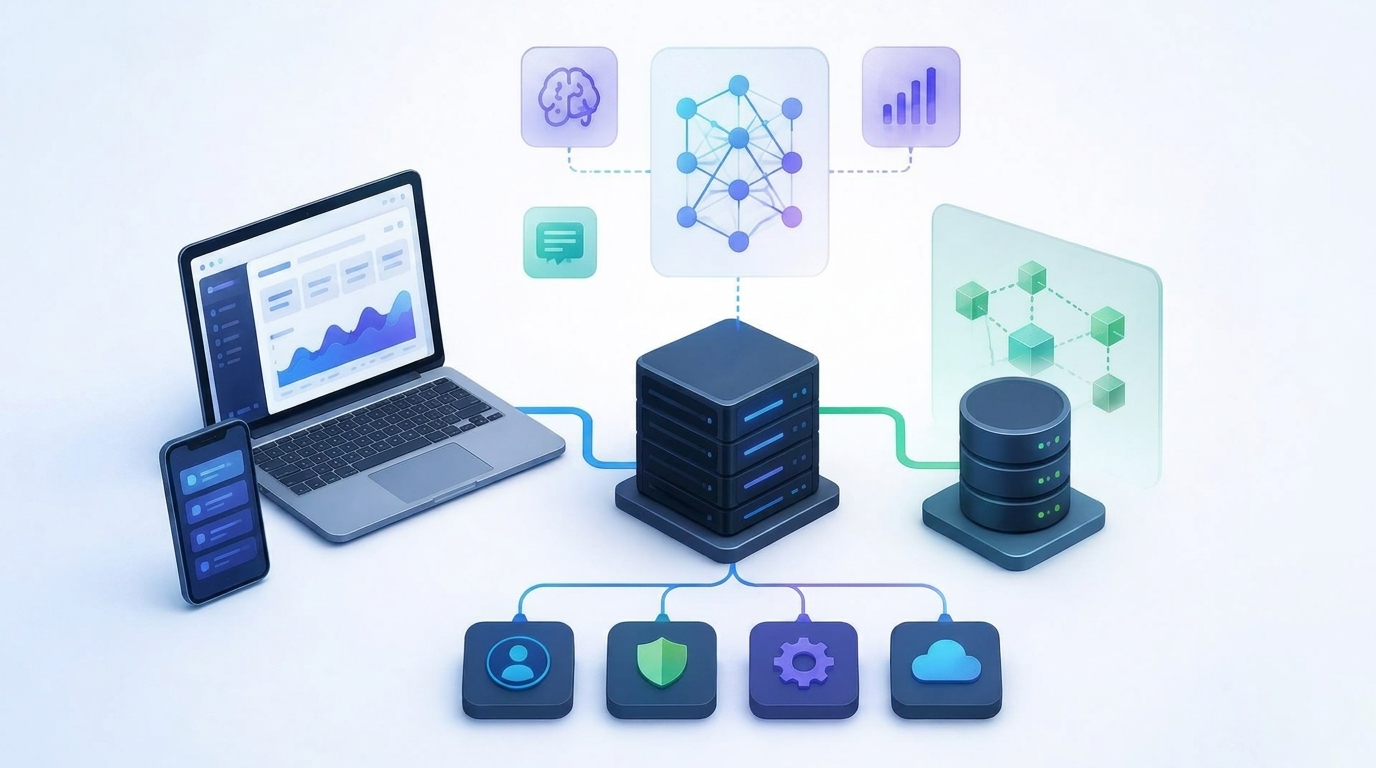
A well-built AI-enhanced MERN app usually has a thin, fast React frontend, an Express and Node backend doing the real orchestration and validation, MongoDB holding regular app data and vector embeddings side by side, and a clear line around which AI decisions the system gets to make on its own versus which ones go to a person.
Get that architecture right the first time and you skip the rebuild later, which is almost always the more expensive path. Teams that add AI without thinking through where it sits in the stack tend to end up retrofitting security and validation and monitoring after something’s already gone wrong in production, instead of building for it from day one. That’s the part that keeps getting skipped: figuring out where AI belongs in the architecture is its own decision, separate from picking a model or an API, and it has to come first, not get patched in after.
None of that architecture holds up without people who can actually build and maintain it. That backend orchestration layer, checking model outputs, enforcing guardrails, managing the line between frontend and AI logic, takes real MERN-specific experience, not just general comfort with the stack. Skip that and the guardrails everyone talked about in planning meetings quietly stop existing six months into production.
Frequently Asked Questions
Where should AI logic live in a MERN stack app?
Sensitive or decision-critical AI logic belongs in the backend, Express and Node, or a separate service, not the frontend. Anything handled only in React can be inspected or worked around through browser dev tools.
Can MongoDB store AI embeddings alongside regular application data?
Yes. MongoDB’s flexible document structure lets vector embeddings sit right next to standard application data, so there’s no need for a completely separate database just to support features like semantic search.
Should a MERN app use an AI API or a custom-trained model?
Most applications do fine starting with an existing AI API called from the backend. Custom models are worth the extra cost only when the problem is specific enough that a general-purpose model genuinely can’t handle it well.
Is it secure to call an AI API directly from a React frontend?
Generally, no, not for anything involving API keys, sensitive prompts, or rate-limited resources. Those calls should route through the Express backend, which can validate and control what the frontend actually gets to see.