
Marketing has never had more information at its fingertips. We have dashboards tracking nearly every interaction, platforms analyzing audiences in real time and generative AI capable of producing strategies, recommendations and content in seconds.
Yet for all that intelligence, marketing leaders still face the same fundamental question: What should we do next?
And increasingly, there’s another question attached to it: Can we defend why we’re doing it?
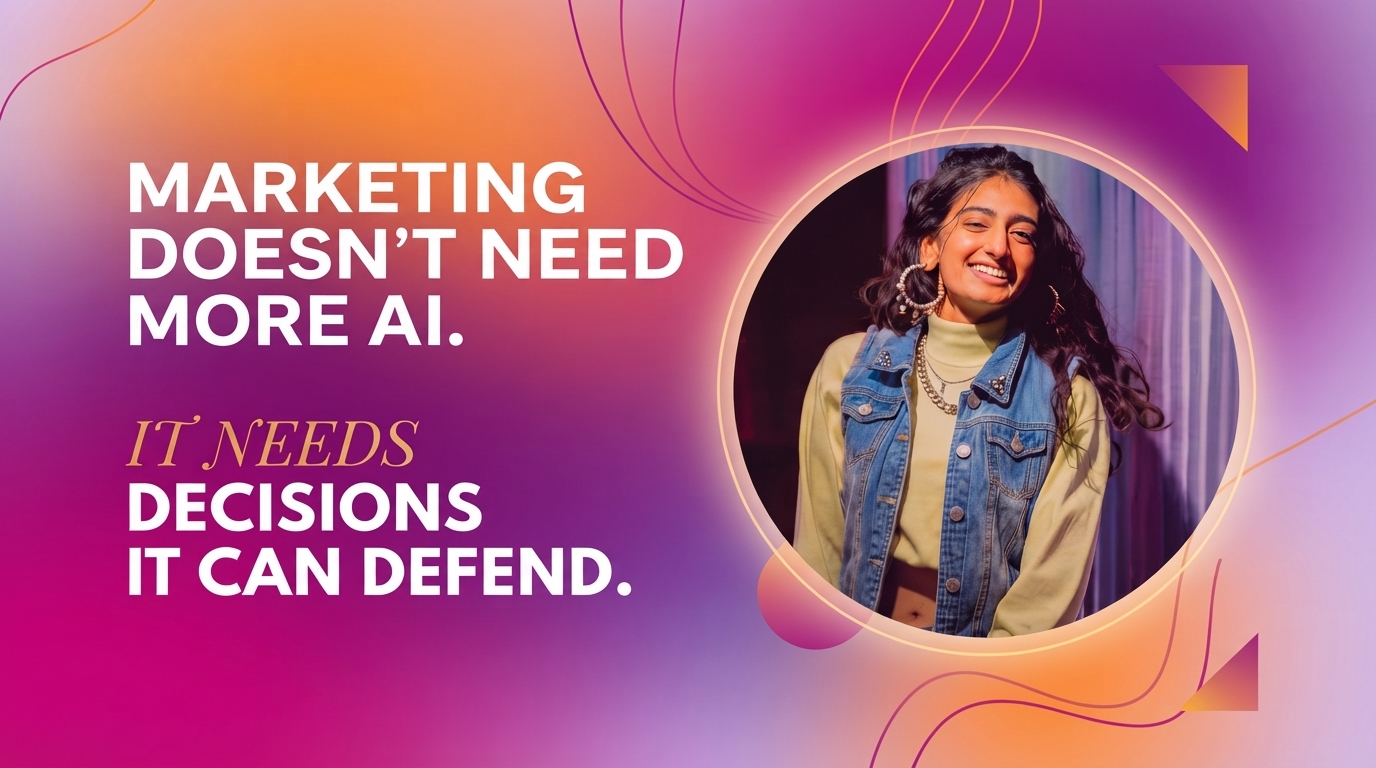
That’s becoming the real challenge for marketing. We don’t have an information problem anymore. We have a decision problem.
More information doesn’t necessarily mean better decisions
For years, marketing technology has been built to give us greater visibility. Analytics tells us what happened: which campaigns performed, where customers engaged, what converted and what didn’t.
Audience intelligence takes us further. It helps us understand who those customers are, what they care about, how they behave and the cultural signals shaping their decisions.
But understanding what happened and why still doesn’t answer the question every marketer eventually has to answer: What should we do next?
That’s where decision intelligence comes in. Data tells us what happened. Audience intelligence tells us what people care about. Decision intelligence helps determine what to do next and what evidence supports that decision.
The distinction may sound subtle, but it represents an important shift. The goal is no longer simply to become more informed. It’s to turn that intelligence into decisions marketers can explain, justify and ultimately defend.
Influencer marketing makes the problem obvious
Influencer marketing is a good example of how this plays out.
A marketer today can access databases containing millions of creators. They can filter by follower count, engagement rate, category, location and audience demographics. They can also ask a general-purpose AI tool to recommend the best influencers for a campaign and receive a list in seconds.
But a list of creators isn’t a strategy.
The more important question comes before creator selection: Who are we actually trying to influence?
Within almost any broad audience are smaller communities with different behaviors, motivations, interests and cultural signals. Understanding those micro-communities changes the questions marketers should ask: Who genuinely influences these people? What conversations matter to them? What content is likely to resonate? And which combination of audience, creator and message gives the campaign the strongest foundation?
Finding creators is relatively easy. Determining which creators are right and having evidence to support that decision is much harder.
Why a convincing AI answer isn’t enough
Generative AI has quickly become an essential part of the marketing toolkit. It is extraordinarily useful for research, ideation, synthesis, content development and countless other tasks that previously consumed hours of a marketer’s day.
But there’s an important difference between asking AI to draft an email and asking it where to put your next $500,000 in marketing spend.
A general-purpose AI system can produce a remarkably persuasive recommendation. Ask the question differently, provide slightly different context or ask again later and you will receive another recommendation that sounds equally persuasive.
The challenge isn’t getting AI to give us an answer. It’s determining whether there’s enough evidence behind that answer to act on it.
Marketing leaders aren’t accountable for the answers AI generates. They’re accountable for the decisions they make.
AI needs reasoning, verification and evidence
For higher-stakes decisions, marketers should expect more from AI than a confident recommendation.
Consider how a strong leadership team makes an important decision. One person may analyze the customer data while another challenges the financial assumptions. Someone else may introduce competitive information or question whether the team is solving the right problem in the first place.
The value comes from examining the problem from multiple perspectives, challenging assumptions and validating the conclusion against available evidence.
AI-supported decision-making should move in the same direction.
Rather than relying solely on one model, one prompt or one reasoning path, more robust approaches can examine a question in multiple ways, compare conclusions, verify outputs against source evidence and identify areas where the evidence conflicts.
That doesn’t eliminate uncertainty. Marketing will always involve uncertainty.
What it does is give marketers something far more valuable than an answer: a basis for deciding whether that answer deserves to be acted upon.
AI versus manual isn’t the right debate
Skepticism about allowing AI to influence marketing decisions is understandable. But framing the choice as AI versus human judgment misses the larger opportunity.
The alternative to AI isn’t perfect human analysis.
It’s often teams spending hours or days manually searching platforms, compiling spreadsheets, comparing data from different sources and trying to identify patterns across more information than any person could reasonably process.
AI can do that analytical heavy lifting at a scale and speed humans cannot.
Humans bring something equally important: judgment, creativity, context, relationships, experience and accountability.
The goal shouldn’t be to automate judgment. It should be to automate more of the analytical work required to make better judgments.
Accountability is the real issue
Marketing leaders aren’t expected to predict the future perfectly. Campaigns will underperform. Consumer behavior will change. Competitors will make unexpected moves and external events will disrupt even the best plans.
What leaders are expected to do is make the best decisions they can with the evidence available.
When a CEO asks why a particular audience was prioritized, a CFO questions why budget moved from one channel to another or a board asks why a campaign took a particular direction, the answer shouldn’t be, “The AI recommended it.”
It should be: Here’s the decision we made. Here’s why we made it. And here’s the evidence that supported it.
That’s a very different standard for marketing technology.
The biggest risk in marketing isn’t making the wrong decision. It’s making a decision you can’t defend.
The next phase of marketing AI
The first wave of generative AI was largely about creating faster. We can draft faster, research faster, summarize faster and generate more ideas than ever before.
The next phase will be about deciding better.
That will require AI systems that don’t simply generate recommendations, but help marketers understand the reasoning behind them, examine the evidence and challenge the assumptions before they act.
Because the competitive advantage won’t belong to the marketing organization with the most dashboards, the most data or even the most AI.
It will belong to the one that can turn all that intelligence into better decisions before the money is spent.
Generative AI made answers remarkably easy to produce. The next generation of marketing AI will be defined by something much harder: giving marketers enough evidence to make and defend the decisions that move their businesses forward.