
At the World Economic Forum’s Annual Meeting in Davos this January, the conversation around AI had noticeably changed. The question was no longer simply what AI could do, but whether it was actually delivering meaningful results. The Forum’s white paper, made much the same case: AI now has to prove its value in the real world.

Software development is a clear example of this. According to Stack Overflow’s 2025 Developer Survey, 84% of developers use or plan to use AI tools, which is the highest rate so far. However, confidence in these tools is lagging. In the same survey, 46% said they do not trust the accuracy of AI-generated output, up from 31% the year before.
The gap between using AI and trusting it is what makes AI-assisted development so interesting in 2026. Even though they are prevalent across organizations, their impact isn’t as straightforward as reducing development time.
This article looks at what is really changing, where the benefits last, and where developers and engineering teams need to be cautious.
Key takeaways
●AI coding tools are now widely used, but trust in them is still low. While 84% of developers use or plan to use these tools, 46% say they do not trust the accuracy of the results. This is up from 31% a year ago.
●Developers often think they are working faster than they actually are. Research shows a gap between how productive developers feel and what the data show. This means it is important to measure real-world results rather than rely on intuition.
●AI is changing how developers spend their time. Now, more work happens after code is generated, with developers reviewing, debugging, and fixing AI-written code.
●Accuracy remains a weak spot for buyers. In G2’s Fall 2026 Grid data, accuracy is the lowest-rated functionality dimension at 84%, compared with 88% for interface and 86% for code quality.
●The category has grown quickly. G2 lists 141 AI code generation products as of Fall 2026, up from 29 in 2023, backed by more than 7,200 verified reviews.
Sources: Stack Overflow Developer Survey 2025, JetBrains State of Developer Experience and Productivity 2025, METR developer productivity research, and G2’s Fall 2026 Grid Report for AI Code Generation. Opening context: World Economic Forum Annual Meeting 2026 and its Proof over Promise white paper.
How many developers actually use AI to code now?
AI coding tools have moved well beyond the early-adopter stage. The Stack Overflow
Developer Survey 2025, which included over 49,000 developers from 177 countries, found that 84% are using or planning to use AI tools, and 51% of professional developers use them daily. JetBrains’ State of Developer Experience and Productivity 2025 showed a similar result: 85% of developers use at least one AI tool for coding or related tasks. Any hesitation from two years ago has mostly faded, and using these tools is now part of the routine.
What happens after adoption is even more telling. Developers often use these tools, but they still double-check the results. In the same 2025 Developer Survey, 46% said they do not trust the accuracy of AI output, up from 31% the year before, and only 3% said they trust it highly. The main reasons are that 66% find the solutions almost correct but not quite, and 45% say
debugging AI-generated code takes longer than writing it themselves. Developers are using these tools more, but their trust in them is dropping at the same time.
Verified buyer reviews show a similar pattern. G2’s Fall 2026 Grid Report for AI Code
Generation found that accuracy is the lowest-rated feature at 84%, compared to 88% for interface and 86% for code quality. Most reviewers are happy overall, with 89% recommending their tool, and ease of use averaging 91%. Still, the area they rate lowest is the one that matters most: whether the output is correct.
Do AI coding tools make developers faster?
Sometimes, but not as much as developers think. In controlled research from METR, experienced developers expected AI tools to make them faster and still felt faster after using them. The measured results told a different story: on the tasks studied, developers using AI actually took longer to finish their work.
That gap between feeling faster and being faster matters. AI can make individual moments of coding feel easier, whether that means generating a function, explaining unfamiliar code, or getting past a blank screen. But those small wins do not automatically translate to faster delivery once reviewing, debugging, and correcting the output are factored in.
For teams, the takeaway is simple: productivity needs to be measured, not assumed. Tracking things like delivery time, throughput, and defects gives a much clearer picture of whether AI is actually helping than asking developers whether it feels faster.
How is AI changing what developers actually do?
The clearest change is not in how much code gets written, but in what developers spend their time doing. As AI takes on more of the initial code generation, developers are increasingly being asked to assess, refine, and make decisions about code they did not write line by line themselves.
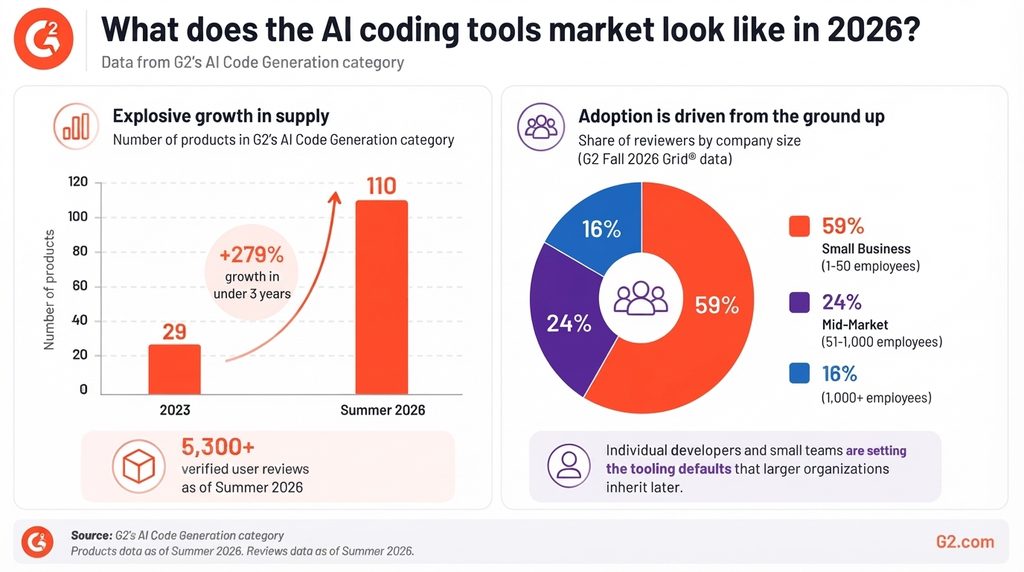
The same shift shows up in who is adopting these tools. G2’s Fall 2026 Grid data shows that across the category, an average of 59% of reviewers come from small businesses, 24% from mid-market, and only 16% from enterprises. Individual developers and small teams are setting
the tooling defaults that larger organizations inherit later, which is part of why usage has outrun formal governance.
That relocation of effort puts more weight on skills: understanding the wider codebase, spotting weak assumptions, making architectural decisions, and knowing when an
AI-generated solution is good enough to use. Writing code still matters, but it is becoming only one part of the job.
In that sense, AI is not removing the developer from the process. It is moving them further up the decision chain, from producing every line themselves to deciding what to keep, change, or reject.
What does the AI coding tools market look like in 2026?
The market has fractured in an interesting way. General-purpose assistants still lead on awareness, with GitHub Copilot recognized by a large majority of developers. But a new category of agent-first tools has emerged alongside traditional environments rather than replacing them, and adoption of these has climbed unusually fast. Most developers now run several tools rather than committing to one, treating the AI layer as a stack rather than a single choice.
The scale of the supply side shows how far the category has come. G2 lists 141 products in its AI code generation category as of Fall 2026, up from 29 when the category launched in 2023, with more than 7,200 verified user reviews behind them. A market that did not meaningfully exist three years ago now has enough entrants to sustain its own buying process, and the pace of new listings has not slowed according to https://learn.g2.com/ai-coding-assistants.
Frequently asked questions
Got more questions? Find answers below.
What should teams look for in an AI coding assistant?
The right AI coding assistant should do more than generate code quickly. Teams should look at how well it understands the surrounding codebase, how accurately it handles multi-file work, how naturally it fits into the existing IDE, and how much review its output requires. This matters because, in G2’s Fall 2026 Grid data for AI code generation, accuracy is the lowest-rated dimension at 84% even as ease of use averages 91%, so reliability, not speed, is where tools most often fall short.
Can AI coding assistants reduce repetitive coding work?
Yes, repetitive tasks such as generating boilerplate, completing common patterns, and drafting routine code are some of the clearest places AI coding assistants can reduce manual effort. The bigger question is whether those savings survive the review process. As the productivity research shows, faster generation does not necessarily mean faster delivery if developers spend significant time checking and correcting the result.
How important is context awareness in an AI coding assistant?
Context awareness becomes especially important when developers are working across multiple files or a large repository. A useful assistant needs enough understanding of the surrounding code to keep its suggestions consistent with existing functions, dependencies, conventions, and architecture. Without that context, code can look plausible in isolation while still being wrong for the project.
Do AI coding assistants work well with large codebases?
Many AI coding assistants are designed to work inside development environments, but integration alone does not guarantee a good experience. Teams should also test how the tool performs as repositories grow, including how quickly it retrieves context, whether it slows the IDE, and how well it handles changes spread across multiple files.
How can teams tell whether an AI coding assistant is accurate and reliable?
The most effective test is observing how the tool works on the team’s own codebase. Instead of just judging the quality of generated code initially, teams should monitor acceptance rates of suggestions, the amount of rework needed, any defect introduction, and the impact on project completion time. Trust in the tool is crucial, especially when developers can rely on its output without needing to endlessly rewrite prompts or fix preventable errors.
The bottom line
The Davos standard set out in the Forum’s Proof over Promise paper, that AI earns its place through measurable outcomes, applies to software development more literally than to any other function, because developers can measure it precisely. The 2026 data delivers a split verdict: adoption is effectively universal, the tools remove real effort from some tasks, and the market behind them is maturing fast. But trust is falling, measured productivity is not keeping pace with the felt sense of speed, and the work has shifted from writing toward reviewing rather than disappearing.
For engineering leaders, the implication is not whether to adopt but how to measure. The teams getting durable value are the ones instrumenting AI usage in their own repositories, tracking throughput and defect rates rather than trusting perception, and treating AI-generated code as a draft to be verified rather than a finished product. The tools have already changed how software gets built. Whether that change is a net gain is a question each team still has to answer with its own data.
Learn more in Silicon Valleys Journal on the infrastructure layer behind the shift to agentic AI https://siliconvalleysjournal.com/2026/03/09/the-40-billion-infrastructure-layer-investors-are-missing-in-agentic-ai/