
For twenty years, point-of-care advertising has been sold on a simple promise: reach the physician at the moment of decision. It is a good promise, and the channel has largely kept it. Physicians are reached, in the room, at the right time.
The trouble is that the promise was built on a misreading of where the decision actually sits.
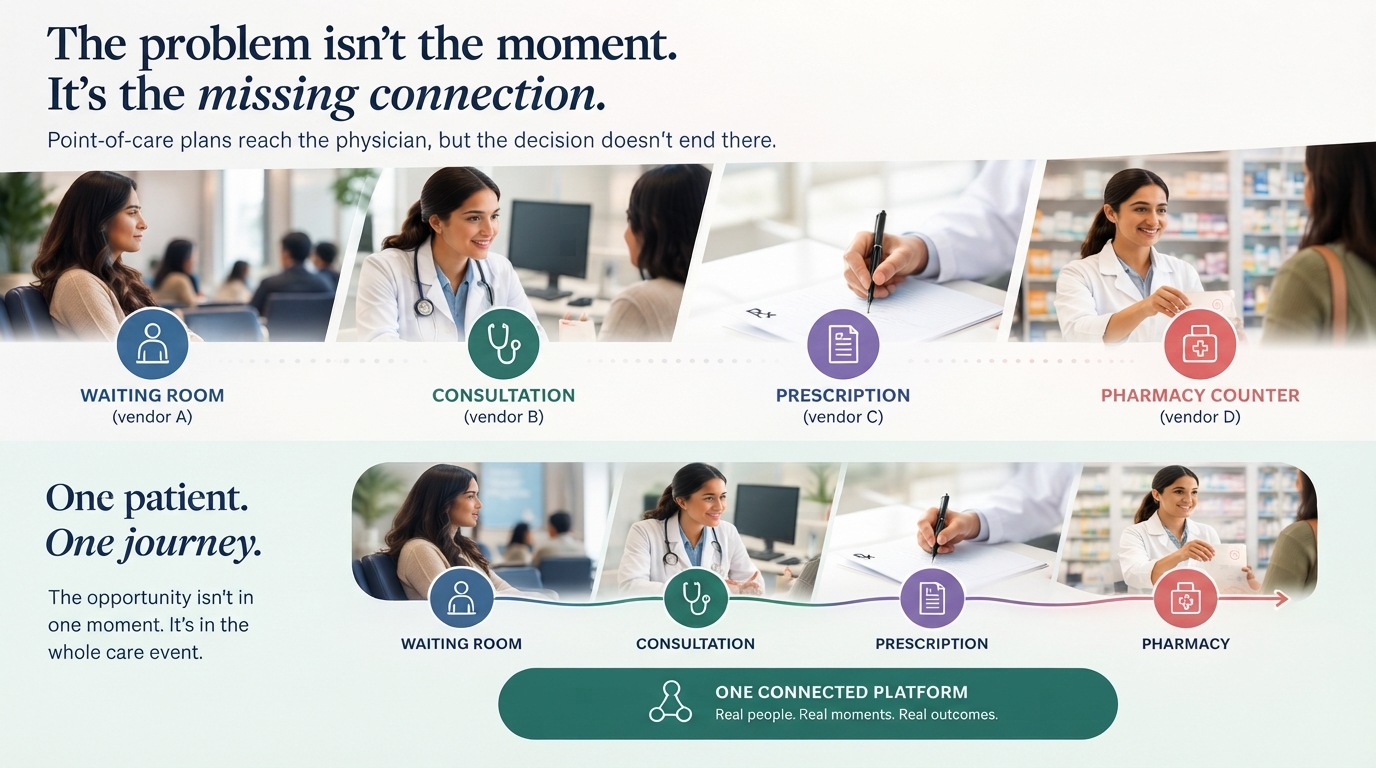
A prescription is not the end of a decision. It is the middle of one. What comes before it, a patient’s worry, a conversation, a question, shapes whether it is written at all. What comes after it decides whether it means anything: whether the patient fills it, whether the cost stops them, whether the pharmacist hands over what was prescribed or something else. The outcome every brand is measured on, the prescription that is written, filled and stays filled, is settled across that entire arc. The channel built to influence it has been present for a sliver.
This is why so much point-of-care spending produces strong engagement and disappointing results. It is not a failure of execution. The campaigns work, the placements deliver, the dashboards look healthy. It is that the industry has been buying one moment and being held to an outcome that turns on several. No degree of precision inside that one moment closes the gap, because the gap is not about precision. It is about presence. A brand can be flawless in the exam room and absent everywhere the care event is actually won or lost.
What makes this more than an academic point is that the situation was never necessary. The signals that describe a clinical decision, the diagnosis, the procedure, the prescription, have existed in every health record for as long as those records have been digital. The industry did not lack the information to follow a decision from beginning to end. It lacked the means to act on that information in the moment it mattered, rather than reading it back from a report months later. That is a solvable problem, and for most of the channel’s history it simply went unsolved. So brands reached the moments that were within reach and learned to treat the rest as someone else’s territory, or as no one’s.
The instinct, faced with a decision that spans many moments, has been to assemble more vendors, one for each. A partner for the waiting room, a partner for the workflow, a partner for the follow-up, a partner for the pharmacy. But a row of vendors, each accountable for its own moment, is not the same as a single presence that moves with the patient. The difference is not philosophical. It is the difference between knowing you reached the same person at each step and merely hoping you did, then assembling a story after the fact that says you must have. Coordination of that kind produces a convincing report. What it does not produce is a single connected care event, the one thread that could confirm the same patient was reached from the waiting room to the counter rather than four different people at four separate moments.
There is a quieter cost to that arrangement, one that rarely reaches the people approving the budget. It is the time a brand team loses forcing separate reports into agreement, and the patients who slip through the seams between one vendor’s moment and the next while that work goes on. Neither appears on the plan. Both are paid for anyway.
I am not going to pretend that reaching the whole encounter is a solved matter, or that the ability to do it settles every question about how a brand should conduct itself inside a clinical setting. It does not, and those questions deserve more attention as the capability grows, not less. But the reason a brand’s understanding of the patient and its actual media plan have never lined up is worth stating plainly, because it is neither mysterious nor anyone’s failure of will. The care event could only be bought where the wiring existed, and the wiring reached almost none of it.
That is the part that is changing. The means to act on a single verified clinical event across the whole arc of a decision, rather than intercept that decision at one point, is no longer theoretical. And once that is true, the relevant question shifts. It stops being how well a given placement performs and becomes whether the brand is buying the whole care event or buying pieces of it. Those are different purchases, measured against different outcomes. It was always one encounter. The brands that buy it as one will pull away from the brands that buy it in parts.