
An audit of 100 AI sales and revenue products suggests that the market has become much better at automating work than showing how commercial outcomes improve the next decision.
Artificial intelligence is rapidly changing how sales teams find prospects, research accounts, write messages, follow up and update customer records. Most of the public conversation has focused on how much activity these systems can generate and how little human input they require.
The more important question comes after the action. Can the system connect its work to a qualified opportunity, a win, a loss or revenue? Can it then use that result to improve the next account it prioritises, the next message it sends or the next recommendation it makes?
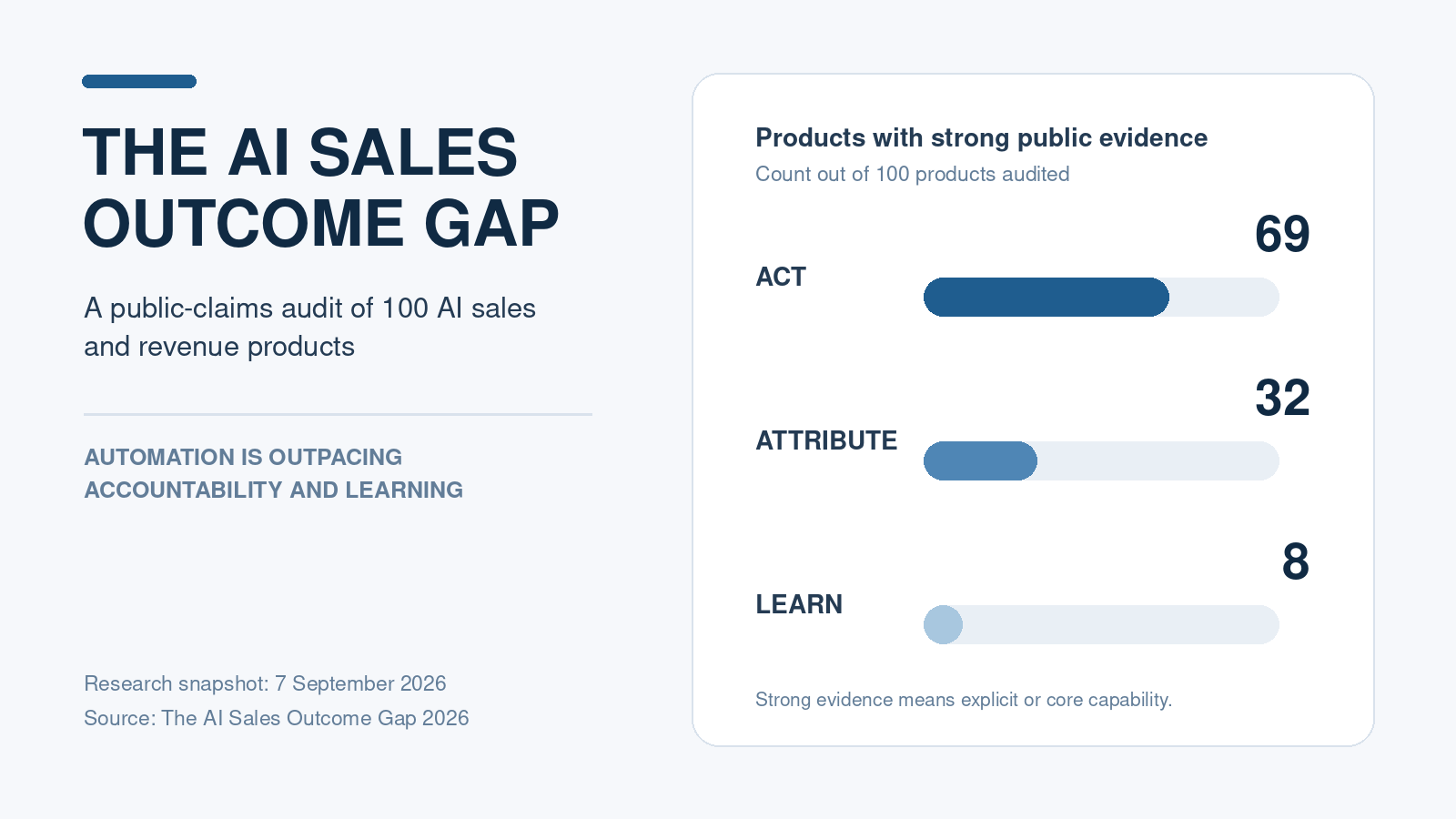
To examine that gap, Go7 conducted The AI Sales Outcome Gap 2026, a public-claims audit of 100 active AI sales and revenue products. The central finding was stark: 69 products strongly evidenced the ability to take sales action, 32 strongly evidenced commercial attribution, and only eight strongly evidenced learning from downstream commercial outcomes.
The gap between action and learning
The audit mapped each product against seven stages of a commercial loop: Discover, Detect, Understand, Decide, Act, Attribute and Learn. The first stages cover identifying an account, recognising relevant timing, gathering context and deciding what should happen. Act covers execution such as sending, routing, updating or triggering work.
Attribute asks whether the product clearly connects its activity to downstream commercial results such as qualified opportunities, pipeline, forecast, wins or revenue. Learn applies a higher threshold: whether those outcomes are used to change future decisions or agent behaviour.
Across the sample, 69 products made execution an explicit or core public capability. Only eight did the same for outcome learning, creating a 61-point gap between taking action and learning from the result.
| Commercial stage | Products | What strong evidence meant |
| Act | 69 of 100 | Execution was explicit or central to the product proposition |
| Attribute | 32 of 100 | Activity was explicitly connected to pipeline or commercial results |
| Learn | 8 of 100 | Downstream outcomes clearly informed future decisions or behaviour |
Source: Go7 public-claims audit of 100 AI sales and revenue products, snapshot dated 7 September 2026.
The market is dividing into two halves
The overall numbers become more revealing when the market is separated by product type. In the 25-product sales-engagement and outbound-execution segment, every product strongly evidenced Act. None strongly evidenced Learn.
The 30-product agentic SDR and revenue-agent segment showed almost the same pattern. Twenty-eight products strongly evidenced execution, while none made learning from commercial outcomes an explicit or core public capability.
Revenue and conversation-intelligence products looked different. Fourteen of the 20 products in that segment strongly evidenced attribution and seven strongly evidenced learning, but only two showed any discovery capability.
This suggests a structural split. Upstream systems are built to create activity, while downstream systems inspect conversations and results. Integrations may connect the two, but relatively few products publicly describe a complete feedback loop from account selection to commercial outcome and back to the next decision.
Activity is not the same as outcome
The language vendors use to define success reinforces the same pattern. Fifty-five products led primarily with activity, efficiency, data outputs, replies or meetings. Twenty-three led with pipeline, while 22 led with revenue, win rate or forecast.
These early-stage metrics are useful. A team needs to know whether prospects are being identified, messages are being delivered and conversations are being created. The problem begins when the proxy becomes the objective.
An increasingly autonomous system can become highly effective at maximising an activity metric without necessarily improving the commercial outcome behind it. More messages do not automatically produce better opportunities, and more meetings do not automatically produce profitable customers.
This changes the questions buyers should ask. The relevant test is no longer simply whether a product can automate a task. Buyers also need to know which outcome the system is optimising, how that outcome is measured and whether the result changes future behaviour.
Autonomy creates a governance question
As systems take more action, controls and transparency become part of product performance rather than optional governance features. A business needs to understand why an account was prioritised, why an action was selected, when a person can intervene and what record remains afterwards.
On the public pages reviewed, 57 products showed no evidence of human approval controls. Sixty-three showed no public evidence of explainability or audit trails, while 12 made explainability or auditability explicit or core.
Those figures do not prove that the remaining products lack these capabilities. They do show that autonomy is currently much easier to find in public positioning than the mechanisms businesses need to supervise and evaluate it.
This matters most when the commercial stakes are high. Sending a low-risk follow-up is not the same as approaching a strategic account, changing a forecast or reallocating budget. Useful autonomy will require different levels of permission, evidence and oversight for different decisions.
What buyers should ask
The audit points towards a more demanding way to assess AI sales products. Buyers should look beyond feature lists and ask how the system connects activity to evidence of commercial value.
- What business outcome is the system actually optimising?
- Can its activity be connected to qualified opportunities, wins, losses or revenue?
- Does that outcome change the next recommendation or action?
- Can a user see why an account, message or action was selected?
- Which actions require human approval, and can those thresholds vary by risk or account value?
- Does the system retain the business context and decision history needed to avoid repeating mistakes?
Public evidence is not the same as full capability
The research was designed as a public-claims audit, not a hands-on performance test. It assessed the information that buyers, analysts and journalists can reasonably see across official product pages, pricing pages, documentation and vendor-published case studies.
Each product was scored 0, 1 or 2 across the seven stages: no public evidence located, supporting evidence, or explicit and core evidence. The resulting workbook contains 700 stage-level evidence records, along with source links and review notes.
A score of zero does not mean that a capability is absent. It means sufficient evidence was not located on the reviewed pages. The sample was structured rather than random, so the findings should be read as patterns within these 100 products, not as a statistical census of the entire market.
Go7 commissioned the study and was excluded from scoring. Vendor case studies were treated as vendor-published evidence rather than independent proof.
The next advantage may be the feedback loop
The findings do not suggest that AI sales agents are incapable or overhyped. They show that execution has matured faster than accountability, attribution and learning in the public market story.
The underlying models will continue to improve, and research, drafting and workflow execution will become more widely available. As those functions become abundant, durable differentiation may move towards business context, decision history, human controls and feedback from real commercial outcomes.
The next generation of AI sales software will not be judged only by how much work it can automate. It will be judged by whether it can explain the work, connect it to a meaningful outcome and become more useful because of what happened.