
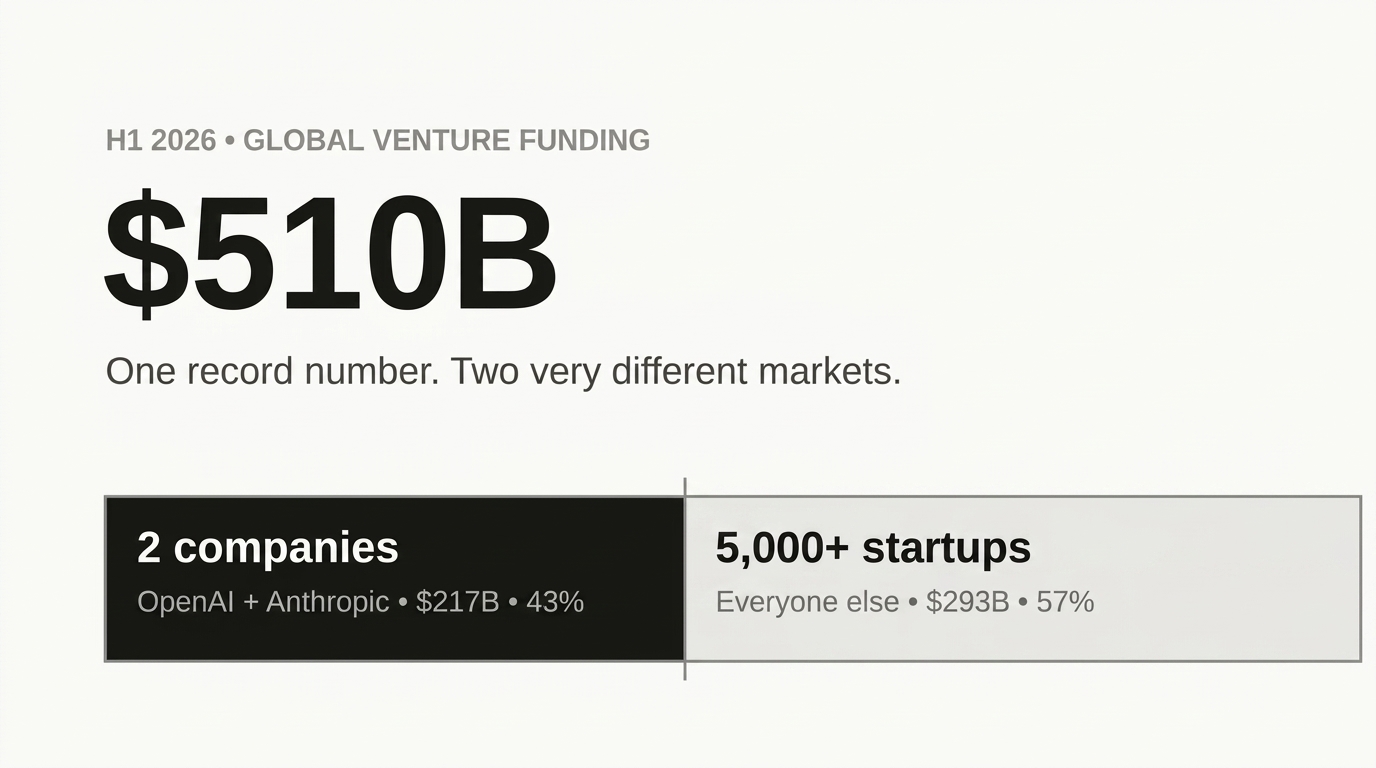
Global venture funding hit a record $510 billion in the first half of 2026. That is the largest total ever recorded for any six month period, surpassing the $440 billion invested across all of 2025, according to Crunchbase data.
It also beat the previous half year high by a wide margin. The prior record was $375 billion, set in the second half of 2021, a mark H1 2026 cleared by more than $135 billion, per Silicon ANGLE’s coverage of the same report.
Here is what the headline number does not tell you. OpenAI and Anthropic alone accounted for $217 billion, or 43 percent of all startup funding worldwide in the first half. Two companies took nearly half of every venture dollar deployed globally, across every sector, every stage and every geography, for six straight months.
If an investor or founder is trying to read the state of the market off the $510 billion figure alone, they are reading a number that describes almost nobody’s actual experience raising or deploying capital this year. This piece pulls the two megadeals out and looks at what is left.
What Is Left When Two Checks Are Removed
Take OpenAI and Anthropic out of the $510 billion total and roughly $293 billion remains for every other startup on earth. That is still a large number, but it is not obviously a record breaking one. An independent read of the same underlying data, from insights4vc and summarized by AI Weekly, found that once the four largest rounds of the half are excluded, namely OpenAI, Anthropic, xAI and Waymo, comparable venture activity tracked close to 2024 and 2025 levels rather than meaningfully above them.
The quarterly pattern supports that reading. Investors put $205 billion into more than 5,000 startups in the second quarter, following $305 billion invested in the first, according to Crunchbase News.
Sixteen companies raised billion dollar rounds in Q2 alone, totaling $108.6 billion, or 53 percent of the quarter’s entire funding total, as reported by Neuron Feed’s summary of the release. That means more than five thousand other companies split the remaining 47 percent among themselves.
This is the real story of 2026. It is not one venture market, it is two. One market is a handful of companies a quarter, writing and receiving checks in the tens of billions, increasingly backed by strategic capital from hyperscalers rather than traditional venture syndicates.
The other market is the several thousand startups that make up the everyday venture ecosystem, where growth has been real but far more ordinary than the headline number suggests.
Where the Early Stage Money Is Actually Going
Once the frontier labs are set aside, the data shows early stage capital concentrating in a narrower set of places than the broad AI boom narrative implies. Robotics and AI research labs led the sectors for new unicorns minted in H1 2026, alongside financial services, healthcare, AI infrastructure, defense and semiconductors, according to Crunchbase’s count of 195 new unicorns for the half, a figure that already exceeds the 193 minted across all of 2025.
That is a genuine expansion in company creation, and it is the fastest pace of new unicorn formation since the second half of 2022. It is not evenly spread across the economy, however. It is concentrated in AI infrastructure and physical world applications of AI, not general purpose software, which matters for founders trying to gauge whether their own category is actually in favor.
A Barbell Forming at the Earliest Stage
The bifurcation shows up clearly at seed as well. Global seed and angel funding totaled roughly $12 billion in the second quarter, up in dollar terms year over year even as the number of seed deals declined, a pattern documented separately in Crunchbase’s Q1 data and echoed in the Q2 figures. Investors are writing larger checks into fewer, more selective companies rather than spreading capital broadly across a growing pool of new seed stage startups.
In plain terms, even at the earliest stage, money is barbelling toward a handful of very large seed rounds, typically AI labs raising at scale before they have shipped a product, alongside a shrinking number of conventional smaller seed checks. The middle of that range is thinner than it used to be. For a founder outside the frontier AI cluster, that means the bar to close even a modest seed round has risen, not fallen, despite the headline growth in total dollars.
A Shifting Map of Where Capital Lands
Geography is moving too, which complicates any narrative that AI is simply eating the entire market in one place. The United States again dominated global funding, but its share slipped. Two thirds of startup capital in Q2 went to U.S. based companies, down from 83 percent in Q1, according to Crunchbase figures cited in AI Weekly’s roundup.
A 16 point swing in one quarter is unusually large for a metric that typically moves slowly, and it suggests capital outside the U.S. frontier lab cluster is finding more places to deploy than the H1 headline implies.
China’s share of new unicorn formation also picked up meaningfully in the same period, alongside continued strength in the U.K., India and other markets building AI infrastructure, robotics and semiconductor businesses. None of that shows up in a single global total that is dominated by two U.S. based labs.
What This Means for Portfolio Construction
The practical problem with a $510 billion headline is that it invites two bad readings. The optimistic reading says the market is roaring back for everyone, which risks making limited partners and general partners slower to notice that deal counts and check sizes outside AI infrastructure have not moved nearly as much. The pessimistic reading, once someone points out the concentration, says the whole figure is a mirage, which ignores that seed activity and unicorn creation outside the megadeals are both up in real terms, just not by 43 percent.
A more useful approach is to build a view of the market from an adjusted baseline that strips out the largest rounds each quarter, a framing multiple outlets have now applied independently to the same Crunchbase data. Funding excluding the top handful of deals tracked close to prior year levels for most of H1, broadly in line with recent quarters rather than record setting. Using that adjusted figure, rather than the topline $510 billion, is a more honest reference point when assessing whether a fund’s own deal flow, pricing or performance looks strong or weak relative to the market.
For fund managers, this has a direct benchmarking implication. A fund that does not write nine or ten figure checks into frontier labs should compare its growth against the ex megadeal baseline, not the headline. A portfolio that grew deployment in double digits year over year in a market where the adjusted baseline grew at a similar rate is performing in line with its actual market, even though it will look like it is falling behind if measured against a headline inflated by two companies.
For founders, the useful question is which market they are actually competing in. Companies building AI infrastructure, physical AI, defense technology or anything a frontier lab might plausibly fund strategically are competing in an environment where check sizes and valuations are set by companies raising tens of billions at a time, and should price and staff accordingly, because their comparables are inflated. Everyone else is fundraising in an environment that looks closer to 2024 and 2025 than the headline suggests, with real capital available but no discount on diligence and no benefit from the AI labeled growth happening two tiers above them.
The Takeaway
The $510 billion figure should not be cited to a founder, a limited partner or a board without immediately noting what it contains. It is not a market wide temperature check. It is a report on a handful of companies plus everyone else.
Anyone underwriting a deal or a fund should ask for deal flow and pricing data with the largest rounds excluded, because that adjusted number is the one that actually describes the market most participants are operating in.
When a pitch, a memo or a market update leans on the headline venture number to argue that capital is flowing again, the useful follow up question is simple: what does the number look like with OpenAI and Anthropic taken out. In H1 2026, the honest answer is that funding is up, but nowhere near as dramatically as the headline suggests.