

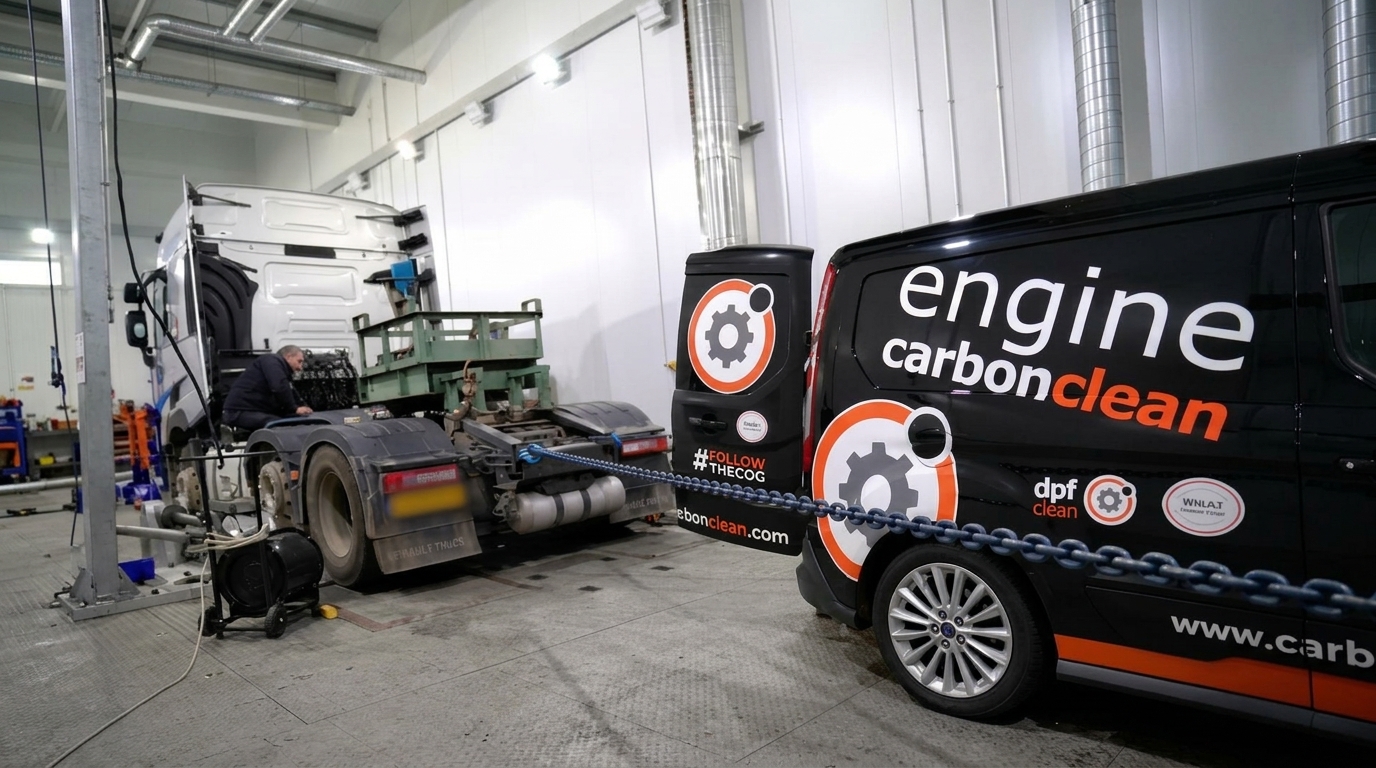
Advanced Hydrogen Technologies (AHT) has a proven working commercial proposition today: Engine Carbon Clean, its flagship modular offering for improving the performance and longevity of all internal combustion engines. The system simply generates oxyhydrogen from water (via electrolysis) on demand and introduces it through the engine’s air intake in a process designed to remove carbon deposits and reduces harmful emissions – helping engines operate more efficiently without replacing them or changing their fuel. The company’s longer-term ambition is to apply safe hydrogen engineering to heating and power. CEO Ben Kattenhorn explains what has been tested, what comes next, and why he believes hydrogen can become an alternative fuel of choice.
1) Engine Carbon Clean is AHT’s main offering today. What does it do?
Engine Carbon Clean (ECC) is an innovative and patented on-demand hydrogen generator technology that cleans combustion engines internally by removing carbon build up. It was piloted with empirical testing at the renowned Millbrook Proving Ground in Bedford. Hydrogen is piped into the air intake and the engine sucks in on demand what it needs, significantly improving fuel efficiency and reducing toxic emissions, including CO₂, CO, NOx, and N₂O.
The important point is that this is a technology being used and tested in real operating environments. It gives us a practical starting point: working closely with customers, integrating seamlessly into maintenance routines and measuring tangible improvements on the assets they rely on.
2) What has been demonstrated so far?
There are hugely encouraging results from trials with industry leaders. Balfour Beatty are the first infrastructure company to apply this solution to rail-mounted plant as part of efforts to address Scope 1 emissions. The initial trial simulated a full year of usage aligning with typical maintenance cycles and saw a 15.79% reduction in emissions – with the company now rolling out the ECC service across its entire tamper fleet.
Industrial Chemicals Limited reported similar results in both emissions reduction and fuel efficiency from its HGV fleet trials and signed a three-year nationwide contract for the service. Colas Rail has also reported fuel and emissions savings of more than 13% in trials on its tamper fleet, while they are the first company to take advantage of the new ECC subscription solution, whereby they have their own generators and can perform the cleans themselves – anywhere in the country and on demand – as part of their maintenance and servicing schedules.
3) The technology has also appeared on the big screen. What did that coverage show?
BBC Click featured our work on hydrogen technology and diesel-engine emissions in a rail context. Their Arctic Energy episode included a segment on hydrogen and diesel trains, which helped show how ECC is being applied to a real engineering challenge on a 1962 Class 08 locomotive. It reported how ECC offers an immediate solution – also restoring engine efficiency and power, lowering maintenance costs, extending the lifespan of assets and aligning with the new ESG requirements of the International Financial Reporting Standards mandate.
4) Why is Engine Carbon Clean a useful place to begin AHT’s hydrogen story?
It demonstrates the approach in a practical setting: generate hydrogen on demand, control how it is used and apply it to an existing asset for circular economy benefits. We’ve been able to work with operators, test the system and gather results in real-world environments.
As much as the world needs to look at alternate fuels for the future, we need to clean up the fuels we use now.
That experience gives us a foundation for developing other applications. But each one has its own engineering and regulatory requirements. Results from an engine-cleaning system do not automatically prove how a heating or power system will perform.
5) You see hydrogen becoming a fuel of choice. Where do you expect it to make the greatest difference?
Hydrogen is so far under-utilised (1% of total energy to date) and has the capacity to provide clean, green and cost-effective energy across a multitude of industries, including transport, automotive, manufacturing and marine. It’s particularly valuable where existing equipment has a long working life and replacing it immediately is difficult and prohibitively expensive.
This equally applies to domestic households, but I don’t think one fuel or technology will suit every application. Hydrogen’s role will depend on where it can be produced and used safely, reliably and economically. Our ambition is to develop systems that make it practical for specific applications, with evidence to support the case.
6) How does that ambition lead to Chimera?
We see an imminent future that harnesses the power of hydrogen to heat homes with a cleaner, more affordable localized energy source – so Chimera takes AHT’s work in controlled, on-demand hydrogen generation into domestic heating to supply a sustainable supply of central heating and hot water.
It is designed as a modular system for commercial and residential boiler environments, with the aim of enabling a staged transition rather than requiring immediate replacement of the whole heating asset.
The development plan starts with commercial low-blend validation at 3-5% hydrogen, then commercial operation at around 20%. It continues to residential adaptation at up to approximately 20%, a controlled high-blend demonstration of up to around 50%, and ultimately a hydrogen-dominant or full-hydrogen prototype under controlled conditions.
Those are planned stages, not completed validation results. Each one needs evidence on performance, safety, controls and compliance before progressing, but the work is underway and public sector organisations who stand to benefit are now in discussions to trial it with us!
7) What are the main engineering features?
As a miniaturised generator, Chimera is designed to generate hydrogen on demand in a compact unit. A single cell produces 3.58 litres per minute at idle pace, and multiple cells can be combined to meet greater demand. The system includes safety interlocks, fault detection, shutdown logic and telemetry-enabled monitoring, plus it has the capacity to be carbon-neutral.
Traceability is important. We want the system to generate the operational data needed to assess its performance and support future CE and UKCA conformity planning.
8) Hydrogen heating can prompt questions about energy use and carbon impact. How will you answer those?
With measured performance and transparent reporting. The climate case depends on how the hydrogen is produced, how much energy the system uses, what fuel it displaces and how it performs in practice. Hydrogen is not automatically low carbon simply because it is hydrogen.
For Chimera, the project needs to establish the case at each planned blend level. That means being clear about the system’s inputs and outputs, its operating conditions and what the results do, and do not show.
9) And what role does Thea play in AHT’s plans?
Thea Power is our longer-term work on generating electricity through hydrogen-powered systems. It extends the same ambition to apply controlled hydrogen technology to another essential energy need, but it is at a different stage from Engine Carbon Clean.
Thea is a development project. It will need its own engineering work and evidence before we can generate results on where or how it could be deployed.
Thea, like Chimera, is controlled by AHT’s overarching software system, Athena, which regulates how much hydrogen is produced on demand and monitors the flow. It logs the power that is used and how many times it has cleaned itself, with all this operational information available in a real-time data stream. Athena will manage all subscription services for both current and future AHT products.
10) So how would you describe AHT’s trajectory?
AHT envisages the widespread use of hydrogen as the primary source of safe, economical, and sustainable energy, with the potential to reduce both pollution and household energy bills.
Today, it is Engine Carbon Clean: a commercial offering that has been tested with customers globally and reported results in specific settings. Looking ahead, we want to build on the engineering experience behind it to develop Chimera for heating and Thea for power.
The future for AHT is about extending on-demand hydrogen technology into new applications. Each system has to prove its own performance, but the ambition is clear: make hydrogen a practical fuel choice wherever it can deliver a safe and measurable benefit and we most certainly will.