
Your bot defence now stops customers and waves the scrapers through
The squint test nobody is passing
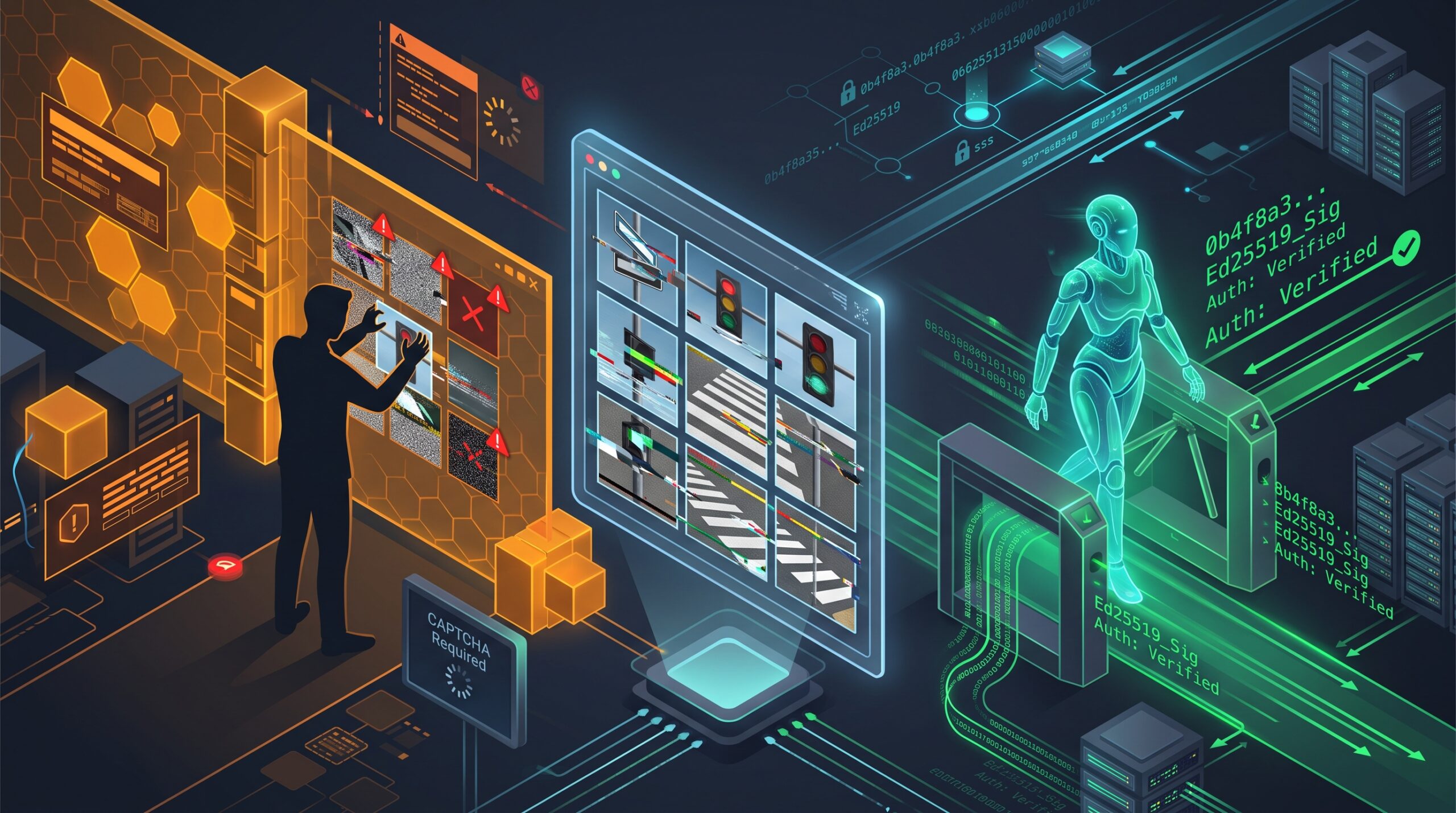
You know the moment: a grid of blurry street photographs appears, you hunt for the last sliver of a crosswalk, you guess wrong, and a fresh grid fades in. Somewhere on the same page, an autonomous AI agent clears the identical challenge in under a second for a fraction of a cent. The puzzle that just cost you forty seconds of goodwill is the cheapest line item in an attacker’s budget.
That inversion is the entire argument. CAPTCHA was built on the premise that certain tasks are easy for people and hard for machines, and that premise has quietly expired. In 2024, researchers at ETH Zurich published Breaking reCAPTCHAv2, solving 100% of the challenges they were served with a fine-tuned YOLOv8 pipeline, against 68–71% for earlier attempts. Their bot needed fewer attempts than the human control group: a mean of 2.71 challenges versus 3.50.
The thesis: CAPTCHA has flipped from a security asset into a business liability. It no longer deters determined automation, yet it imposes measurable friction on the highest-intent humans you have — the ones already reaching for their wallet.
1. The modern heist: scraping became a commodity
The brittle script is dead
Traditional scrapers were selector-based scripts that shattered the moment a developer renamed a container. Modern agentic scrapers drive a real headless browser and read the rendered page through a vision-language model, as a new employee would. Change the layout and the agent re-reads the screen and continues. Imperva’s 2026 Bad Bot Report puts automated traffic above 53% of all web traffic in 2025, up from 51% the year before, with human activity down to 47% and still falling.
Visual puzzles are solved, not merely endured
Multimodal models read distorted text, classify objects and reason about spatial layouts faster and more consistently than the average customer on a phone, and the accessible fallback is weaker still: academic work on audio CAPTCHAs reports success rates above 97% using mainstream speech-to-text services. The ETH team also found that reCAPTCHA leans heavily on cookies and browsing history when scoring a visitor, which makes the visible puzzle largely theatre layered over an invisible risk score.
The attacker’s economics
Commercial solver services advertise token and image tasks in the range of roughly $0.14 to $2 per 1,000 solves, and agent-oriented endpoints now sell single solves for a cent or two. Solving is now packaged as an ordinary tool call, including MCP servers built so agents can route around challenges. For a competitor harvesting your pricing in real time, your defence is a rounding error; for your customer, it is thirty seconds and a small insult.
2. The hidden cost of security theatre
Conversion leakage at the worst possible pixel
A CAPTCHA sits immediately before the submit button, which makes it the most expensive element in the funnel. Vendor and academic analyses point the same way: a reported 40% reduction in form conversions in the most-cited figure, a 3–5% overall conversion drop simply from switching one on, and 5–15% drop-off on visual challenge screens depending on difficulty. A peer-reviewed empirical study of modern CAPTCHAs measured 15–26 seconds per image challenge at 71–85% human accuracy, with a 30% abandonment rate among participants who had already committed to the task.
Accessibility and the compliance clock
The W3C has warned about this since 2005 in its note on the Inaccessibility of CAPTCHA; WebAIM’s 2024 screen-reader survey still ranks CAPTCHA as the single most cited accessibility barrier on the web. The regulatory position is hardening rather than softening. The European Accessibility Act became enforceable on 28 June 2025, and the forthcoming update to EN 301 549 adopts the WCAG 2.2 “Accessible Authentication” criterion, which disallows cognitive-function tests on public-sector services. Privacy regulators have moved too: in 2024 Austria’s Federal Administrative Court held that reCAPTCHA requires explicit consent before it loads.
The false sense of security
Meanwhile the board sees “anti-scraping control: implemented” on a slide while the catalogue, the price list and the content keep leaving through the back door. There is a quieter tax too: when most traffic is automated, conversion rates and demand signals become hard to read, so you are degrading the numbers you use to run the business.
3. If not CAPTCHAs, then what?
Invisible risk assessment instead of interrogation
The first move is to replace the test with passive signals: interaction physics, device and network consistency, timing entropy, and lightweight cryptographic proof-of-work rather than image grids. Challenge nothing by default and step up only for high-risk actions such as a password reset or a first-time payout. Be honest about the limits: the ETH work defeated behavioural checks with simulated mouse curves, so behaviour is one layer, not a wall.
Verify identity rather than guess at humanity
The more durable shift is cryptographic. Web Bot Auth has agents sign requests with an Ed25519 key and publish the public half at a well-known directory, so the server verifies a claim instead of inferring one; Cloudflare folded it into its Verified Bots programme in July 2025. That changes the question from “is this a human?” to “who is this, and what are they entitled to do?” Good automation identifies itself; everything unsigned can be rate-limited, priced or refused on its own terms.
Make exploitation uneconomic, not impossible
Once identity is provable, permission becomes sellable. Cloudflare’s pay-per-crawl revives the dormant HTTP 402 “Payment Required” response so a publisher can quote a price and a crawler can pay it or leave, and from 15 September 2026 mixed-use AI crawlers are blocked by default on ad-supported pages for new and free-tier sites. The equivalent moves on your own estate are unglamorous and effective: per-identity rate limits, metered API tiers, and crown-jewel data behind an authenticated session rather than a puzzle.
Sell to the agents you cannot stop
If competitors and assistants will read your catalogue anyway, a controlled, attributed, monetised feed beats an uncontrolled scrape. Standards for this arrived fast: the Agentic Commerce Protocol from OpenAI and Stripe, Google and Shopify’s UCP, and AP2, now governed by the FIDO Alliance. Treat them as plumbing rather than prophecy: OpenAI retired its in-chat Instant Checkout in March 2026 and pivoted to retailer-operated apps, a reminder to invest in clean feeds and verifiable identity rather than one company’s storefront.
Defend the session, not the doorway
Finally, stop treating the front door as the control point. Anomaly detection across the full session lifecycle — enumeration patterns, impossible journeys, catalogue-shaped traversal, payout velocity — catches what a single checkpoint never will, and it stays invisible to customers behaving normally.
4. The executive takeaway
The reframe is simple: bot management is not a generic IT problem to be delegated and forgotten, but a customer-experience and revenue-retention problem that happens to be implemented by the security team.
| Dimension | Old model (challenge-based) | New model (identity + economics) |
| Core question | Are you a human? | Who are you, and what may you do here? |
| Cost borne by | Every legitimate visitor, at the point of purchase | High-volume automated consumers, priced per request |
| Failure mode | Customer abandons; scraper pays $0.0002 and continues | Scraper hits a rate limit, a price, or a contract |
Four questions for your next review:
- What is our measured conversion delta on challenged versus unchallenged flows? Without that A/B test, we are guessing at a revenue line.
- Which challenges land disproportionately on mobile, VPN and privacy-browser users — our most valuable and most privacy-conscious customers?
- If our CAPTCHA vanished tomorrow, what would actually be exposed — and could rate limits, authentication or pricing protect it better?
- Do we have a sanctioned, paid path for automated access — or are we forcing every legitimate agent to behave like an adversary?
Final thought. In an era of autonomous agents, stopping bots by making life harder for humans is a losing strategy on both sides of the ledger. The companies that win the next decade will make access effortless for real customers, identity provable for legitimate machines, and exploitation commercially unviable for everyone else. The blurry crosswalk does none of the three.