
The Power-Hungry Reality of AI
The artificial intelligence revolution has captured global imagination with its promise to transform every industry. Yet while the world obsesses over the latest language models and breakthrough algorithms, a more fundamental challenge looms: electricity. The infrastructure crisis threatening to slow AI’s advance isn’t about chips, algorithms, or even talent—it’s about power.
Data centers in the United States already consume 4.4% of the nation’s total electricity, according to recent analysis. To put that in perspective, that’s roughly equivalent to powering all residential homes in California and Texas combined. This isn’t just another infrastructure statistic—it represents a fundamental shift in how we think about digital progress.
From Efficiency Gains to Exponential Demand
For over a decade, from 2005 to 2017, data center electricity consumption remained remarkably flat despite explosive growth in cloud computing and streaming services. Efficiency improvements offset the expansion. Then AI changed everything in 2017, triggering a doubling of data center electricity consumption by 2023.
The International Energy Agency projects an even more dramatic acceleration ahead.Global electricity demand from data centers is expected to more than double by 2030, reaching 945 terawatt-hours—slightly more than Japan’s entire current electricity consumption. AI workloads will be the primary driver, with AI-optimized data centers projected to quadruple their electricity demand by decade’s end.
The Economics of AI’s Power Problem
Training a single large language model now consumes staggering amounts of energy.OpenAI’s GPT-4 training alone consumed an estimated 50 gigawatt-hours of electricity—enough to power San Francisco for three days. That’s just training. The ongoing inference costs—every time someone uses ChatGPT, Claude, or similar tools—add up to approximately 2.9 kilowatt-hours per 100,000 words generated.
The financial implications are equally dramatic. Goldman Sachs Research forecasts that global power demand from data centers will increase 165% by 2030 compared to 2023 levels. This surge requires an estimated $720 billion in grid infrastructure spending through 2030.
Meanwhile, consumers are already feeling the impact. Bloomberg analysis found that wholesale electricity costs as much as 267% more in areas near data centers compared to five years ago. Over 70% of the nodes recording price increases are located within 50 miles of significant data center activity.
The Grid Infrastructure Bottleneck
The problem extends beyond raw generation capacity. The U.S. electrical grid, much of which was built decades ago, simply wasn’t designed for the concentrated power demands that AI data centers represent. Transmission infrastructure takes years to plan, permit, and construct—far longer than the 18-24 month timeline for building a data center.
Interconnection queues—the waitlists to connect new power generation to the grid—have become a critical bottleneck. Projects can wait years for approval and connection, while data center operators need power immediately. This timing gap is forcing the industry to explore alternative solutions.
The Carbon Paradox
Here’s where the situation becomes more complex: AI data centers don’t just need constant power—they need it 24/7, 365 days a year. Research from Harvard’s T.H. Chan School of Public Health found that the carbon intensity of electricity used by data centers was 48% higher than the US average.
The reason? Intermittent renewable sources like solar and wind can’t provide the reliability that data centers require. This forces many facilities to rely on baseload power from natural gas or coal, even as their parent companies announce aggressive net-zero commitments.
One study analyzing 1,795 data centers found average carbon intensity of 548 grams of CO2 equivalent per kilowatt hour—about 50% higher than the national average. The IEA projects data center emissions could reach 1% of global CO2 emissions by 2030, making it one of the few sectors where emissions are set to grow.
Innovation at the Intersection of Power and Computing
The industry isn’t standing still. Multiple pathways are emerging to address the electricity crisis:
Nuclear Renaissance
Tech companies are revisiting nuclear power as a solution. Amazon Web Services recently acquired Talen Energy’s Cumulus project, which connects directly to a 2.5 GW nuclear power plant. Nuclear offers consistent baseload power with low carbon emissions—though high costs and public skepticism remain significant hurdles.
Behind-the-Meter Solutions
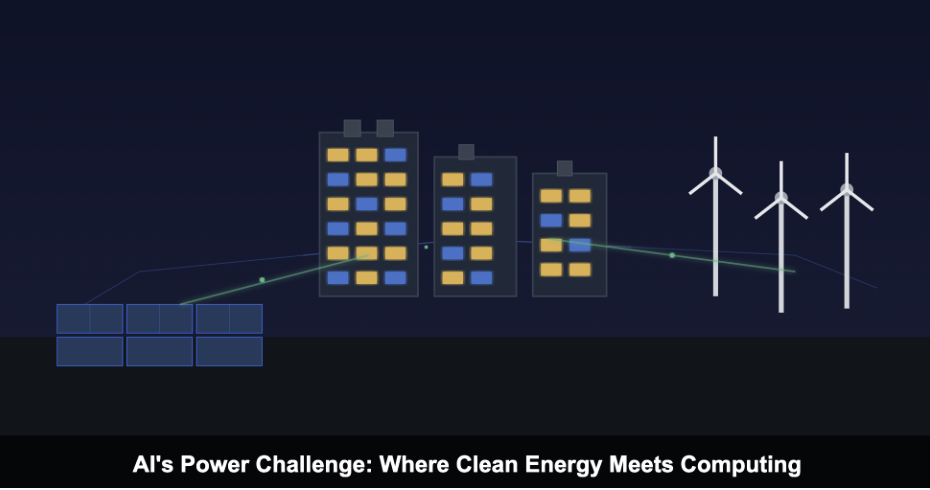
Rather than relying solely on grid power, data centers are increasingly exploring “behind-the-meter” generation—producing power on-site or through dedicated sources. This includes everything from traditional backup generators to sophisticated microgrids powered by renewable energy and battery storage.
Solar and onshore wind combined with battery storage can be deployed in under two years—faster than natural gas plants, which take three to four years. These renewable projects also keep electricity rates stable, avoiding the price spikes associated with fossil fuel plants.
Efficiency Breakthroughs
Data center operators are making significant strides in efficiency. Google’s data centers now deliver six times more computing power per unit of electricity than five years ago. Innovations include AI-driven cooling systems that adjust to real-time conditions, liquid cooling technologies, and chip designs optimized for specific AI workloads.
The Department of Energy leads the Energy Efficiency Scaling for 2 Decades initiative, targeting a 1,000-fold increase in microelectronics energy efficiency over 20 years.
Geographic Strategy
Some companies are pursuing a geographic solution—building data centers where clean, cheap power already exists. States like Washington, Oregon, and Vermont offer abundant hydroelectric power. West Texas provides some of the nation’s lowest electricity prices thanks to wind and solar farms.
The Demand Flexibility Frontier
Perhaps the most promising approach involves fundamentally rethinking how AI workloads operate. Unlike traditional data processing that must happen in real-time, many AI training and inference tasks could potentially shift to times when renewable energy is abundant or grid demand is low.
Data centers participating in demand response programs can help stabilize the grid during peak periods while reducing their own costs. Some facilities are even exploring ways to sell excess capacity back to utilities, creating new revenue streams while supporting grid reliability.
The Policy and Planning Imperative
Addressing AI’s electricity crisis requires more than technology—it demands coordinated policy action. The current regulatory framework wasn’t designed for the scale and speed of AI infrastructure deployment.
Utilities and tech companies must improve transparency about energy needs and interconnection requirements. Regulators need better tools to assess the electricity rate impacts and community benefits of different solutions. Without proactive planning, the regions that fail to address these challenges risk losing out on the economic benefits of AI development.
The IEA emphasizes that countries wanting to benefit from AI potential need to quickly accelerate investments in electricity generation and grids, improve data center efficiency, and strengthen dialogue between policymakers, tech companies, and the energy industry.
Looking Ahead: A Manageable Crisis
The good news? AI’s electricity challenge, while significant, is ultimately solvable. Data centers still represent only about 2% of global electricity consumption—substantial but not overwhelming in the context of the total energy system.
The solutions exist: more efficient hardware and software, strategic facility placement, renewable energy integration, grid modernization, and smarter load management. What’s needed now is the will to deploy these solutions at scale and speed.
The electricity bottleneck facing AI isn’t an insurmountable barrier—it’s a design challenge that sits at the intersection of our digital future and our energy present. How well we navigate this challenge will determine not just AI’s trajectory, but also our ability to pursue technological progress while meeting climate commitments.
The race to power AI has begun. The winners will be those who recognize that silicon and software alone aren’t enough—the future belongs to those who can master the electrons as well as the algorithms.