
Twenty years ago, when I first coined the term “Artificial General Intelligence,” the idea of machines matching human-level thinking felt like science fiction to most observers. Today, as CEO of the Artificial Superintelligence (ASI) Alliance and someone who has spent 3+ decades building toward this goal, I can tell you: science fiction is rapidly becoming science fact and practical everyday product. But we’re not there yet, and 2026 will be a fascinating year of watching AI capabilities race ever closer to that threshold.
This year won’t be defined by a single dramatic breakthrough. Instead, we’ll see a steady accumulation of advances that make AI genuinely useful in ways that felt impossible just two years ago. Here’s what I expect to unfold.
1. Assistants That Actually Remember You
The AI assistants we use today are remarkably capable but frustratingly forgetful. Ask ChatGPT something today and it has no memory of your conversation last week. In 2026, expect research assistants and personal assistants with genuine cognitive architecture – long-term memory that builds understanding of your goals over time, working memory that tracks complex multi-step projects, and the ability to take autonomous action toward your objectives rather than simply following narrow instructions. These won’t just answer questions; they’ll anticipate needs and work alongside you.
2. AI Art That Surprises Its Creators
Current AI-generated art, for all its technical impressiveness, often feels derivative – a sophisticated remix of existing styles. This year will bring AI artistic creations with genuine novelty. By moving beyond standard large language models and diffusion techniques to incorporate more innovative computational creativity methods, we’ll see AI music improvisation with truly unique character, visual art that doesn’t merely combine existing aesthetics but invents new ones. The difference will be unmistakable: art that surprises even the people who built the systems.
3. Business Intelligence You Can Trust
One of AI’s most frustrating limitations has been its tendency to confidently state things that simply aren’t true: the hallucination problem. For business applications, this has been a dealbreaker. This year, we’ll see AI models that handle reasoning about business data reliably by grounding their linguistic capabilities in symbolic reasoning tools doing in-depth processing of quantitative, relational and graphical business data. These systems will know what they know and, crucially, know what they don’t know. Expect AI that can analyse your company’s data and give you answers you can actually stake decisions on.
4. Epic Mathematical Breakthroughs
Last year, AI systems conquered the International Mathematical Olympiad – problems designed to challenge the world’s brightest students. But contest problems, however difficult, are designed to be solved. The next frontier is genuinely open mathematical questions that have stumped humanity’s best minds for decades. I expect 2026 to bring AI contributions to longstanding unsolved problems, possibly including progress on challenges like the Clay Millennium Prize problems. Mathematics may be one of the next places where AI demonstrates truly superhuman capability.
5. Animation at the Speed of Imagination
Tools like Veo3 can already generate compelling eight-second video clips from text descriptions. This year, that limit will shatter. More importantly, AI will learn to artfully connect short sequences into cohesive long-form animation, understanding narrative flow and visual continuity. For independent creators, small studios, and educators, this means the ability to produce animated content that previously required teams of artists and months of work.
6. AI for Organisational Governance
Managing organisations – coordinating people, allocating resources, making fair decisions- remains remarkably difficult. AI agents capable of genuinely assisting with governance and management will emerge this year. For traditional companies, this means better-informed strategic decisions. But the impact may be even more significant for novel organisational forms like decentralised autonomous organisations and open-source collectives, which have long struggled with coordination challenges that AI is well-suited to address.
7. Robots That Navigate Our World
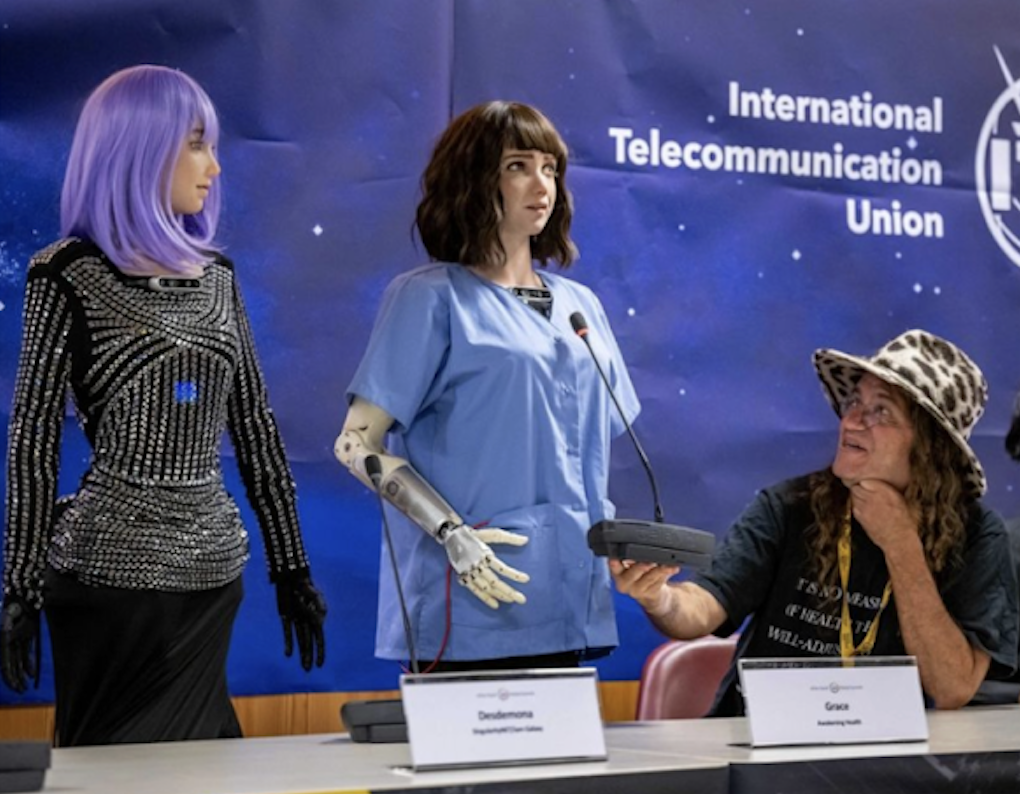
The gap between robots in controlled factory settings and robots in messy human environments has been vast. 2026 will narrow it substantially. Expect humanoid robots that can move through homes, offices, and public spaces without confusion – understanding spatial context, recognising objects and their purposes, and executing simple practical tasks on request. We’re not talking about robot butlers, but robots that can reliably fetch items, open doors, and assist with basic physical tasks. The transition from amazing robot demo videos to Rosie the Robot in every home will not be completed this year, but we should see some substantial steps forward.
8. Breaking the Languages Barrier
Billions of people speak languages and dialects that have no written form or significant online presence. Effectively locked out of the global internet. AI-powered voice-to-voice translation has long promised to change this, but results have been poor for non-dominant languages. This year, we’ll see real progress on translation systems that work for communities the digital revolution has largely bypassed, potentially bringing unprecedented connectivity to the world’s linguistic minorities.
9. The Wild Card: Could AGI Arrive This Year?
Here’s where I must be honest about uncertainty. A genuine breakthrough to human-level artificial general intelligence during 2026 is possible, not probable, in my view, but totally possible. If it happens, everything else on this list becomes a footnote, because an Artificial General Intelligence (AGI) system would rapidly transform every domain it touches.
Continued scaling of current large language models likely won’t deliver this breakthrough. But multiple alternative approaches are being actively pursued: Yann LeCun’s world-modeling architecture, my own team’s Hyperon project integrating neural networks with logical reasoning and evolutionary learning … and many, many others working in less public settings. My best guess places the breakthrough in 2027-28 rather than 2026, but in a field moving this fast, nothing is impossible but certainty.
What This Means for All of Us
These predictions share a common thread: AI moving from impressive demonstrations and tools that are useful around the margins to agents providing critical utility in everyday life, and now and then creative and intellectual breakthroughs at the frontier. The technology is maturing from a novelty into infrastructure.
This transition demands both optimism and responsibility. The potential benefits – in scientific discovery, creative expression, accessibility, and human capability – are extraordinary. But so are the stakes. As these systems grow more powerful, questions of alignment, safety, and equitable access become not abstract concerns but urgent practical challenges.
After decades working toward artificial general intelligence, I am more convinced than ever that getting this right is humanity’s most important project. The year ahead will bring us meaningfully closer to that goal; one practical advance at a time.