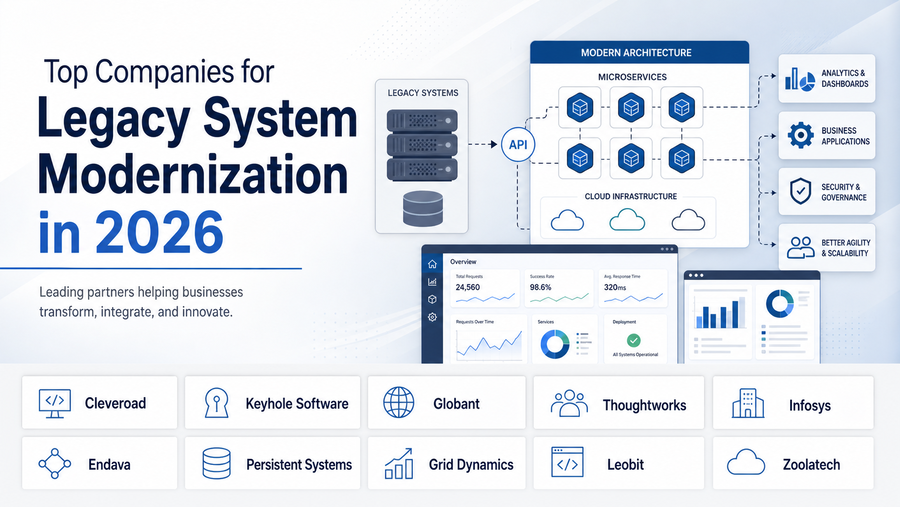
While legacy systems continue to cause problems for organizations, including outdated technologies and mounting Technical Debt, many organizations making the decision to modernize their legacy systems will have to make many changes before they begin migrating. Organizations that choose to modernize their legacy systems will not be migrating systems only; they will be re-architecting their systems into scalable, cloud-native, and API-driven ecosystems, while maintaining the integrity and continuity of their business.
1. Cleveroad
Great for: End-to-end legacy modernization for companies with a focus on business-first type concerns.
Cleveroad has succeeded in providing an efficient path for businesses transitioning from monolithic architectures to microservice-based architectures with very little operational downtime by utilizing their practical approach to modernization. They also leverage their technology capabilities via a combination of Cloud Migration, DevOps Enablement and User Interface/User Experience improvements to provide demonstrable return on investment (ROI) for their customers.
Key strengths are:
- Incremental modernization (Low-Risk Transformation)
- Strong expertise in Healthcare, Financial Services, Logistics, etc.
- Aligning Modernization initiatives with the Customer’s Business KPI’s
- Transparent Delivery Model (Mid-Market flexibility)
2. Keyhole Software
Great for: Senior engineering company using AI to modernize.
Keyhole Software is one of the best providers of modernization. The company has well-trained engineering teams that use state-of-the-art AI tools to help modernize.
Strengths include:
- Expertise in Java, .NET and Legacy systems (COBOL).
- Experience with enterprise migrations.
- A strong focus on the quality of the Senior engineer and architectural design.
3. Cognizant
Ideal for: Upgrading large organisations subject to compliance/regulatory requirements
Gradient has good experience in upgrading large organisations through its work with healthcare, finance and insurance industries.
Noteworthy Points:
- Very strong compliance and governance models
- Accelerators to assist facilities upgrade with AI support
- Extensive industry experience
4. Capgemini
Great for: End-to-end legacy modernization
Capgemini has an esteemed reputation for its automation-oriented modernization approach, emphasizing the acceleration of the migration process while reducing manual labour associated with manual migrations.
Notable Aspects:
- Migration using AI and automation technologies.
- Outstanding Global Delivery Capacity.
- Large-Scale Transformation at the Enterprise level.
5. Infosys
Great for: Large-scale upgrade option.
Infosys will deliver hybrid upgrade strategies (re-host, re-platform, re-architect) based on the needs of your business.
Areas of focus include:
- Development of its own proprietary modernisation toolset
- Cloud partnerships
- Enterprise clients globally.
6. Endava
Target Market: Financial Services and Modernization of Payments
Endava’s focus is on the modernization of systems in the financial services and digital banking sectors.
Highlights:
- Experience in real-time systems
- Use of Agile Transformation Methods
- A strong engineering culture
7. Persistent Systems
Best suited for: Modernization of product-centric applications (MACH Architecture)
Persistent Systems specializes in converting software products into microservices using MACH architecture.
Key strengths:
- Solid background in SaaS and product engineering
- Ability to successfully transform apps into cloud-native apps
- Use of APIs as design principles.
8. Coherent Solutions
Who they serve: SMBs looking for legacy system modernization
The best choice for customizing and modernizing your company is with the use of custom solutions from Coherent Solutions. This is accomplished through close collaboration with clients by providing each with individualized modernization strategies.
Highlights:
- Varied delivery models
- Expertise in engineering
- Supportive of the continued evolution of your systems
9. Leobit
Who they serve: Mid-sized companies looking for an agile approach to modernize.
Leobit helps companies modernise their legacy systems by effectively merging software development with a high level of Modernity experience.
Important features:
- Strong quality assurance and engineering
- Cost-effective modernisation.
- Focus on maintainability for the long run.
10. Zoolatech
Ideal for: Deeply engineering-focused transformation
Zoolatech focuses on solving complex legacy systems at the architecture level, while also improving performance and giving CI/CD support.
What You Will Find At Zoolatech:
- Structured measurable performance upgrades
- Extensive competencies in reengineering (refactoring) the system architecture
- Established DevOps and cloud platform engineering
Key Trends in Legacy Modernization (2026)
The modernization of legacy systems in 2026 has shifted from just a one-time migration to now being continually transformed strategically. Some of the important trends are:
AI will help with the legacy modernization process
AI tools will help expedite the code process by quickly analyzing it, refactoring it and migrating it – speeding up the timeline and lowering risks.
Tremendous growth in market size
The continued acceptance of cloud-based solutions and the readiness to deploy AI technology will create sustained investment in legacy modernization.
Incremental as opposed to “Big Bang” migration
Many organizations will prefer a phased migration to minimize disruption in their operations and maintain their level of service to their customers.
API-first and microservices architectures
As organizations customarily broke up monolith systems (single systems for all functions) into scalable, loosely coupled independent services, this has become the new standard of developing technology systems.
Cloud-native, event-driven design
Technology companies developing new systems will be completely leveraging cloud computing concepts in addition to using newer programming techniques with real-time processing.
Conclusions
To select your last modernization partner in 2026, you need to consider the complexity of your systems, your industry’s unique needs, and your ambitious plans for transforming those systems.
If you’re looking for a balanced, business-driven company for your modernization needs, look no further than Cleveroad.
If you’re planning large-scale modernization initiatives across multiple industries, partner with any of the major consultants (e.g., Infosys, Capgemini, Cognizant) who are experienced in managing large-scale programs.
Conversely, you would want to work with an engineering-centric firm with experience solving deep technical problems using innovative solutions (e.g., Keyhole & Zoolatech).
Author bio
Yuliya Melnik is a technical writer, passionate about innovative technologies that make the world a better place, and loves creating content that evokes vivid emotions.