
Everyone is watching AI agents write code, answer questions, and automate routine work.
The more consequential shift is happening inside enterprise operations. Diagnostic agents are beginning to investigate failures across applications, infrastructure, data pipelines, test environments, and deployment workflows.
This is not another chatbot use case. It is a new reliability layer.
Traditional monitoring tells teams that something has failed. A diagnostic agent can connect fragmented signals, test competing explanations, identify the likely source, and recommend the next action. The opportunity is not to remove engineers from incident response. It is to remove the hours they spend assembling evidence before meaningful diagnosis can begin.
The winners will not be the organisations with the most alerts. They will be the ones that convert operational noise into reliable decisions.
The Burning Platform: Enterprise Complexity Has Exceeded Human Triage
Modern systems rarely fail in isolation. A visible application error may originate in a stale data pipeline, a configuration change, an overloaded dependency, an expired credential, or an automated test that failed to catch an incompatible release.
The Scaling Gap. AI use is now widespread, with 88% of surveyed organisations reporting regular adoption in at least one business function. Yet only about one-third have started scaling AI across the enterprise. Agentic systems remain even earlier: 23% report scaling an agent somewhere, while 39% are still experimenting.
The technology is advancing faster than the operational systems required to manage it.
The Outage Burden. A 2025 global survey of 1,700 technology professionals reported a median annual cost of $76 million from high-impact outages among participating organisations. The median cost reached $2 million for each hour of disruption.
Those figures reveal a deeper problem. Detection alone is not enough. Every minute spent correlating logs, reproducing failures, checking recent deployments, and locating the responsible team extends the business impact.
The Signal Explosion. Distributed environments generate logs, metrics, traces, test results, deployment records, user reports, and security events across dozens of services. More telemetry has not automatically produced faster understanding. In many organisations, it has created a larger search problem.
The bottom line: enterprises do not need another alerting layer. They need a diagnostic layer.
The New Playbook: Build Agents That Investigate, Not Merely Summarise
1. The Incident Detective: Start with Hypotheses
A weak diagnostic assistant summarises the alerts already visible on a dashboard.
A useful agent forms hypotheses.
When a service slows down, the agent should ask whether the cause is increased traffic, a recent release, resource exhaustion, dependency latency, data skew, or a network issue. It should then gather evidence for and against each explanation.
This changes incident response from unstructured searching into controlled investigation. Engineers receive a ranked set of probable causes, supporting evidence, and unresolved questions.
The agent does not replace engineering judgement. It gives that judgement a better starting point.
2. The Context Broker: Connect the Evidence Silos
Most enterprises already possess the evidence required to diagnose failures. The problem is fragmentation.
Application traces sit in one environment. Test failures sit in another. Deployment history, code changes, pipeline status, configuration records, and service ownership may all be stored separately.
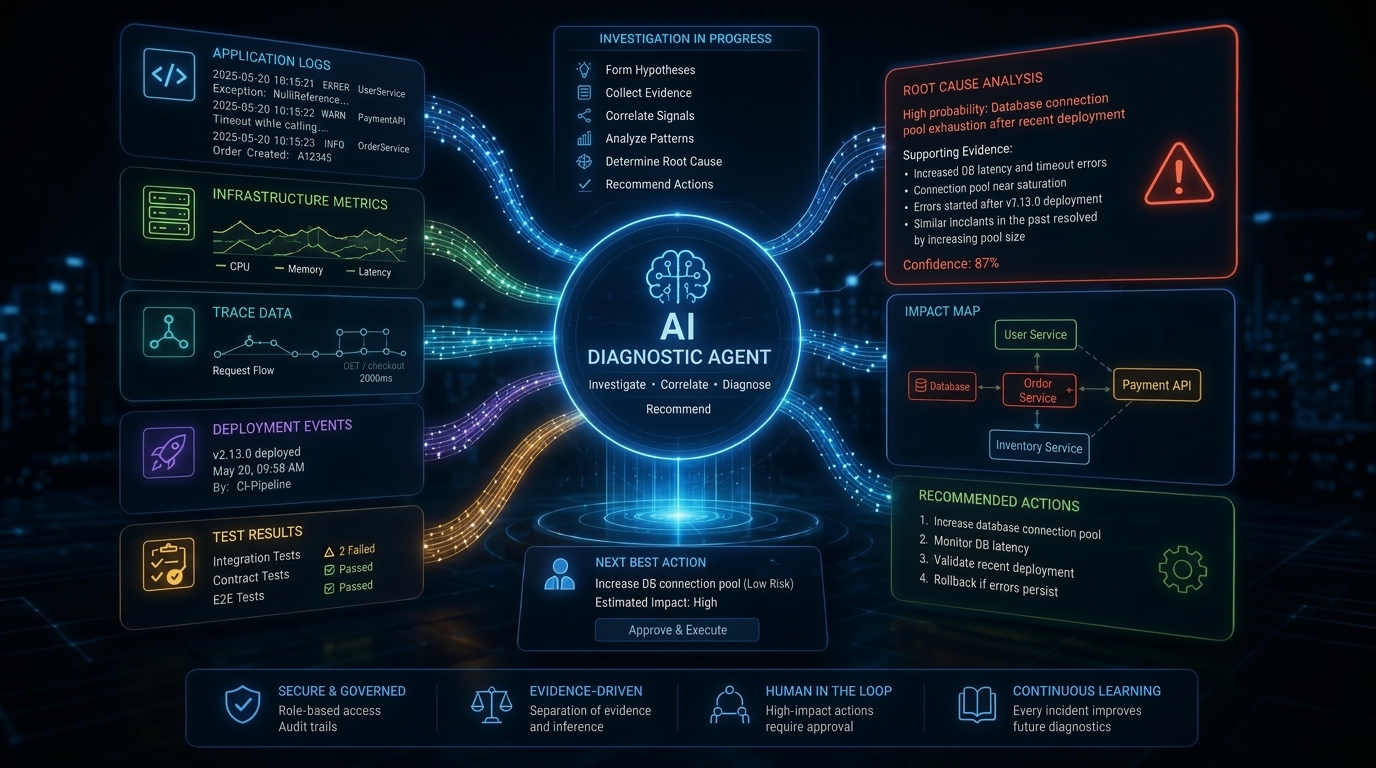
A diagnostic agent must retrieve context across these boundaries while preserving access controls. It should connect a production symptom to the release that preceded it, the test coverage associated with that component, and the downstream services showing related behaviour.
The real advantage of an agent is not conversational fluency. It is its ability to move across evidence faster than a human operator switching between systems.
3. The Failure Cartographer: Map the Entire Dependency Chain
Enterprise failures propagate.
A delayed ingestion process can create stale features. Stale features can affect a machine learning service. That service can return degraded results to an application whose infrastructure remains technically healthy.
A component-level monitor may miss this relationship because no individual system has completely failed.
Diagnostic agents should construct a temporary map of the incident: affected services, upstream dependencies, downstream consequences, recent changes, and time-correlated anomalies. This map helps teams distinguish the visible symptom from the initiating event.
Everyone forgets that the loudest alert is rarely the root cause.
4. The Confidence Engineer: Separate Evidence from Inference
Diagnostic agents will sometimes be wrong. The architecture must make that visible.
Every conclusion should distinguish direct evidence from agent inference. A trace showing increased dependency latency is evidence. A claim that the dependency caused the outage is a hypothesis until further validation.
The agent should expose confidence levels, contradictory signals, and missing information. When the evidence is weak, it should request another diagnostic step rather than manufacture certainty.
This is especially important when agents can execute actions. Restarting a service, changing capacity, rolling back a release, or modifying a data workflow can create additional damage when the diagnosis is incorrect.
Reliable autonomy begins with calibrated uncertainty.
5. The Automation Governor: Escalate Authority Gradually
The first generation of diagnostic agents should observe, retrieve, correlate, and recommend.
Only after their performance is measured should they gain authority to act.
Low-risk actions, such as collecting additional logs or running a read-only health check, can be automated early. Reversible actions may follow once teams establish approval rules. High-impact changes should remain under human control until the agent has demonstrated consistent performance under realistic conditions.
This staged model prevents a common mistake: confusing technical capability with operational permission.
The strongest agent is not the one allowed to do everything. It is the one given exactly the authority its evidence supports.
6. The Learning Operator: Turn Every Incident into Better Diagnostics
Most incident knowledge disappears after resolution.
An engineer identifies an unusual failure, restores service, writes a brief explanation, and moves on. Months later, another team investigates the same pattern from the beginning.
Diagnostic agents can convert resolved incidents into reusable operational memory. They can retain symptoms, evidence paths, confirmed causes, failed hypotheses, remediation steps, and validation results.
This creates a compounding system. Each incident improves the diagnostic process for the next one.
Industry risk guidance already emphasises continuous monitoring, structured measurement, documentation, and incident management throughout the AI lifecycle. Diagnostic agents should be held to the same standard.
Diagnostics in the Wild: Three Patterns That Matter
In distributed application environments, research teams have demonstrated multi-agent approaches that divide incident triage into specialised activities rather than relying on one general-purpose model. The crucial lesson is that diagnosis improves when investigation is structured around distinct roles and evidence sources.
In data-intensive systems, agents can compare pipeline status, schema changes, record volumes, and downstream anomalies before blaming the application layer. The crucial lesson is that operational diagnostics must include data quality, not just infrastructure health.
In automated testing environments, agents can connect a production defect to missing coverage, unstable tests, or environmental differences. The crucial lesson is that diagnostics should improve prevention as well as recovery.
The objective is not simply faster incident closure. It is a system that becomes harder to break in the same way twice.
The 90-Day Diagnostic-Agent Rollout
Days 0–15: Bound the Investigation. Choose one recurring incident class. Map the evidence sources, service dependencies, ownership boundaries, and actions the agent may perform. Define what a correct diagnosis looks like.
Days 16–45: Build Read-Only Intelligence. Let the agent collect telemetry, analyse recent changes, generate hypotheses, and create evidence-backed summaries. Measure diagnostic accuracy, investigation time, false conclusions, and missing context.
Days 46–90: Introduce Controlled Action. Automate low-risk evidence gathering first. Add human-approved remediation for reversible actions. Feed confirmed outcomes back into the evaluation set and operational knowledge base.
Do not automate remediation before proving diagnosis.
The Inevitable Future: Reliability Will Become Agentic
Enterprise systems are becoming too distributed, dynamic, and data-dependent for manual diagnostics to remain the primary operating model.
AI agents will become the connective tissue between observability, testing, deployment, data engineering, and incident management. They will continuously assemble context that humans currently reconstruct under pressure.
This is not the end of the reliability engineer. It is the end of forcing reliability engineers to behave like search engines.
The future of enterprise operations will not belong to the system that generates the most signals. It will belong to the system that knows what those signals mean.