


Before we brought AI into our creative process, my graphic designer produced 30 pieces of ad creative a week. He now produces a minimum of 100. Same person, same role, same brief. That is a 233% increase in output.
He still decides what gets made, what goes live and what gets cut. Not one of those decisions has moved to a machine, and I have no intention of moving them.
That distinction is the whole argument. The version of the AI conversation that dominates business media right now, the one where AI is coming for jobs and making decisions and replacing human judgement, is not just wrong. It is actively dangerous for any founder who takes it seriously and starts building their business around it.
AI belongs in the preparation seat
The biggest mistake I see founders making with AI is using it to make decisions for them. That is not what it is for. AI is there to get you to a decision faster. It is not there to make the decision on your behalf.
I have built and scaled multiple six and seven figure businesses, and AI runs across almost every part of my operations. Content production, paid media, customer service. But it is bounded deliberately in every one of them.
My designer uses ChatGPT, Claude and Higgsfield AI to generate creative assets for paid campaigns. The AI produces faster. He decides better. Volume went up 233% and the quality bar did not move, because the person holding the quality bar did not change.
The same rule applies to customer service. Across Zaros and Undeniable London, AI has brought our average response time down from 4 hours 35 minutes to 1 hour 45 minutes, a reduction of just over 60%. A human is still involved in every single customer interaction. The AI gets the conversation started faster. The human makes the call on how it ends.
We do not rely on AI to do the work. We leverage AI to speed up the work. That difference is everything.
Speed is not intelligence
The trap most founders fall into is mistaking one for the other. Because AI produces an answer in four seconds, they assume the answer is right, and they act on it without running it through their own expertise or their own understanding of their specific market.
AI does not know your customer the way you do. It does not know why your brand exists, what your long term vision is, or what you have already tried and watched fail. It can synthesise information at extraordinary speed. Synthesising information is not the same thing as making a good decision.
The founders winning with AI right now are using it to gather information faster, generate options faster and iterate faster, then applying their own judgement to everything it puts in front of them. The founders losing are the ones who have quietly outsourced their thinking to a tool that does not understand their business.
What happens when a human directs the volume
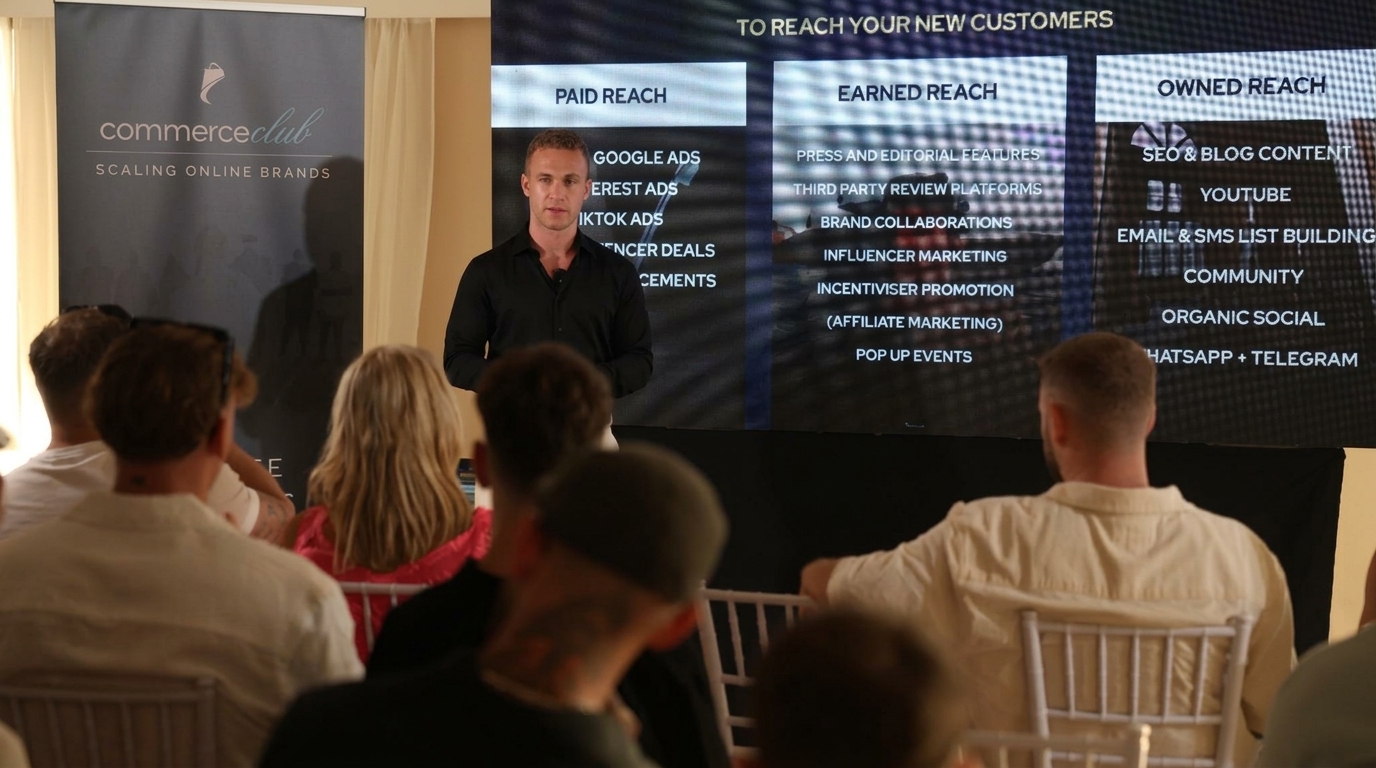
One of my Commerce Club mentees went from zero to $301,000 in a single month running over 150 AI assisted ad creatives. That volume would have been physically impossible for one person to produce without AI tools.
But the strategy was human. The creative direction was human. Every decision about what to scale and what to kill was human. AI made execution possible at that speed. The operator made it work.
That is the pattern I see repeatedly. AI amplifies human capability. It does not substitute for it. If the judgement behind the volume is poor, all AI does is help you make the wrong decision faster and at greater scale.
What disciplined adoption looks like
For founders wanting to integrate AI properly, my framework is simple.
Use AI to access information faster, not to interpret that information for you.
Use AI to speed up execution, not to decide what gets executed.
Use AI to generate options, not to choose between them.
Keep the human in the decision seat, always, because that is where accountability, expertise and real business understanding live.
AI is changing how businesses operate. It is also changing how people operate inside those businesses, and the founders who understand this best are the ones who recognise that the human role does not shrink. It gets more important. You now need the judgement to know what to do with everything AI hands you.
The competitive advantage is real and it is significant. It belongs to the founders disciplined enough to treat AI as a tool rather than a replacement for their own thinking.
The decision always belongs to the human.







