For most of the history of computing, we’ve had to learn how technology wants us to communicate with it. We learnt commands, menus, icons, search boxes and increasingly complex software interfaces. Even as those interfaces became more intuitive, the underlying relationship remained much the same: if you wanted the computer to do something, you needed to understand how to ask it in a way the computer understood.
Conversational AI is beginning to turn that relationship around. Instead of knowing where information lives, which menu to open or what search terms to use, we can increasingly just ask for what we want in much the same way we might ask another person.
That already feels like a significant change, but I suspect we’re still looking at the very beginning of it. The interesting question for enterprise technology isn’t simply how good AI will become at conversation, but what happens when that conversation becomes connected to everything else an organisation knows and does.
Conversation Is Only the Beginning
Chatbots have existed for years, and generative AI has made them dramatically more capable. Today’s systems can understand natural language, maintain context and generate responses that would have seemed remarkable not very long ago. Yet conversation on its own still has some fairly obvious limitations.
If I ask an AI to explain why sales fell last quarter, I probably don’t want three paragraphs describing the figures. I want to see them too. If I’m asking about a new product, show it to me. If we’re discussing a technical process, a diagram might explain something in seconds that would otherwise take several minutes of conversation.
And if I’m standing in an airport asking about a delayed flight, I certainly don’t want an eloquent explanation of how flight delays generally work. I want to know what’s happening to my flight now.
This is where I think the current development of conversational AI becomes particularly interesting, because several technologies that have largely been discussed separately are beginning to come together. Natural language, multimodal AI, retrieval systems, real-time data and increasingly agentic systems create the possibility of a conversation becoming much more than an exchange of words.
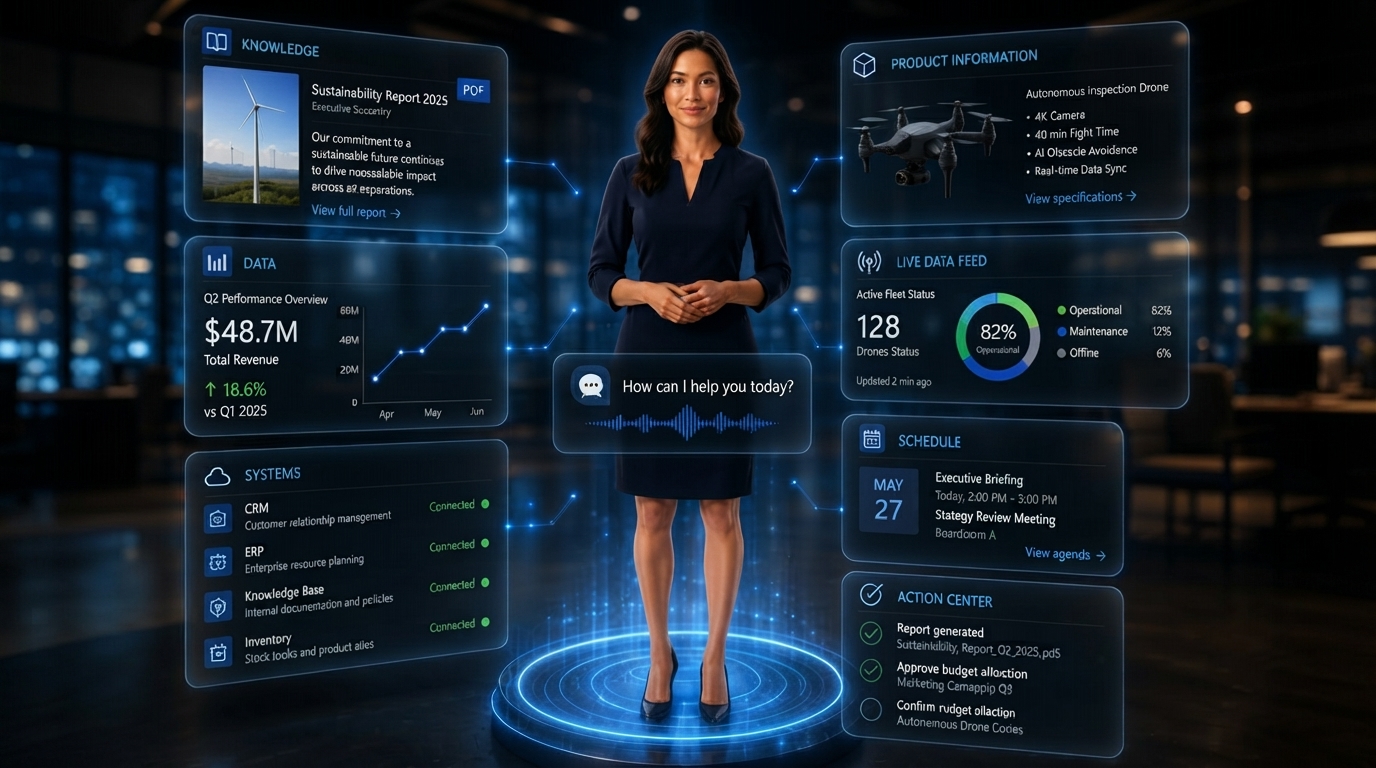
Add a visual human representation and information can potentially be spoken, shown and explained within the same interaction. At that point, describing the experience as a chatbot starts to feel increasingly inadequate.
Sometimes Showing Is Better Than Telling
I’ve spent much of my career working in visual communication, so I’m probably more conscious than most of the importance of showing rather than simply telling. Humans don’t communicate exclusively through words, and we’ve never really expected them to.
Put two engineers in a room discussing a component and, sooner or later, someone will probably pick it up or point towards a drawing. A financial director explaining quarterly performance is likely to bring up a chart. Give someone directions and watch how quickly their hands become involved.
Good communication moves naturally between conversation and supporting information, often without us consciously noticing.
That creates an interesting opportunity for AI Digital Humans. Imagine asking an AI representative about an organisation’s sustainability performance. It answers naturally, but as the conversation develops the relevant chart appears alongside it. Ask about a particular year and the information changes. Ask what caused an improvement and it retrieves the supporting data.
You haven’t stopped the conversation to navigate through a website or open another application. The information has appeared because, at that particular point in the conversation, it became useful.
I think that’s a more significant change than it initially sounds. Rather than the user navigating an interface to find information, the interface begins assembling itself around what the user is trying to understand.
And Then There Is Action
Things become more interesting again when the conversational layer is connected securely to live enterprise systems.
Imagine a customer asking whether a product is available. The AI can explain the options, show the relevant products and check current stock. If the customer decides to proceed, it could potentially arrange delivery or begin the purchasing process.
At an event, a delegate might ask what’s happening next, discover a session relevant to their interests and add it to their schedule without ever having to search an event app. An employee might ask about their remaining annual leave, receive the current figure and then begin the appropriate workflow.
None of those examples is revolutionary in isolation. Organisations already have software that can perform those tasks. What’s interesting is that the person no longer necessarily needs to know which piece of software performs them.
Today, we often have to understand something about an organisation’s technology before we can use it. We need to find the correct website, application, menu, portal or form and then follow the process somebody else designed.
A conversational interface potentially changes that relationship. The user explains what they’re trying to achieve and the technology works out which systems and information are required to make it happen.
This is where the current development of agentic AI becomes particularly relevant. As AI moves from generating information towards taking authorised actions, the distinction between “talking to AI” and “using software” starts becoming much less obvious.
Combine that capability with natural conversation and a visual human interface, and the Digital Human starts looking less like an avatar attached to a chatbot and more like an interface to the organisation behind it.
Then You Put a Person in Front of It
There is another side to all of this which I think is sometimes overlooked when we’re discussing architecture, models and enterprise systems: somebody still has to want to use the thing.
Through my own work developing conversational Digital Humans, I’ve had the opportunity to watch hundreds of people interacting with AI across enterprise events and public environments. It has probably taught me as much about people as it has about artificial intelligence.
People absolutely test these systems. Some want to understand how everything works before they’ll engage properly. Others seem almost determined to expose a weakness, asking increasingly obscure questions until they’re satisfied they’ve worked out what they’re dealing with. Then there are people who couldn’t care less about the technology and simply start talking.
What’s particularly interesting is the moment when those different behaviours begin to converge.
Once someone decides the system is capable enough, their attention tends to move away from the technology and towards whatever they actually came to discover. Questions become less about “What can you do?” and more about “Can you help me with this?”
I’ve started thinking of that moment as a kind of trust threshold. It’s certainly not a scientific measurement and different people reach it at very different speeds, but after watching enough interactions you begin to recognise it. Body language changes, questions become less performative and the conversation starts to flow.
A recent deployment at NiCE World, where delegates could interact with an AI Digital Human of Chief AI Officer Philipp Heltewig, was particularly interesting because many of those using it already understood conversational AI extremely well. Yet the basic behaviour wasn’t dramatically different. Once the technology had established sufficient confidence, people stopped evaluating the interface and concentrated on the subject they wanted to discuss.
Perhaps that’s something enterprise technology has always been trying to achieve. The best interface may ultimately be the one we stop noticing.
A Human Face Changes the Responsibility
There is an obvious complication here, and I think it’s an important one.
Making AI appear more human doesn’t remove any of the existing problems associated with artificial intelligence. If anything, it can make some of them more significant.
Consider a confidently delivered wrong answer. We might react one way when it appears as text beneath a search box, but potentially very differently when exactly the same information is spoken naturally by a realistic Digital Human representing an organisation.
The more convincing the interface becomes, the more seriously we need to think about what sits behind it.
What is the AI permitted to discuss? What information can it access? Which actions can it perform? How is personal information handled? What happens when it doesn’t know the answer, and when should the conversation be handed to an actual person?
There are questions around identity too. If a Digital Human represents a real employee or executive, consent, likeness, voice and approved knowledge become fundamental considerations. Users should also understand that they’re interacting with AI. Realism should improve communication, not become a means of deception.
Agentic capability raises the stakes again. An AI that can tell me my account balance is useful; one that can make changes to my account needs to be extremely certain that I am who I say I am, that I have permission to make the request and that the action itself falls within clearly defined boundaries.
Perhaps there’s a useful principle here: the more human and capable the interface becomes, the higher the standard of governance should be.
So, Is the Digital Human the Next Enterprise Interface?
I’m not convinced that’s actually the right question.
Not every interaction needs a face. Sometimes a search box is quicker. For some tasks a dashboard is far better, sometimes we’d rather type than speak, and there will always be situations where the right answer is simply to talk to another human being.
I don’t imagine a future in which every piece of enterprise software suddenly becomes a Digital Human.
What I do find interesting is the possibility that conversation becomes an increasingly important way of accessing everything underneath it. The CRM doesn’t disappear, and neither does the booking engine, knowledge base, analytics platform or enterprise database. What may gradually disappear is the user’s need to understand where each of those things lives and how each one works.
For decades, we’ve learnt how to use software. We’re now developing software that is increasingly capable of understanding how we naturally communicate, retrieving the information we need, presenting it in the most appropriate form and, with the right permissions, helping us act upon it.
AI Digital Humans are one expression of that shift. Whether they become commonplace across enterprise technology remains to be seen, and there are significant questions around trust, governance, security, cost and whether a human representation genuinely improves any particular interaction.
That’s healthy. Not every technological possibility needs to become a product.
But I do think the underlying change is important. The next generation of enterprise AI won’t simply be judged by how naturally it can talk to us.
Increasingly, we’ll judge it by whether the conversation actually helps us get something done.