
CEO, Constantin Haag weighs in on why skilled workers remain difficult to replace. AI-enabled equipment shows how manufacturers can expand complex production capability while keeping human judgment in the process.
Manufacturers are confronting a workforce constraint just as AI is moving deeper into factory operations.
The U.S. Bureau of Labor Statistics projects about 867,700 openings in production occupations each year through 2035, largely because workers will permanently leave those occupations. At the same time, NIST reports that 46% of manufacturers already use AI tools in manufacturing operations and more than 80% expect to increase their use over the next two years.
Together, those trends raise a specific operating question: Can AI make scarce production knowledge available to more people while preserving the human judgment required for quality, safety and process variation?
Constantin Haag encountered that question directly at Hammer Haag Steel, where an older plate-rolling process depended heavily on operators with decades of experience. If the right operator was unavailable, certain work could wait.
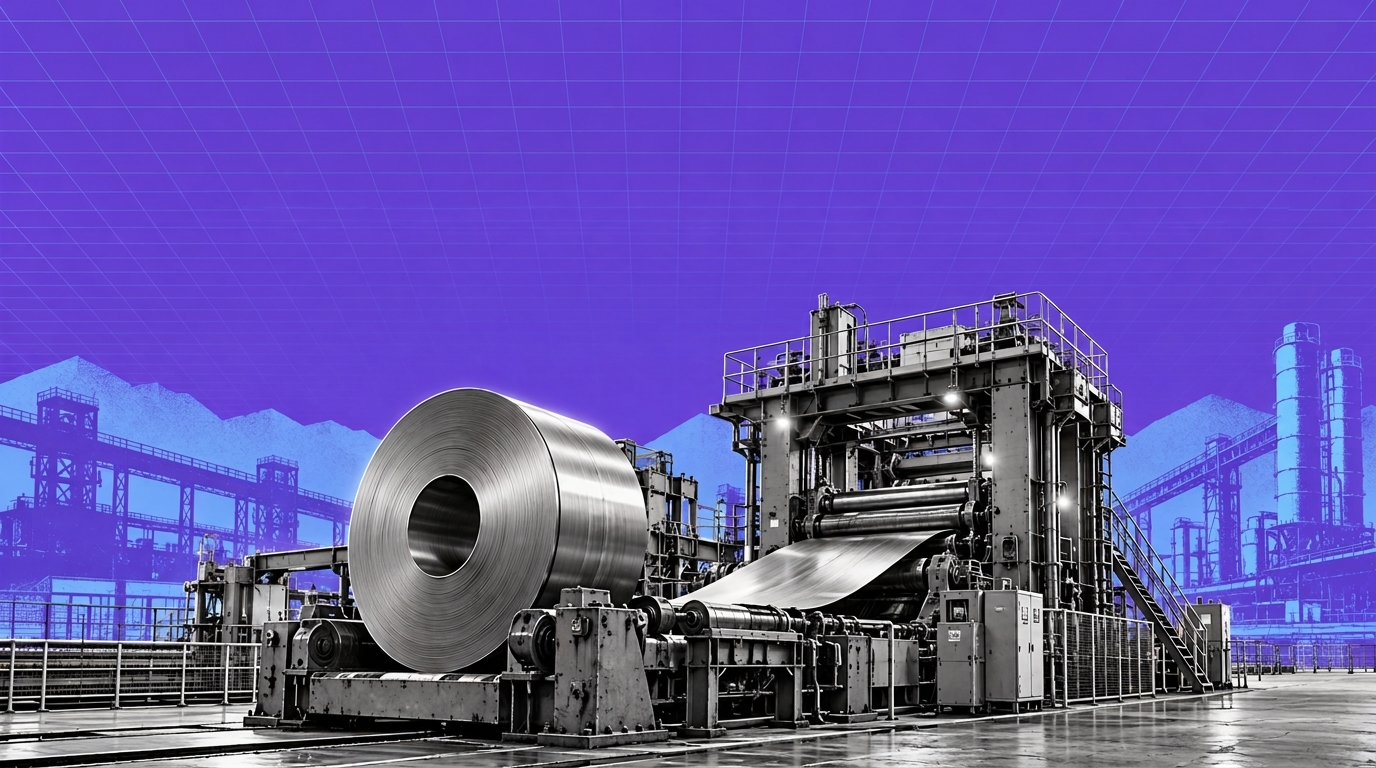
Hammer Haag Steel eventually invested in Davi CNC-controlled rolling equipment with self-adjusting AI. The controls use historical data from similar parts to generate programs that operators can review and edit. After training, less-experienced operators could produce relatively complex shapes while the shop reduced measurements, rerolls and a separate bending step.
AI created leverage by moving part of the process knowledge into the equipment while leaving operators responsible for review, adjustment and material variation. At Hammer Haag Steel, the result was wider access to complex work with skilled judgment still embedded in the process.
That lesson has become more consequential as Hammer Haag Steel has grown. While the company specializes in heavy plate fabrication, large-scale CNC machining, and complex mechanical assembly supported by skilled millwrights, its capabilities extend across a broad spectrum of manufacturing, including light- and medium-duty steel fabrication, precision machining, and high-volume production. This versatility allows Hammer Haag Steel to execute everything from highly engineered, one-of-a-kind assemblies to repeatable production programs, adapting to the unique geometries, tolerances, production requirements, and workflows of each customer and project.
Constantin Haag’s experience suggests a broader rule for high-skill businesses: AI creates leverage when it makes scarce expertise more accessible while experienced people remain responsible for quality, safety and exceptions.
When expertise becomes a capacity constraint
Constantin Haag founded Hammer Haag Steel in 2011 with six people and about 15,000 square feet. The Clearwater, Florida, company gradually expanded into increasingly large and complicated fabrication and CNC machining work, building components and assemblies for industrial customers across multiple industries. Its manufacturing capabilities today extend through fabrication, machining, inspection, assembly and other stages of production.
Custom work complicates conventional approaches to scale. A factory producing the same product thousands of times can refine a repeatable sequence around that product. Hammer Haag can move from one large industrial assembly to a completely different geometry, tolerance and production plan on the next job. Its large custom fabrications may require different combinations of floor space, equipment, rigging, labor and inspection.
As the company expanded, the six-person model stopped being sufficient. Information that once traveled naturally among a small team had to move across more employees, shifts and production processes.
A September 2026 study from Deloitte and the Manufacturing Institute found that technician shortages and skill gaps can increase downtime and constrain production capacity and growth. The researchers identified AI as a way to put technical knowledge and guidance directly into daily workflows, helping a broader pool of workers develop specialized skills on the job.
AI as a knowledge-transfer tool
Constantin Haag’s experience suggests a more disciplined way to evaluate AI: Start with the human or operational constraint, then determine whether AI can extend capability around it.
The company has invested in CNC equipment, production tracking and systems that give employees greater visibility into projects moving through the operation. Hammer Haag Steel’s machines and processes still rely on experienced welders, fitters, machine operators, machinists, project managers, detailers, millwrights, and certified inspectors. Constantin Haag’s objective has been to give that experience greater reach across the organization.
The same shift is beginning to reach other high-variation fabrication processes. The American Welding Society reported in September that AI-enabled systems can use vision, sensing and adaptive path correction to handle variation in high-mix parts and large fabrications, where inconsistent fit-up and changing joint locations have historically made automation difficult.
That distinction is central to industrial AI. Its output can become physical motion, which makes reliability, safety, process control and product quality part of the application itself.
Hammer Haag Steel uses different tools for different constraints. AI-enabled rolling controls widen access to complex forming work. Production-tracking systems improve visibility as projects move through the shop. Cross-training distributes capability across the workforce, while bringing selected production stages in-house reduces handoffs. The common discipline is diagnostic: identify the bottleneck first, then choose AI, software, training or integration according to what is constraining throughput.
The next test: 2.5 times the throughput
Constantin Haag is now preparing to test that operating model at a much larger scale.
Hammer Haag Steel is pursuing a self-funded $37.5 million Site 2 expansion with five approximately 500-by-80-foot bays, additional heavy-lifting capability and plans to add roughly 100 employees initially. Constantin Haag expects the investment to increase throughput by more than 2.5 times.
The visible investment is physical. Site 2 will also test whether Hammer Haag Steel’s organizational capability can keep pace with its new capacity. More throughput means more decisions, handoffs and information flows, and the expansion can only perform as planned if the company’s people, systems and expertise can absorb that added complexity.
Leaders considering AI can apply the same test inside their own organizations:
- Where is throughput constrained by expertise held by only a few people?
- Which parts of that expertise can AI surface or apply at the point of work?
- Which decisions should stay with experienced people because quality, safety or variation require judgment?
Site 2 will test whether Hammer Haag Steel can increase physical throughput without recreating the same knowledge dependencies at a larger scale. For specialized businesses, scale becomes more durable when expertise can travel as quickly as capacity grows.