
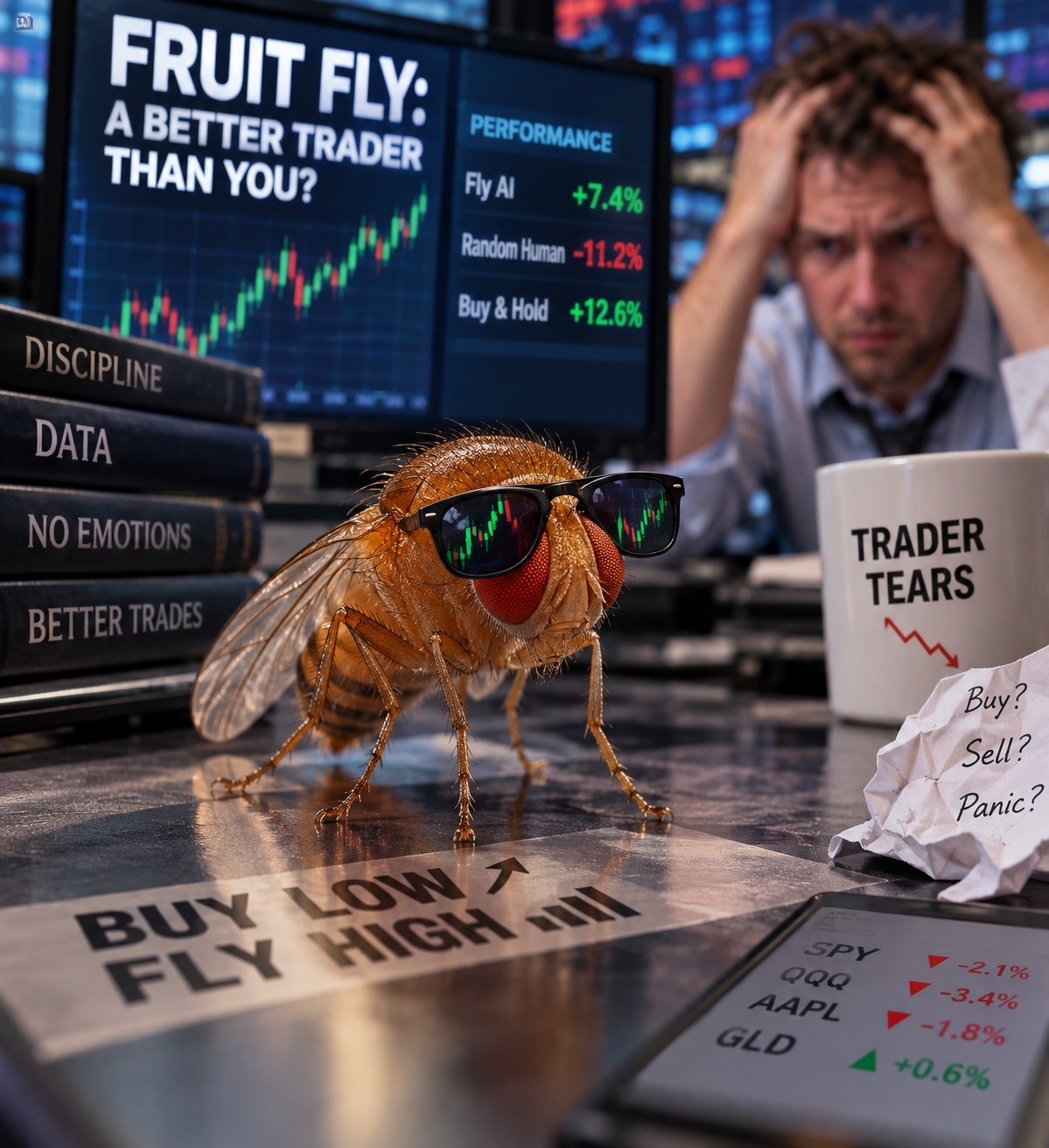
Historical studies show most day traders struggle after costs. A system inspired by fruit-fly neural wiring brought discipline and repeatability – yet still trailed a passive benchmark in three of four assets.
Day trading has a simple problem: the average odds are bad even before psychology gets involved. In one U.S. study, 64.2% of day traders lost money after commissions.[1] In Taiwan, fewer than 1% of the broader day-trading population consistently earned positive abnormal returns after fees, while a Brazilian study found 97% of traders who persisted for more than 300 days lost money net of fees.[2][3] Against that record, a rule-based system inspired partly by the neural wiring of a fruit fly looks surprisingly competent – but on the paper’s common risk-adjusted objective, simple buy-and-hold still beat it in three of four assets.[4]
| 64.2% of one U.S. day-trader sample lost money after commissions | <1% of the broader Taiwan day-trader population showed persistent positive abnormal returns after fees | 3 of 4 assets saw the fly-derived system trail buy-and-hold on the paper’s assigned risk-adjusted objective |
Why the Human Baseline Is So Weak
The U.S. numbers show how quickly trading costs can erase what looks like skill. In a 324-trader sample, only 35.8% finished with positive net profits and 64.2% lost money after commissions.[1] The average trader generated more than $8,000 in gross profit, yet the average net result was about a $750 loss once commissions were counted.[1] A trader can therefore be right often enough to feel successful while still giving the edge back through constant buying and selling.
The international evidence makes the same point from different angles. In Taiwan, researchers found that some traders did display skill, but fewer than 1% of the broader day-trading population reliably earned positive abnormal returns after fees.[2] In Brazil, among 1,551 people who kept day trading equity futures for more than 300 days, 97% lost money net of fees; only 1.1% earned more than the minimum wage and 0.5% earned more than the starting salary of a bank teller.[3] These studies do not prove that every day trader loses, but they do make one thing hard to ignore: randomly selecting a human trader gives you a weak starting benchmark.
What the Fruit-Fly System Actually Did
The machine was not literally taking trading advice from an insect. The strategy used a recurrent architecture derived partly from the male Drosophila connectome – a map of neural connections in a fruit fly – along with engineered momentum, volatility and memory signals.[4] The practical advantage was not biological magic; it was consistency. The system could follow the same rules after a loss, after a win, during a quiet session, and during a volatile one without boredom, fear, revenge trading or a sudden belief that a stock “just feels cheap.”
That discipline produced an interesting result, but not a market-beating one. On the paper’s assigned risk-adjusted objective, the fly-derived system scored about 13.3% below buy-and-hold for SPY, 46.3% below for GLD and 48.3% below for QQQ; Apple was the only asset where it finished ahead, by roughly 1.6%.[4] Across the four assets, the strategy averaged about 48.8% market exposure, 12.56 times turnover and a 7.55% absolute maximum-drawdown statistic.[4] Those figures describe an active, controlled and repeatable system, but they do not establish a durable edge over simply owning the assets.
Why This Matters
The comparison needs one important warning label: no synchronized human-versus-fly trading contest has taken place. The human statistics come from separate U.S., Taiwanese and Brazilian studies, while the machine statistics come from the underlying fly-derived trading manuscript; the markets, time periods, instruments and populations are not the same.[1][2][3][4] That means the evidence can compare historical baselines, but it cannot prove that this machine would beat a randomly selected person in a live contest. The distinction matters because a funny headline can easily outrun the actual experiment.
Still, the comparison exposes a serious investing problem. Humans can destroy a small edge through commissions, slippage, inconsistent risk-taking, overconfidence and emotional decisions, while an automated system can at least execute the same rules every time. But automation does not transform a weak strategy into a strong one; it only makes the weak strategy more consistent. That is why buy-and-hold is the uncomfortable third competitor here: it requires almost no tactical cleverness, yet it beat the fly-derived approach on the paper’s scoring measure in three of four assets.[4]
What Should Happen Now
This is a solvable research problem. The next useful step is not another retrospective comparison, but a prospective matched test in which the human and machine are selected before trading begins and judged under the same rules. The purpose should be to separate genuine trading skill from selection bias, favorable assumptions and after-the-fact storytelling.
1. Select the human and lock the machine before the first trade. Choose the trader prospectively rather than selecting someone because a past record happens to look exceptional, and freeze the machine’s rules and parameters at the same time. Neither side should be allowed to rewrite its process after a bad month or quietly discard decisions that no longer look smart. That makes the result much harder to explain away later.
2. Give both sides the same market and the same constraints. Use the same SPY, QQQ, GLD and Apple universe, starting capital, leverage limits, trading hours, price data, short-selling rules and transaction-cost assumptions.[4] If one side gets cheaper execution, more leverage or a different opportunity set, the contest stops measuring strategy quality and starts measuring structural advantages.
3. Run the test for roughly one trading year and keep buy-and-hold visible. A period of about 252 market sessions would allow the experiment to record costs, slippage, turnover, drawdowns, market exposure and any rule violations or changes from the start.[4] The passive benchmark should remain on the scoreboard because the real question is not only whether the human beats the machine. It is whether either active approach creates enough value to justify the extra trading, complexity and risk compared with doing almost nothing.
The Outcome Wall Street May Enjoy Most
A fair test could end with the human ahead, the fly-derived system ahead, or both behind buy-and-hold. That third outcome would be amusing, but it would also be informative because it would show that neither human intuition nor exotic neural architecture automatically creates an investment edge once costs and risk are counted. The existing evidence does not establish a head-to-head winner, and it should not be presented as though it does. Day traders do not need to fear fruit flies; they need to fear bad base rates, trading friction and strategies whose complexity is more impressive than their evidence.