
Accessibility Is Moving Into the Product
Accessibility often enters a product conversation near the end, when a release is being tested or a compliance requirement needs to be addressed. That approach becomes harder to maintain when AI is part of the product itself.
AI systems can generate text, images, documents, interfaces, and other content. If those outputs are inaccessible, fixing the problem after they have already been produced can create another layer of work.
For product teams, the question is shifting from whether an AI product meets an accessibility requirement before launch to whether accessibility has been considered while the product is being designed and built. That includes the interface, the way users interact with it, and the content it produces.
Why AI Products Create New Accessibility Questions
AI products do not always behave like traditional software. A user may enter a question and receive text, an image, a table, a document, or another form of output. The interface may also change as new features and interaction methods are introduced.
That creates accessibility questions at several points in the experience.
- Can a keyboard user reach and operate the controls?
- Can a screen reader make sense of the conversation and its changing content?
- Is generated content structured in a way that makes it usable with assistive technology?
- What happens when the system produces something that was not anticipated during product design?
These questions become more important as AI moves into products used for work, education, publishing, customer services, and other everyday tasks. Accessibility therefore needs to account for both the product itself and what the product produces.
Accessibility Needs to Be Considered at the Product Design Stage
Accessibility is easier to address when it is considered before the product has settled into its final shape. Once an interface, interaction pattern, or output format is already in production, changing it can affect several connected parts of the product.
Start with how different users will actually move through the experience. Keyboard navigation, focus order, readable controls, clear feedback, screen reader support, and predictable interactions need to be part of the design discussion rather than items left for final testing.
The same thinking applies to what the product produces. If a system creates reports, PDFs, presentations, or other content, those outputs need their own accessibility requirements. A product can have an accessible interface and still produce inaccessible material.
What This Means for AI-Generated Documents
Document generation adds another layer to the accessibility question. The issue is not only whether someone can use the product that creates the document. It is whether the document that comes out of it is usable.
A publisher, university, or organisation might generate hundreds of reports, handbooks, forms, or other PDFs from the same system. If the underlying process produces incorrect tags, inconsistent heading structures, missing alt text, or a poor reading order, those problems can be repeated across every file.
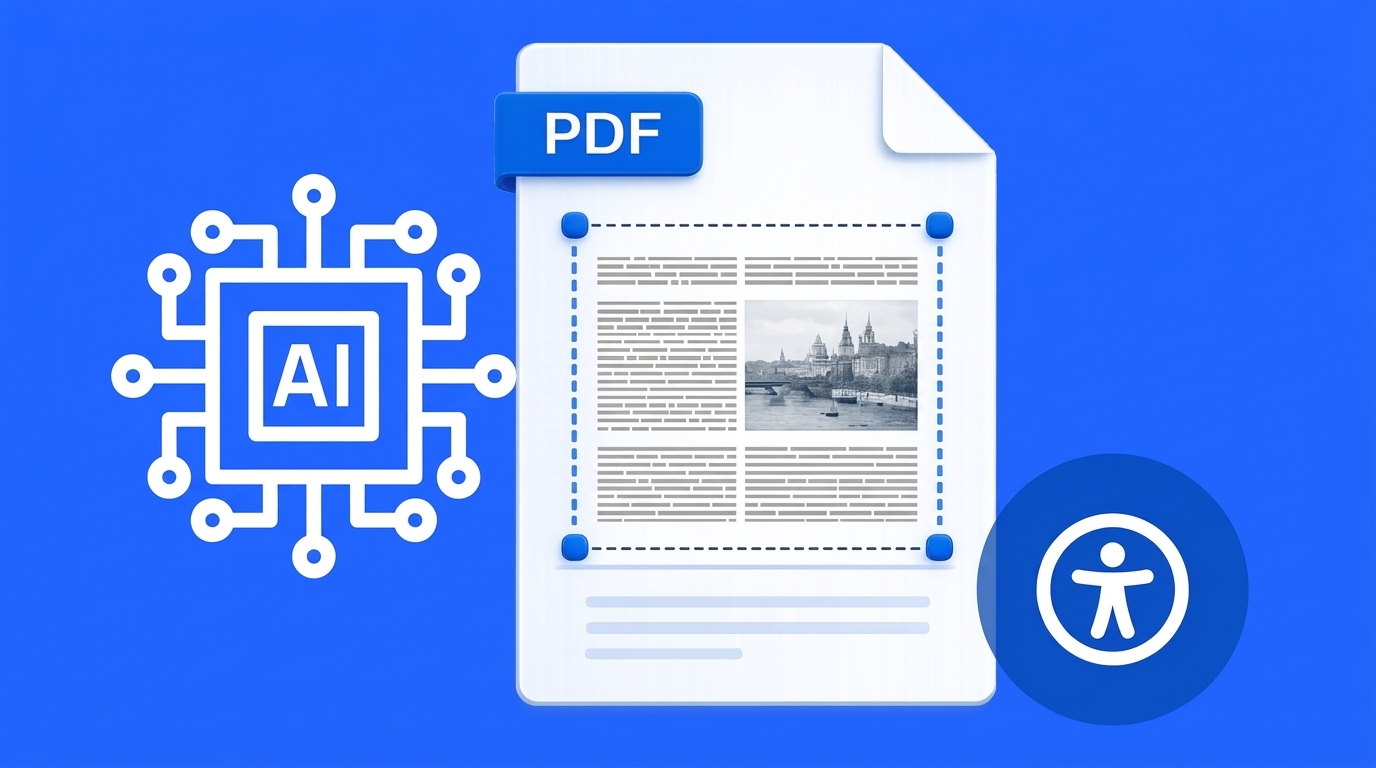
That makes ai pdf accessibility less about fixing individual PDFs after they are created and more about how accessibility is handled during document production. The output still needs to be checked by someone who can recognise problems that an automated process may miss.
AI Can Help With Accessibility, But It Cannot Validate Everything
Automation can take care of some of the repetitive work involved in making a document accessible. It can identify common structural problems, apply tags, generate alternative text, or flag issues across a large batch of files.
That does not mean the document has been properly validated.
Some accessibility problems depend on context. A generated description might technically be present but tell the reader very little. A table may have the right tags but still make little sense when read in sequence. A heading structure may pass a technical check while making the document difficult to navigate.
This is where human review still has a role. Someone needs to look beyond whether a tag exists and ask whether the document actually makes sense to someone using it. For products generating content at scale, that distinction becomes part of the product workflow, not a final quality check.
Accessibility Is Also Becoming a Product Quality Issue
Accessibility is often discussed as a compliance requirement, but for products that generate content, it also affects the quality of the final output. A document that contains the right information but is difficult to navigate or understand is still a poor experience for part of its audience.
This matters when the same product is used to create large volumes of content. An error in a template or generation process does not necessarily stay in one file. It can appear repeatedly across reports, learning materials, publications, forms, and other documents.
That makes document accessibility something product and content teams need to consider alongside other quality checks. Accessibility problems can reveal weaknesses in templates, content structures, generation rules, and review processes. Looking at them during product development can prevent the same issue from appearing across hundreds or thousands of outputs.
What Product Teams Should Build Into the Workflow
Accessibility needs clear ownership during product development. Designers need to consider how people navigate the interface, developers need to account for accessibility when building interactions, and content teams need to consider the structure of generated material.
Testing should happen at more than one point. An interface can be checked during development, while generated documents can be reviewed after creation. Repeated issues should then be traced back to the templates, prompts, rules, or product behaviour that produced them rather than corrected one file at a time.
It also helps to define what “accessible” means for the specific product. The requirements for a document-generation tool will not be identical to those for a conversational interface or publishing platform. Clear requirements give teams something practical to design, test, and review against.
What Publishers and Content Teams Should Watch
For publishers and content teams, accessibility does not end with the system that creates the content. It extends to the templates, editorial rules, file formats, and review processes surrounding that system.
A practical place to start is with content that gets produced repeatedly. If the same book, report, article, or learning material moves through a common production workflow, an issue in that workflow can be repeated across hundreds of files. This is where document accessibility needs to be considered as part of content production rather than treated as a separate clean-up task.
Ownership matters too. Problems can sit unresolved when the product team assumes the content team will fix the output, while the content team has no control over how that output is generated. Defining who checks, fixes, and validates accessibility makes those gaps easier to address.
Accessibility Belongs in the Product, Not at the End
Accessibility is becoming harder to separate from the product itself. When a system creates content, the accessibility of that content becomes part of what the product delivers. For products that generate PDFs, ai pdf accessibility needs to be considered alongside the way those documents are created, structured, and reviewed.
That changes where the conversation needs to happen. Accessibility cannot sit only with the people responsible for final testing or compliance. Product, design, development, and content teams all influence the experience, from the way users interact with the system to the documents it produces.
For publishers and organisations working with large volumes of content, this matters even more. Addressing accessibility during product development can prevent the same problems from being reproduced across every output. Testing and human review still have a place, but they work better as part of the production process rather than as a last-minute fix.