
The software stack has become one of the most important pieces of infrastructure for a modern small business. A founder may need design software, analytics, search optimization, document tools, AI assistance, media conversion, and dozens of small utilities before the first customer even arrives. Individually, many of these services appear affordable. Collectively, they can become a meaningful operating expense.
That is why the freemium model is evolving beyond the familiar idea of a limited free trial. A growing class of digital-tool ecosystems gives users a broad layer of useful functionality at no cost, while reserving more advanced capabilities for paid plans. For startups and small businesses, this model can reduce the cost of experimentation and make sophisticated technology available earlier in the company-building process.
The shift matters most in artificial intelligence and search engine optimization. Both fields are developing quickly, and both can demand specialist knowledge, multiple subscriptions, and substantial time. Integrated freemium ecosystems are beginning to lower those barriers by bringing practical AI, SEO, and everyday productivity tools into a single environment.
For a small team, the first advantage is simple: access. A business does not always know which tools will become essential until real work begins. A founder may need to compress a PDF in the morning, resize an image before lunch, research a keyword in the afternoon, and experiment with AI-generated creative content later that day. Requiring a separate paid subscription for every task creates friction before value has been proven.
A useful free layer changes that relationship. Instead of purchasing software based on a feature list, users can solve genuine problems first and upgrade when their requirements become more advanced. This is particularly valuable for early-stage companies, freelancers, students, creators, and small agencies whose software needs can change from week to week.
AI illustrates the point clearly. Generative tools can now help teams draft ideas, create images, develop marketing assets, summarize information, and turn static creative concepts into richer media. Yet the cost and complexity of using several specialized AI products can discourage experimentation. When AI capabilities sit alongside the everyday utilities a team already uses, experimentation becomes part of the normal workflow rather than a separate technology project.
The same principle applies to SEO. Professional search optimization can involve keyword discovery, competitor analysis, backlink research, technical auditing, content optimization, indexing checks, rank monitoring, and performance measurement. Larger organizations can distribute these tasks across specialists and enterprise platforms. Smaller businesses often cannot.
An integrated ecosystem can make these workflows easier to approach. A user might begin with basic research, discover a technical issue, analyze competing pages, and then improve content without repeatedly exporting data or moving between unrelated interfaces. The value is not simply having more tools. It is reducing the operational distance between identifying a problem and acting on it.
There is also an important learning effect. When sophisticated capabilities are available without a large upfront commitment, people can develop practical skills by using them. A small-business owner who would never purchase an enterprise SEO platform simply to learn keyword research may be willing to experiment with an accessible tool. Over time, that experience can improve the quality of decisions even if the business later adopts more specialized software.
Freemium ecosystems are therefore not only a pricing strategy. At their best, they function as an adoption strategy. Free utilities attract users through immediate, low-risk problems. More advanced AI, automation, analytics, or professional workflows become relevant only when the user’s needs justify them. This creates a more natural progression than forcing every visitor into a subscription decision at the beginning.
The model does have challenges. A platform still has to pay for computing resources, storage, AI inference, data providers, security, and ongoing development. If the free layer is too restricted, users receive little value. If it is too expensive to operate, the economics become unsustainable. Successful ecosystems must therefore distinguish between tools that can be offered efficiently at scale and advanced functions whose operating costs justify a subscription.
Trust is another requirement. Consolidating many functions into one environment can be convenient, but businesses need clarity about data handling, account security, billing, and the limitations of automated outputs. AI-generated material requires human review, and SEO tools should support professional judgment rather than present estimates as certainty. Accessibility should not come at the expense of responsible use.
The strongest long-term opportunity may be interoperability. Small businesses rarely want technology for its own sake; they want fewer steps between an idea and an outcome. Platforms that combine routine utilities, AI creation, marketing intelligence, and professional workflows can reduce context switching and make small teams more productive. The winning experience is likely to feel less like a catalogue of disconnected tools and more like a coherent workspace.
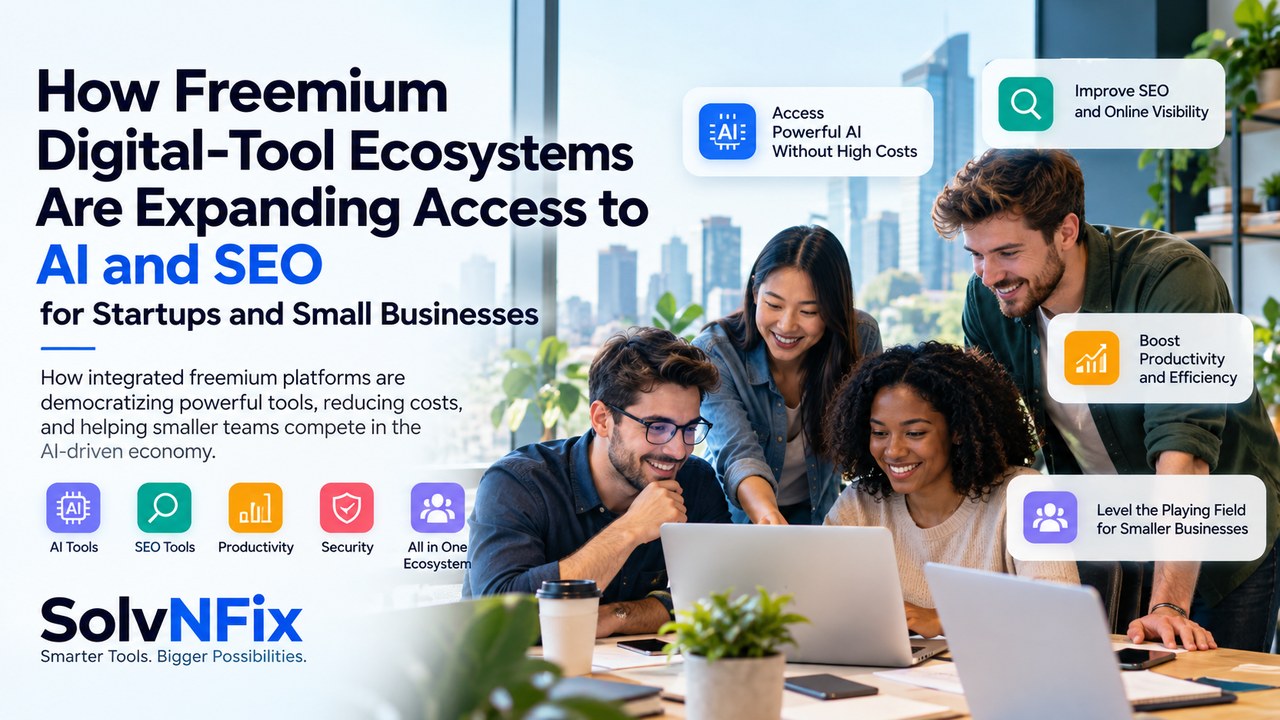
This is already shaping how new digital platforms are designed. SolvNFix, for example, is developing an ecosystem that combines a large collection of everyday web utilities with separate AI and professional SEO capabilities. Its structure reflects the broader trend: common tasks can serve as an accessible entry point, while users with more demanding workflows can move toward specialized functionality. The important industry idea is not any single product, but the shift toward letting users experience practical value before asking them to make a larger software commitment.
For startups and small businesses, that shift can help level part of the technology playing field. It will not remove the need for expertise, strategy, or investment, and it will not make every advanced tool free. What it can do is lower the cost of discovery. A small team can test an idea, learn a workflow, and identify where paid technology genuinely produces a return.
As AI and SEO continue to influence how companies create, market, and compete, access will matter almost as much as capability. The next generation of freemium digital-tool ecosystems has an opportunity to make advanced technology less intimidating, less fragmented, and more practical for the businesses that have historically had the fewest resources to experiment with it.