
Abstract
As enterprises expand their digital ecosystems, workflow complexity grows exponentially. Traditional automation often fails to scale across dynamic, multi-domain environments. Multi-agent AI architectures—composed of autonomous, collaborative agents—represent a transformative shift in enterprise automation. This article presents a vendor-neutral framework, detailing their cognitive layers, coordination mechanisms, and potential to reshape enterprise operations.
1. Introduction
Modern enterprises operate across diverse functional domains, yet users typically express their needs in natural language. Analysts must interpret, route, and document these requests manually. Multi-agent AI systems address these inefficiencies by distributing cognitive tasks across specialized agents capable of independent reasoning and coordinated action.
2. Multi‑Agent AI Architecture for Enterprise Automation
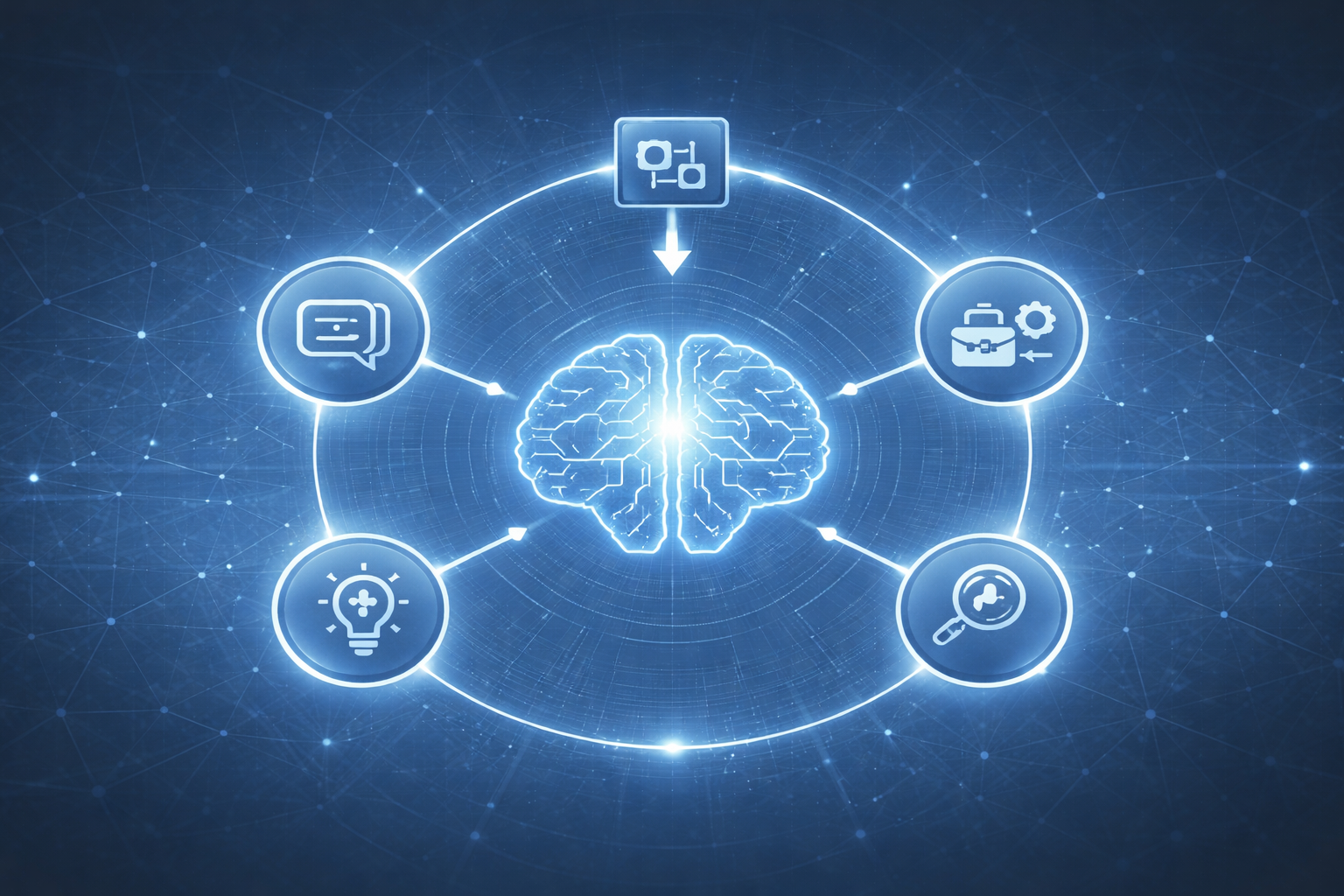
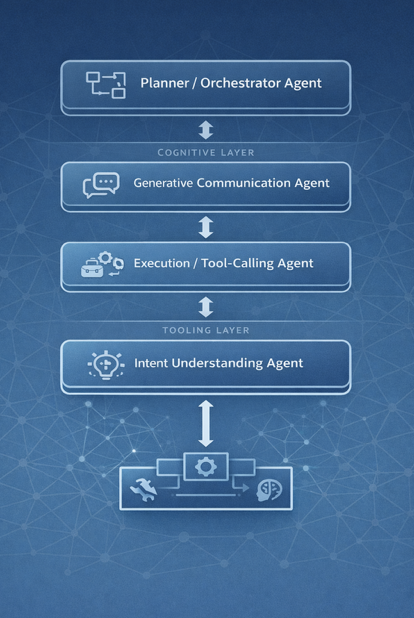
A multi-agent system (MAS) consists of autonomous agents capable of perception, decision-making, task execution, and collaboration. MAS architectures in enterprise automation generally align into four cognitive layers.
2.1 Intent Understanding Agent
This agent transforms natural-language requests into structured intent models. It detects domain, action type, field values, and contextual indicators, enabling downstream automation.
2.2 Workflow Execution Agent
The execution agent maps structured intent to workflow actions. It ensures parameter integrity, error handling, and compliance with business logic.
2.3 Generative Communication Agent
This agent produces summaries, updates, and insights, ensuring communication clarity and auditability.
2.4 Planner / Orchestrator Agent
A higher-order agent that performs reflective reasoning, multi-step planning, and coordination across other agents to achieve enterprise objectives.
Figure 1: Conceptual Multi-Agent Architecture
3. Enterprise Use Cases Enabled by Multi‑Agent AI
Multi-agent architectures support workflows across IT, HR, customer operations, compliance, security, and infrastructure. They enable:
• automated incident creation and analysis
• HR case interpretation and routing
• real-time threat signal interpretation
• policy inquiries and compliance documentation
• predictive operational automation
4. Benefits of Multi‑Agent AI Systems
The advantages of MAS include modularity, interpretability, scalability, resilience, and cross-domain intelligence. Enterprises can expand capabilities using new agents without re-engineering the entire system.
5. Challenges and Considerations
MAS implementations require governance controls, safety checks, robust data privacy mechanisms, and well-defined escalation paths. Coordination overhead and natural‑language ambiguity pose additional challenges.
6. Future Research Directions
Key research areas include collaborative agent reasoning, self-healing automation, reinforcement‑learning agents for workflow optimization, cross-organization agent ecosystems, and symbolic‑neural hybrid architectures.
7. Conclusion
Multi-agent AI systems represent the next evolution in enterprise automation. By distributing cognition across specialized agents, organizations can build scalable, autonomous, and intelligent digital ecosystems.