
Abstract
Automated case routing has become essential for customer service organizations operating at scale. Many teams lack the infrastructure, licensing, or data maturity to deploy full AI‑based classification engines. This article introduces a vendor‑neutral framework for Simulated AI Case Auto‑Routing, demonstrating how organizations can mimic AI‑driven triage and assignment using workflow automation. The approach accelerates issue classification, ensures consistent routing, and prepares teams for future AI adoption.
1. Introduction
Customer service environments receive high volumes of inquiries across multiple channels. Manual triage introduces delays, inconsistency, and operational overhead. Simulated AI routing offers a structured way to classify and assign issues intelligently without requiring predictive intelligence tools or large datasets.
2. Why Simulate AI Routing?
Simulation enables teams to validate triage logic, routing rules, and workload distribution before deploying production‑grade AI systems. It provides consistent decisioning, removes manual bottlenecks, and offers an accessible on‑ramp toward more advanced automation.
3. Framework Overview
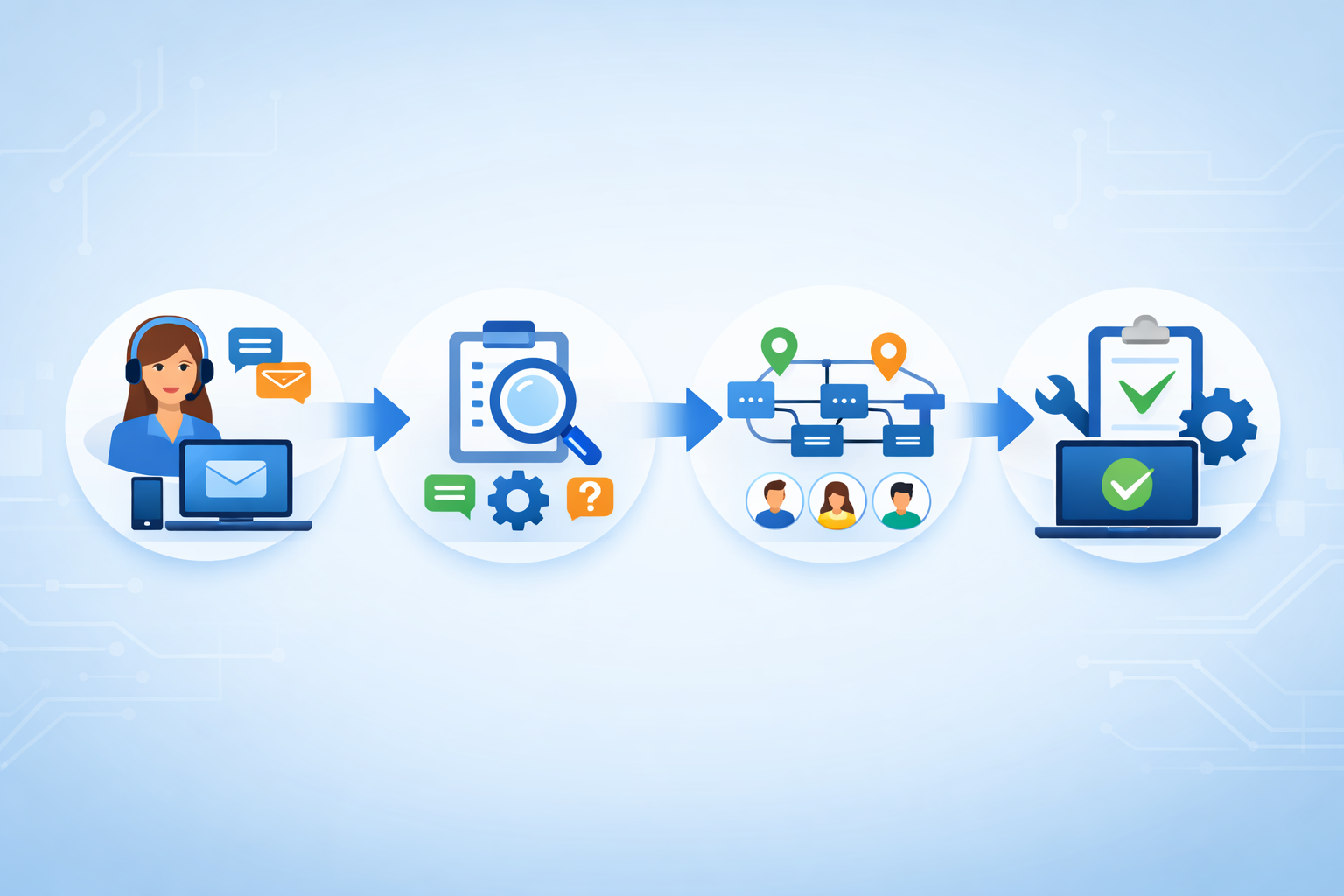
The Simulated AI Case Auto‑Routing framework includes four layers: Signal Intake, Simulated Classification Engine, Routing Decision Logic, and Automated Assignment with Lifecycle Orchestration. Together, they replicate the experience of AI‑assisted triage through deterministic logic.
4. Signal Intake and Case Structuring
Incoming requests—whether from chat, email, web, or integrations—are normalized into structured cases. Structuring includes extracting descriptions, metadata, urgency hints, and context so classification logic can operate consistently.
5. Simulated AI Classification Engine
In the absence of predictive models, deterministic logic approximates AI reasoning. Classification uses keywords, weighted conditions, historical patterns, or sentiment indicators to map cases into categories. This provides reliable, explainable triage behavior.
6. Routing Decision Logic
Once classified, routing rules determine the correct assignment group. Rules may consider skills, load balancing, issue complexity, priority, or escalation needs. This ensures the case reaches the right team quickly and consistently.
7. Assignment and Lifecycle Automation
Automated workflows update statuses, trigger notifications, enforce SLAs, escalate overdue work, and track the case lifecycle. Automation reduces manual effort and improves service predictability.
8. Benefits
• Faster triage and assignment
• Improved accuracy and consistency
• Scalable handling of large inquiry volumes
• Foundation for AI readiness
• Enhanced customer satisfaction through predictable routing
9. Responsible Automation
Simulation must be designed responsibly. Organizations should maintain transparency, review decision logic regularly, avoid biased routing, and allow human intervention for ambiguous or sensitive issues.
10. Conclusion
Simulated AI Case Auto‑Routing provides a practical method for enhancing customer service operations in environments without full AI capabilities. By mirroring AI‑like decision flows through structured automation, organizations improve efficiency, consistency, and operational readiness for future AI adoption.