True operational excellence is rooted in objective reality. Yet, for retail enterprises, a persistent blind spot exists: once inventory—representing millions in working capital—enters a physical store, the enterprise loses its most critical lever: visibility. The sales floor essentially becomes a domain of assumptions rather than facts.
This deficit of truth is the root cause of the industry’s multi-trillion-dollar inventory distortion problem. Without persistent, accurate data, retail operators are forced to navigate by approximation. Financially, this manifests as stockouts that erode revenue, bloated safety stock that traps essential net working capital, and undetected shrink that quietly degrades margins.
Radio Frequency Identification (RFID) has long offered a theoretical solution, providing a mechanism to identify individual items. However, the methodology of its deployment—relying on manual data collection by store associates—is fundamentally compromised. To elevate retail economics, we must shift our perspective: data collection can no longer be a periodic human task; it must become continuous, automated infrastructure.
The Incomplete Picture of Manual Measurement
While manual RFID wanding is an improvement over traditional barcode scanning, it remains a flawed instrument for capturing the high-fidelity data required by modern enterprise systems. Relying on human effort to map a dynamic environment introduces profound operational and financial inefficiencies. Perhaps the greatest flaw in manual scanning is its limitation in capturing spatial context. An associate waving a wand may confirm an item is somewhere in the building, but it fails to pinpoint its exact location. Without this crucial spatial data, inventory is recognized by the balance sheet but remains practically invisible to the operators tasked with retrieving it.
Furthermore, the reliance on manual data collection forces a misallocation of expertise. Store associates are invaluable assets, best deployed providing nuanced customer service and solving complex problems. Diverting their intelligence toward the rote, mechanical task of inventory counting is an inefficient use of human capital.
Because this manual wanding is inherently labor-intensive, it can only occur periodically. When replenishment and forecasting systems are fed this stale intelligence, they inevitably default to conservative logic, ultimately trapping vital working capital in excess safety stock to compensate for the lack of operational certainty.
The Pursuit of Operational Truth Through Robotics
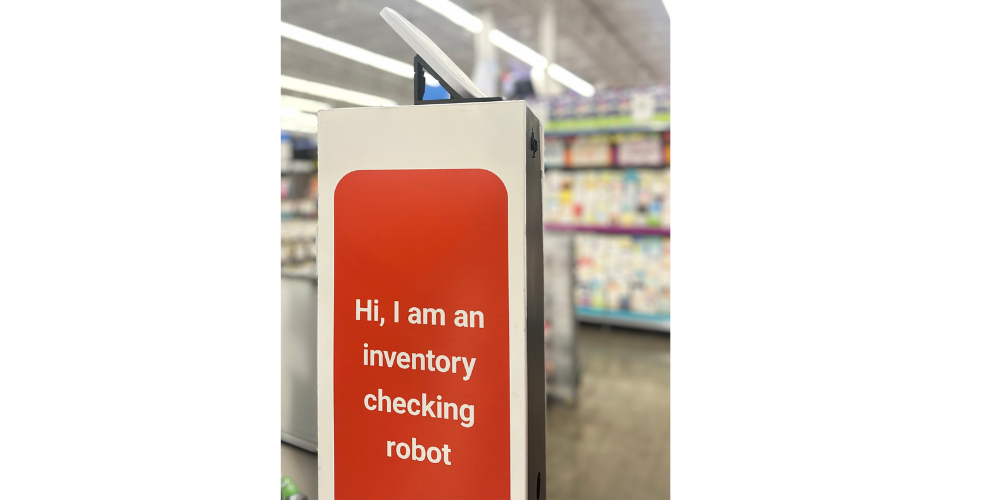
The solution lies in removing human bias and physical constraints from the measurement process. By integrating RFID technology with autonomous mobile robots (AMRs), the retail industry can establish an impartial, mobile sensory network within the physical store.
Mobilizing RFID through autonomous robotics solves the data integrity problem at its foundational level. Because robots navigate using precise digital maps, they do more than just read an RFID tag; they continuously link that tag to an exact, real-time location. They transform a simple inventory count into a dynamic spatial ledger.
The Capital Implications of Localized Clarity
When item-level RFID identification is paired with the persistent, localized mapping of autonomous robotics, the physical store is finally illuminated. For retail CFOs and operating teams, this clarity unlocks immediate, systemic capital efficiencies, most notably by transforming fulfillment economics.
Omnichannel fulfillment is notorious for tight margins, largely driven by the labor costs associated with order picking. By providing item coordinates, robots enable mathematically optimized pick paths, so associates no longer wander aisles searching for misplaced goods; they are directed to precise locations. This drastically reduces the cost-per-pick, expanding margins on every digital order fulfilled directly from the store.
Beyond fulfillment, high-fidelity visibility allows retailers to replace physical safety stock with reliable information. As inventory precision reaches near-perfect levels, organizations can operate with tighter buffers. They can confidently accelerate working capital turnover while simultaneously protecting, or even improving, service levels.
Finally, this continuous observation acts as a powerful mechanism for loss detection. Shrink thrives in the dark, and the longer discrepancies go unmeasured, the more they compound through margin performance. Continuous robotic observation enables the immediate detection of anomalies, halting margin erosion early and significantly reducing downstream drag.
For executive teams and boards across the retail sector, the paradigm is shifting. Inventory can no longer be managed as a static line item; it must be understood as a continuous, spatially accurate signal.
By leveraging autonomous robotics to make the physical store fully observable, we are not simply automating a workflow, we are establishing a foundation of truth upon which resilient retail economics are built.