

Earlier this month, two events brought together investors and technology leaders. At ACG San Diego, conversations focused on digital transformation and the implications of rapidly evolving AI platforms.
A few days later, at the iGlobal Forum Value Creation Summit, private equity leaders were focused on how portfolio companies turn technology into measurable value.
How do you invest in technology when a new model release can wipe out an entire category overnight?
For the last two years, most conversations about AI have centered on possibility. What generative models might enable? What manual work could disappear? What efficiencies companies might gain
In conversation with Fernando Florez, Chief Revenue Officer at Making Sense, the Silicon Valley-based software firm, he presents it like this after ACG San Diego:
“With platforms like OpenAI or Anthropic constantly pushing the frontier, the challenge is not whether to invest, but how to back companies that can evolve with the technology rather than be replaced by it.”
This happens a lot with AI products. A company builds a feature using a large AI model. At first, that feature feels unique. But a few months later, the AI platform itself adds the same feature for everyone.
The data shows how fast adoption has spread. According to McKinsey’s State of AI 2025 report, 88% of organizations now use AI in at least one function. But only about one-third are scaling it across the enterprise. The companies getting the most value are 2.8 times more likely to redesign workflows around AI, instead of layering tools onto existing processes.
At the Value Creation Summit, the conversation moved from strategy to execution.
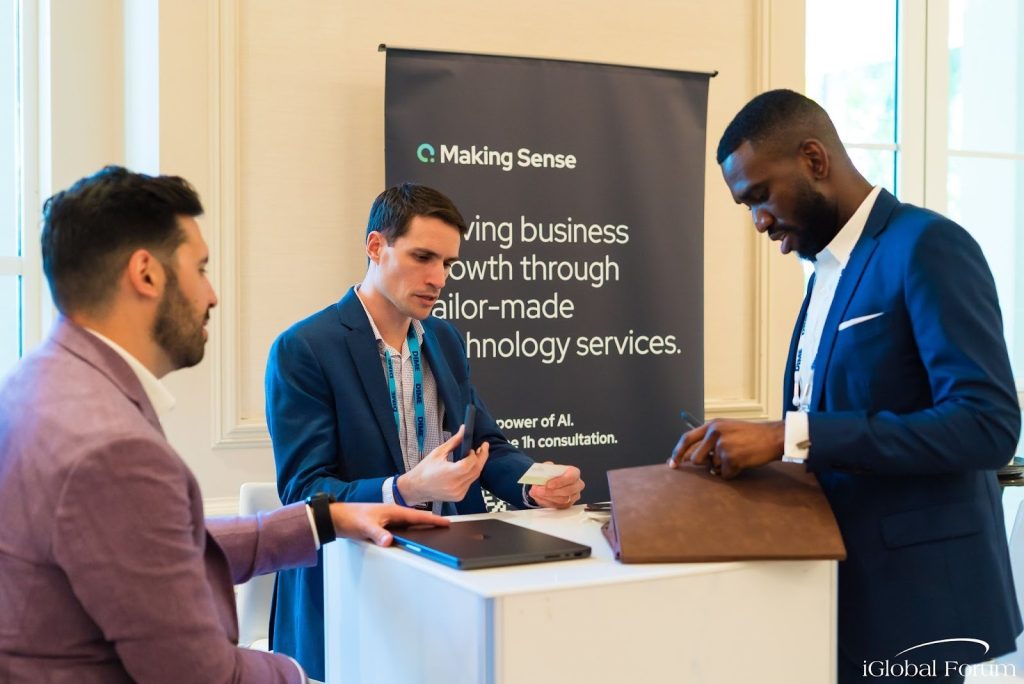
Making Sense sponsored the event, and Mariano Jurich, Senior Product Manager, moderated a roundtable on AI Automation & Workflow Optimization.
Automation is one of the clearest ways organizations attempt to capture value from AI. Companies see opportunities to streamline operations, accelerate internal processes, and reduce repetitive work. But automation initiatives often generate operational activity without necessarily improving the business’s economics.
AI systems differ from traditional automation because they learn from data and adapt over time. They recognize patterns and scale decision-making across workflows.
Yet automation becomes strategically meaningful only when it directly connects to financial outcomes. A recent project illustrates the difference. When Making Sense partnered with Esquire Deposition Solutions, the goal wasn’t simply to deploy AI. The team built a centralized platform that used large language models to extract critical data from complex legal documents. The result was a 40% improvement in operational efficiency and a 10% increase in enterprise valuation. Showing how automation tied directly to workflow redesign can move both operations and valuation.
Jurich, an expert on software building and IA, names the root cause. “Many companies jump into AI because competitors are doing it, not because they have a clear purpose.” The result is pilots that never scale and investments that never show up at exit.
Both conferences kept circling back to the same question: If a foundation model can absorb your product’s core feature overnight, what do you actually own?
Experts at both events point to what tends to survive these cycles. Data quality, process maturity, integrated systems, and teams that know how to apply AI to specific business problems. These are the organization’s structural capabilities.
Technology creates lasting value when it is built around assets that can evolve with the technology itself: proprietary data, workflows shaped around that data, and teams that can integrate new models quickly. When the next model arrives, those organizations are ready to move faster.
A company that simply rents a capability from a model and calls it a strategy won’t survive rapid change.
Every technology decision is tied to the investment thesis and evaluated across the whole portfolio, not project by project. Because without a portfolio-level understanding of where the real constraints lie, technology investments become fragmented, reactive, and inefficient.