
Abstract
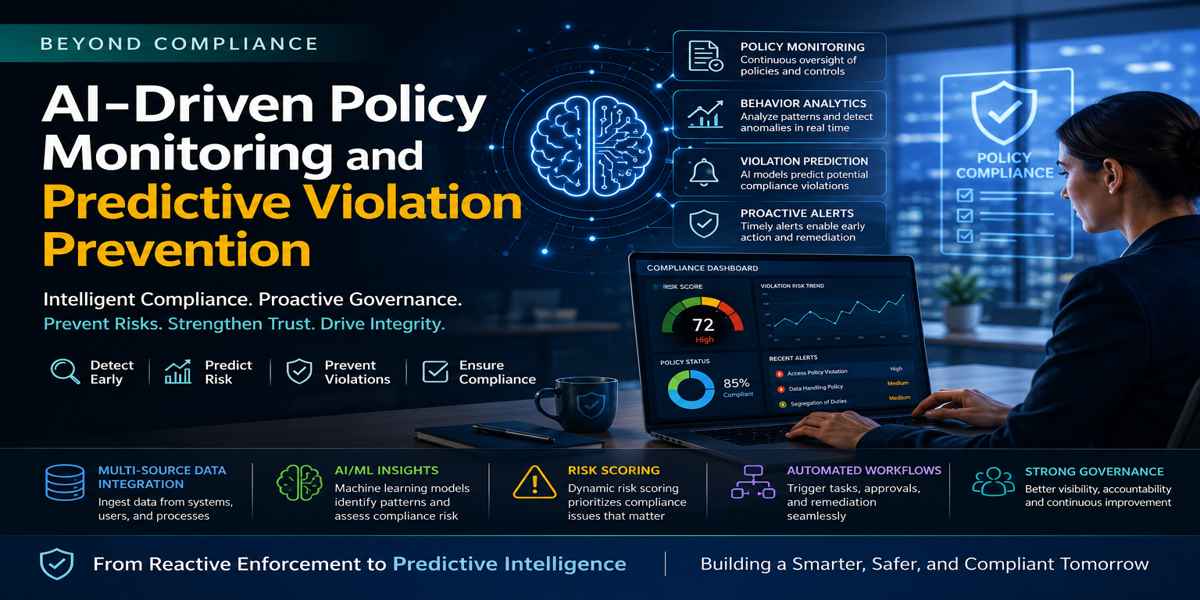
Policy compliance is no longer a static control mechanism but a dynamic challenge in modern enterprises. Traditional governance models rely on retrospective audits and rule-based enforcement, often identifying violations after impact. AI-driven policy monitoring introduces continuous intelligence into compliance workflows, enabling organizations to detect, predict, and prevent violations proactively.
This article presents a comprehensive, vendor-neutral framework for predictive compliance systems, combining behavioral analytics, machine learning, and real-time monitoring to transform governance into a strategic capability.
1. Introduction
Enterprise environments today are defined by complexity, scale, and constant change. As organizations expand digitally, policy enforcement becomes increasingly difficult. Compliance failures are rarely isolated—they are often the result of unnoticed patterns and systemic inefficiencies.
Traditional systems focus on detection after the fact. AI shifts this paradigm by enabling continuous evaluation of operational behavior. Instead of reacting to violations, organizations can anticipate them, fundamentally redefining governance.
2. From Reactive Compliance to Predictive Governance
Compliance has historically been audit-driven, periodic, and manual. These models struggle in environments where risk evolves in real time. AI introduces predictive governance, where systems analyze behavioral trends, detect anomalies, and forecast violations before they occur.
This transformation allows organizations to move beyond enforcement toward prevention, embedding intelligence into everyday operations.
3. Architecture of AI-Driven Compliance Systems
A robust compliance system integrates multiple layers. Data ingestion captures enterprise activity across systems. Machine learning models analyze patterns and detect anomalies. Predictive engines estimate violation probability, while alert systems trigger proactive actions.
This architecture enables continuous monitoring and ensures that insights translate into actionable governance outcomes.
4. Understanding Compliance Risk Signals
Risk signals are often subtle and distributed. Behavioral anomalies, repeated policy deviations, and contextual factors such as regulatory changes contribute to emerging risks. AI systems synthesize these signals, providing a holistic view of compliance exposure.
By analyzing patterns over time, organizations gain visibility into risks that would otherwise remain hidden.
5. Predictive Violation Prevention
Predictive models allow organizations to intervene early. Alerts, automated controls, and guided workflows reduce the likelihood of violations. This proactive approach strengthens governance and ensures continuous adherence to policies.
Prevention becomes the core objective rather than detection.
6. Organizational Impact
AI-driven compliance delivers measurable benefits. Risk exposure is reduced, operational efficiency improves, and decision-making becomes data-driven. Organizations gain real-time insights into governance performance, enabling faster and more effective responses.
This fosters a culture where compliance is integrated into daily operations rather than treated as an external requirement.
7. Ethical and Governance Considerations
AI systems must operate within ethical boundaries. Data privacy, transparency, fairness, and human oversight are critical. Organizations must ensure that AI supports governance without introducing bias or compromising trust.
Responsible implementation is essential for sustainable success.
8. Future Directions
The future of compliance lies in predictive analytics, real-time dashboards, and multi-agent governance systems. These advancements will enable organizations to anticipate risks with greater accuracy and respond proactively.
AI will continue to elevate governance from a control function to a strategic capability.
9. Conclusion
AI-driven policy monitoring represents a fundamental shift in enterprise governance. By enabling predictive compliance and proactive intervention, organizations can enhance resilience, reduce risk, and achieve sustainable growth.
The future of governance is intelligent, continuous, and proactive.
References
Devlin et al. (2019); Pang & Lee (2008); Ribeiro et al. (2016); McTear (2021); D’Mello & Kory (2015)