You’ve posted fifteen Reels. Three of them cracked 2,000 views. You’re leaving comments on twenty accounts a day. Six weeks in: forty-seven followers.
Something’s off, but the math checks out. You’re doing the right things, just in the wrong order. Going from 0 to 1,000 is harder than going from 1,000 to 10,000 — your content is fine, but the algorithm doesn’t know who you are yet, and until it does, almost nothing you post gets a fair shot.
Here’s the part most growth advice skips: small accounts actually have an edge. A new account with a few hundred followers routinely sees several times the engagement rate of a million-follower account, because there’s no dead weight dragging the numbers down — every view is a real, interested stranger. You just have to get the algorithm to start showing you to them. That’s what the first 1,000 is really about.
I’ve run this from scratch on more than one account. Here’s the order that works.
Why 0 to 1,000 is the hardest stretch
Every new account’s Reel goes out to a small test group of non-followers first. If those people watch, share, or save in the first few seconds, the algorithm widens the audience. If they swipe past, it stops showing the post. Hootsuite’s breakdown of the Instagram algorithm lays out the same ranking signals — early watch time and interaction decide how far anything travels.
So your first month isn’t about going viral. It’s about passing those little auditions, over and over, until the algorithm has enough data to know who your content is for. Most of a new account’s reach comes from non-followers, which is good news: you’re not stuck waiting for an audience you don’t have yet. You just have to keep clearing the bar.
You’re not alone if posting into the void feels pointless right now. That’s not a sign your content is bad — it’s a sign the algorithm hasn’t placed you yet, and that’s a fixable problem.
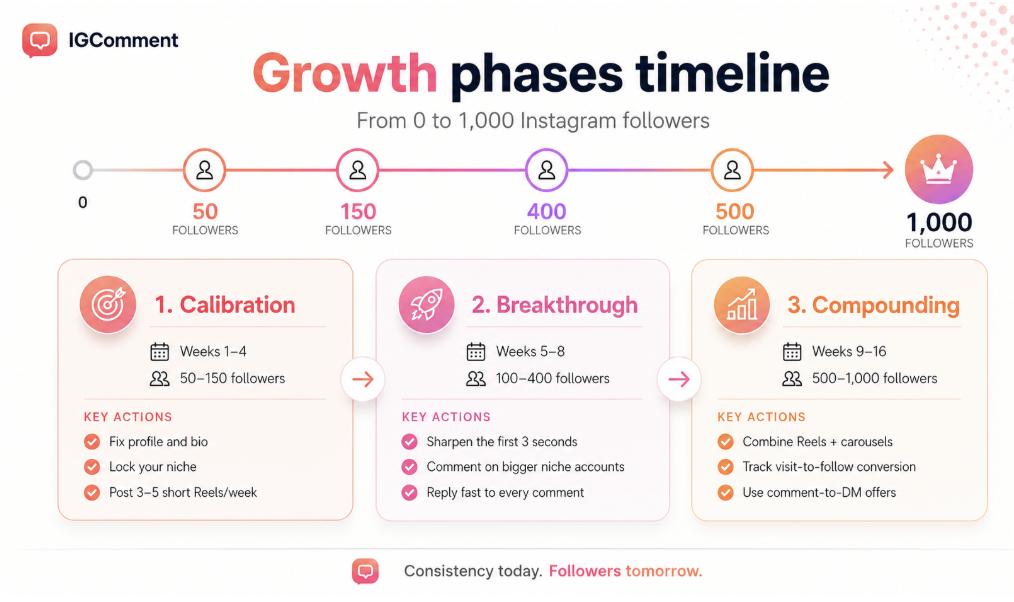
Phase 1: Calibration (weeks 1–4)
Phase 1 is for teaching the algorithm — and any visitor who lands on your profile — exactly what you’re about. Viral reach is wasted if it sends the wrong people to a profile that doesn’t convert them. Chasing followers before the algorithm knows your niche is like handing out flyers for a store you haven’t built yet.
Fix the profile first. Someone decides whether to follow in about a second. Your name field (the bold text, not the @handle) is searchable, so use it for what you do: “Alex | Instagram Growth,” not just your name. Your bio should answer who you help and how, in plain words. And post six or seven solid pieces before you promote anything — a bare grid kills the follow even when the Reel that sent them was great.
Lock your niche. The algorithm classifies your content by what it sees and hears. Broad, scattered posting confuses it; a clear lane gets you routed to the right people. Pick two or three things you’ll post about and stick to them long enough for the pattern to register.
Post Reels that clear the audition. Three to five a week, 15–30 seconds. A short Reel watched to the end beats a long one people bail on. Put your face in the first frame and give them a reason not to swipe in the first two seconds — motion, a question, a bold line. That’s the whole job early on.
By the end of week 4, you’re aiming for 50–150 followers and a profile that converts visitors. If people land and don’t follow, fix the profile before you chase more traffic.
Phase 2: Breakthrough (weeks 5–8)
By now the algorithm has a rough idea of your niche. If your Reels keep clearing the audition, it starts testing them on bigger groups — and this is usually where the first small viral moment shows up.
Sharpen the hook. The first three seconds carry the whole Reel. Motion in frame one, a line that opens a curiosity gap, ideally your face. Everything after that only matters if people stay past second three.
Borrow an audience. Nobody’s commenting on your posts yet, so go where the conversations already are. Spend fifteen minutes a day leaving real comments on bigger accounts in your niche — not “great post,” but an actual point, a question, a counter-take. At this stage an hour of good commenting drives more profile visits than another Reel. And when someone comments on your stuff, reply fast; a back-and-forth is one of the signals the algorithm reads as a real relationship.
Skip the engagement pods. Coordinated like-for-like groups are easy to detect now and they tank your reach instead of helping it. They were a 2020 move. Let them go.
By week 8, expect a first local hit — a Reel doing 2,000 to 10,000 views and bringing in 100 to 300 followers over a few days. That’s the algorithm finding your people.
Phase 3: Compounding (weeks 9–16)
Past about 500 followers the math shifts. The algorithm has enough trust to start recommending you next to similar accounts, and your back catalog keeps pulling in stragglers. Growth stops being linear.
Run Reels and carousels together. Reels reach strangers and bring them to your profile; carousels prove you’re worth following once they’re there. Keep the mix Reels-heavy but lean on carousels that teach — they pull saves, and saves are one of the strongest signals you can earn.
Watch your conversion, not just your reach. The number that matters now is how many profile visitors actually follow. If it’s low, the problem is your bio or your grid, not your reach — fix that before you pour on more traffic.
Use the comment-to-DM move. “Comment ‘GUIDE’ and I’ll send it over” fires three signals at once: a comment, a DM, and (if they reply) a two-way conversation. You’ll need an automation tool connected through Instagram’s API (ManyChat, SlideDM, or the like) — the feature itself relies on business-account API access, not a built-in Instagram toggle. It’s one of the cleanest ways to turn a post into a relationship.
By week 16 you’re at 1,000 — not because one thing worked, but because three phases stacked. Calibration got the algorithm’s attention. Breakthrough found your people. Compounding converted them.
How to speed up any phase
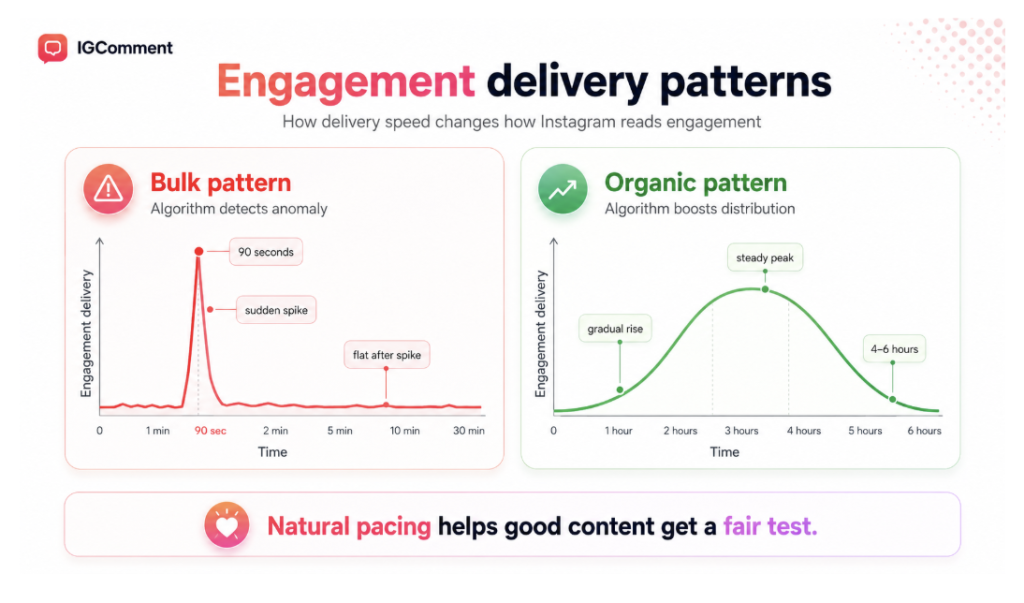
Every phase runs into the same wall: the algorithm tests a post that already has some engagement differently than a post sitting at zero. A cold post gets the smallest test group and the shortest window to prove itself.
If that feels discouraging, I get it — you’re being asked to build engagement on an account that doesn’t have anyone to engage yet. What actually matters is the speed of that first engagement, not just the total. An account with 200 followers pulling 50–80 likes over a few hours looks like a post that’s catching on. The same account pulling a sudden avalanche in ten minutes — whatever the number — looks off. That’s where IGCOMMENT comes in — it adds that early engagement on a natural delivery curve, so a good post gets the real test instead of the cold one. The key is proportion: the engagement fits the account size, and it arrives like real people found it, not like a bot just woke up.
Test it on one post, compare the reach against your usual, and decide from your own numbers.
What to do today, by where you’re starting
| Followers | Phase | Today’s move |
| 0–50 | Calibration | Fix your name field and bio, post 6–7 foundation pieces, then publish a 15-second Reel with your face in frame. |
| 50–150 | Late Calibration | Post 3 Reels this week, comment with real value on 20 niche accounts a day, lock your 2–3 topics. |
| 150–500 | Breakthrough | Re-cut your best Reel’s first 3 seconds, move hashtags into the caption, reply to every comment fast. |
| 500– 1,000 | Compounding | Add 2–3 teaching carousels a week, check your visit-to follow rate, scale whatever converts best. |
The first 1,000 is a system, not luck. Work the phase you’re in, and let the next one arrive on its own.