

Silicon Valleys Journal
  • Topics
    • Finance & Investments
      • Angel Investing
      • Financial Planning
      • Fundraising
      • IPO Watch
      • Market Opinion
      • Mergers & Acquisitions
      • Portfolio Strategies
      • Private Markets
      • Public Markets
      • Startups
      • VC & PE
    • Leadership & Perspective
      • Boardroom & Governance
      • C-Suite Perspective
      • Career Advice
      • Events & Conferences
      • Founder Stories
      • Future of Silicon Valley
      • Incubators & Accelerators
      • Innovation Spotlight
      • Investor Voices
      • Leadership Vision
      • Policy & Regulation
      • Strategic Partnerships
    • Technology & Industry
      • AI
      • Big Tech
      • Blockchain
      • Case Studies
      • Cloud Computing
      • Consumer Tech
      • Cybersecurity
      • Enterprise Tech
      • Fintech
      • Greentech & Sustainability
      • Hardware
      • Healthtech
      • Innovation & Breakthroughs
      • Interviews
      • Machine Learning
      • Product Launches
      • Research & Development
      • Robotics
      • SaaS
  • Media Kit
No Result
View All Result
  • Topics
    • Finance & Investments
      • Angel Investing
      • Financial Planning
      • Fundraising
      • IPO Watch
      • Market Opinion
      • Mergers & Acquisitions
      • Portfolio Strategies
      • Private Markets
      • Public Markets
      • Startups
      • VC & PE
    • Leadership & Perspective
      • Boardroom & Governance
      • C-Suite Perspective
      • Career Advice
      • Events & Conferences
      • Founder Stories
      • Future of Silicon Valley
      • Incubators & Accelerators
      • Innovation Spotlight
      • Investor Voices
      • Leadership Vision
      • Policy & Regulation
      • Strategic Partnerships
    • Technology & Industry
      • AI
      • Big Tech
      • Blockchain
      • Case Studies
      • Cloud Computing
      • Consumer Tech
      • Cybersecurity
      • Enterprise Tech
      • Fintech
      • Greentech & Sustainability
      • Hardware
      • Healthtech
      • Innovation & Breakthroughs
      • Interviews
      • Machine Learning
      • Product Launches
      • Research & Development
      • Robotics
      • SaaS
  • Media Kit
No Result
View All Result
Silicon Valleys Journal
No Result
View All Result
Home Technology & Industry AI

The “Inception” Loop: Why Prompt Engineering Is the New Frontier for Computer Vision

By Kapil S Bidikar, Software Development Engineer, Amazon

SVJ Thought Leader by SVJ Thought Leader
July 17, 2026
in AI
0
The “Inception” Loop: Why Prompt Engineering Is the New Frontier for Computer Vision

The industrial world is facing a “reality gap.” While the previous decade was defined by the race to collect massive amounts of real-world data, the 2026 enterprise landscape has hit a physical ceiling. To train an autonomous drone or a robotic picker, companies traditionally sent fleets into the field to capture millions of images. That approach was slow, expensive, and—critically—it failed to capture the “edge cases” that lead to system failure.

Today, a profound shift is underway. Leading organizations are no longer finding their training data; they are architecting it. By leveraging multimodal large language models (LLMs) and advanced prompt engineering, developers are building synthetic environments that can be more useful than reality itself for machine learning.

The Death of the Manual Data Set

For years, the bottleneck of computer vision was the human labeler. By long-standing industry estimates, data scientists spend roughly 60–80% of project time on data preparation and labelingrather than on modeling. Relying on real-world capture also bakes in an inherent bias toward “sunny day” scenarios.

The economics are shifting quickly. The synthetic data generation market is projected to approach $2.6 billion by 2030, growing at nearly a 38% compound annual rate. The logic is simple: you cannot wait for a once-in-a-decade disaster to train a response AI, so you build that crisis in a digital sandbox.

Beyond Visuals: The Rise of Sensor-Fusion Prompting

The next evolution of the “prompt architect” is not about describing a pretty picture; it is about hardware-aware prompting. In 2026, elite engineers no longer prompt for “a realistic warehouse.” They prompt for the specific lens aberrations, motion blur, and sensor noise of the hardware the AI will actually run on.

By embedding technical specifications—such as ISO grain, focal length, and infrared signatures—directly into the prompt, the model generates data that is pre-calibrated for the deployment environment. The strategic move is from post-processing, which cleans data after collection, to predictive synthesis, which engineers data to match the hardware’s limitations before a single photo is taken.

The 2026 Validation Stack: AI Grading AI

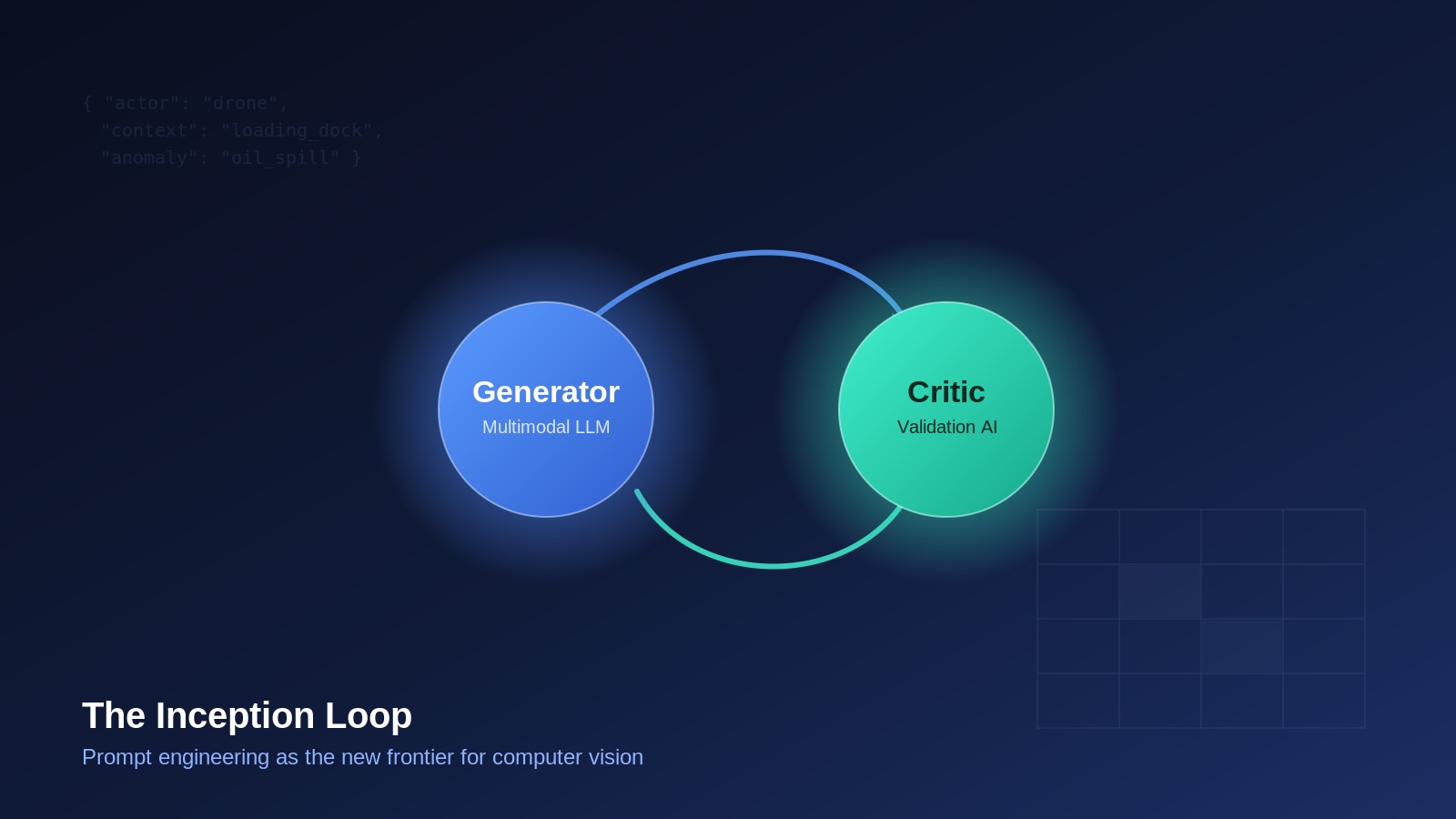
One of the most underrated roles for prompt engineering in this cycle is the “validation loop.” Once a multimodal LLM generates tens of thousands of synthetic training images, a second “critic” LLM is prompted to audit that data for quality. This creates a self-correcting ecosystem that runs in four steps.

1. The architect prompts the generator for a specific scenario, such as an oil spill on a wet loading dock.

2. The generator produces the high-fidelity training frames.

3. The critic AI, prompted with safety standards, flags any frames where the physics or lighting look unrealistic.

4. The model receives only the “gold-standard” synthetic data, which reduces training time.

The ROI of the Synthetic Pipeline

The business case for prompt-engineered training data is no longer theoretical. Independent analyses and vendor benchmarks point to three recurring gains.

• Lower acquisition costs: providers report up to a 70% reduction in data-related costs, and per-image labeling can fall from roughly $6 by hand to a few cents synthetically.

• Cleaner labels, faster convergence: because synthetic data arrives perfectly labeled through prompt metadata, models train on far fewer mislabeled examples and converge sooner.

• Scalability: a single prompt architect can generate thousands of unique edge cases in the time a field team needs to set up one camera.

Technical Sidebar: The Prompt-to-Metadata Workflow

To understand how prompt engineering translates into a high-performance model, consider the direct-to-annotation pipeline. It has three layers.

1. The semantic layer: the architect defines the scene using structured natural language—primary actor, environmental context, and anomalous event.

2. The generation layer: the multimodal LLM processes the prompt and, because it is aware of the objects it is creating, generates a segmentation mask alongside the image.

3. The metadata layer: the system exports a JSON file with exact coordinates and material properties. This synthetic “ground truth” sidesteps the roughly 10% error rate common in manual annotation—a figure that sits near 6% even in benchmark datasets like ImageNet.

Strategic Implementation: Building Your Synthetic Data Unit

For leaders moving beyond the data-collection era, three steps are essential.

1. Hire hybrid talent: look for engineers who understand both computer graphics—specifically lighting and shaders—and natural language processing.

2. Establish a validation sandbox: deploy a secondary LLM as an automated auditor whose job is to prompt the generator to fail by surfacing edge cases the primary model has not seen.

3. Integrate sensor-specific tuning: ensure prompts include hardware-level variables such as LiDAR point-cloud density or thermal sensor noise.

The Road Ahead: The Autonomous Perception Loop

Looking toward 2027, the enterprise architect’s role will expand to manage these “inception loops,” where one AI continually prompts itself to find weaknesses in another AI’s perception. For the C-suite, the mandate is clear: stop investing in bigger nets to catch data, and start investing in better architects to build it. The future of vision is not just about what the AI sees—it is about how we tell it what to look for.

References

1. Pragmatic Institute — Overcoming the 80/20 Rule in Data Science

2. Next Move Strategy Consulting — Synthetic Data Market, $2.63B by 2030

3. Cogent — Synthetic Data Explosion: How 2026 Reduces Data Costs by 70%

4. Sphere Partners — Synthetic Data: Fake With Benefits (per-image cost)

5. Label Your Data — Annotation QA: error rates and accuracy

Previous Post

Preparing your hotel for AI-driven discovery: How independent hotels can stay visible as AI reshapes travel search

SVJ Thought Leader

SVJ Thought Leader

Leave a Reply Cancel reply

Your email address will not be published. Required fields are marked *

  • Trending
  • Comments
  • Latest
Faith and the Digital Transformation of Religion: How One Person Began Helping Faith Communities and People of Faith

Faith and the Digital Transformation of Religion: How One Person Began Helping Faith Communities and People of Faith

December 30, 2025
The AI Cold War and How to Prepare for It

The AI Cold War and How to Prepare for It

May 1, 2026
AI’s Most Underrated Role: Giving Enterprise Architects Back Their Focus

AI’s Most Underrated Role: Giving Enterprise Architects Back Their Focus

November 26, 2025
The UK’s Seed-to-Series A gap is growing. Should we fix it?

The UK’s Seed-to-Series A gap is growing. Should we fix it?

November 25, 2025
The Human-AI Collaboration Model: How Leaders Can Embrace AI to Reshape Work, Not Replace Workers

The Human-AI Collaboration Model: How Leaders Can Embrace AI to Reshape Work, Not Replace Workers

1

50 Key Stats on Finance Startups in 2025: Funding, Valuation Multiples, Naming Trends & Domain Patterns

0
CelerData Opens StarOS, Debuts StarRocks 4.0 at First Global StarRocks Summit

CelerData Opens StarOS, Debuts StarRocks 4.0 at First Global StarRocks Summit

0
Clarity Is the New Cyber Superpower

Clarity Is the New Cyber Superpower

0
The “Inception” Loop: Why Prompt Engineering Is the New Frontier for Computer Vision

The “Inception” Loop: Why Prompt Engineering Is the New Frontier for Computer Vision

July 17, 2026

Preparing your hotel for AI-driven discovery: How independent hotels can stay visible as AI reshapes travel search

July 17, 2026
How to Buy Software the Right Way — And Why the Same Rules Apply to AI Adoption

How to Buy Software the Right Way — And Why the Same Rules Apply to AI Adoption

July 17, 2026

VARON Shares Summer Respiratory Wellness Tips and Introduces Seasonal Savings on Oxygen Solutions

July 17, 2026

Recent News

The “Inception” Loop: Why Prompt Engineering Is the New Frontier for Computer Vision

The “Inception” Loop: Why Prompt Engineering Is the New Frontier for Computer Vision

July 17, 2026

Preparing your hotel for AI-driven discovery: How independent hotels can stay visible as AI reshapes travel search

July 17, 2026
How to Buy Software the Right Way — And Why the Same Rules Apply to AI Adoption

How to Buy Software the Right Way — And Why the Same Rules Apply to AI Adoption

July 17, 2026

VARON Shares Summer Respiratory Wellness Tips and Introduces Seasonal Savings on Oxygen Solutions

July 17, 2026

About & Contact

  • About Us
  • Branding Style Guide
  • Contact Us
  • Help Centre
  • Media Kit
  • Site Map

Explore Content

  • Events
  • Newsletter
  • Press Releases
  • Reports & Guides
  • Topics

Legal & Privacy

  • Advertiser & Partner Policy
  • Communications & Newsletter Policy
  • Contributor Agreement
  • Copyright Policy
  • Privacy Policy
  • Prohibited Content Policy
  • Terms of Service

Tiny Media Brands

  • Silicon Valleys Journal
  • The AI Journal
  • The City Banker
  • The Wall Street Banker
  • World Lifestyler
  • About
  • Privacy & Policy
  • Contact

© 2025 Silicon Valleys Journal.

No Result
View All Result

© 2025 Silicon Valleys Journal.