
It’s becoming impossible to ignore and is being touted as the universal panacea to improving efficiency wherever it’s deployed. Problem is, there’s an issue with Artificial Intelligence (AI) that too many people are overlooking – the significant disconnect between capability and tangible business outcomes.
The ‘AI execution gap’ is a growing challenge. Approximately 78% of organisations report implementing AI in some capacity, whereas only a small fraction, around 5% according to the CDO Trends website, are realising significant financial or operational value at scale. For many observers, a fundamental factor driving low return on investment (ROI) is the disconnect between having a coherent AI strategy and the realities of operational implementation.
Without a coherent strategy, AI struggles to add value
A recent survey – “State of AI 2026 – Trends, adoption and maturity levels in European companies”, conducted by Keepler – illustrated that 38% of companies currently operate with isolated AI initiatives that lack central coordination. The same survey revealed that only 3.8% of those companies claim to have a fully integrated, company-wide AI strategy. It also highlighted how for 66% of companies AI contributes less than 5% EBITDA and more than half, 53%, report limited benefits or unclear results. In a market seemingly obsessed with AI models, tools and transformation narratives, many businesses are overlooking the central point – the absence of a coherent AI strategy will always make it difficult to achieve added value in the real world.
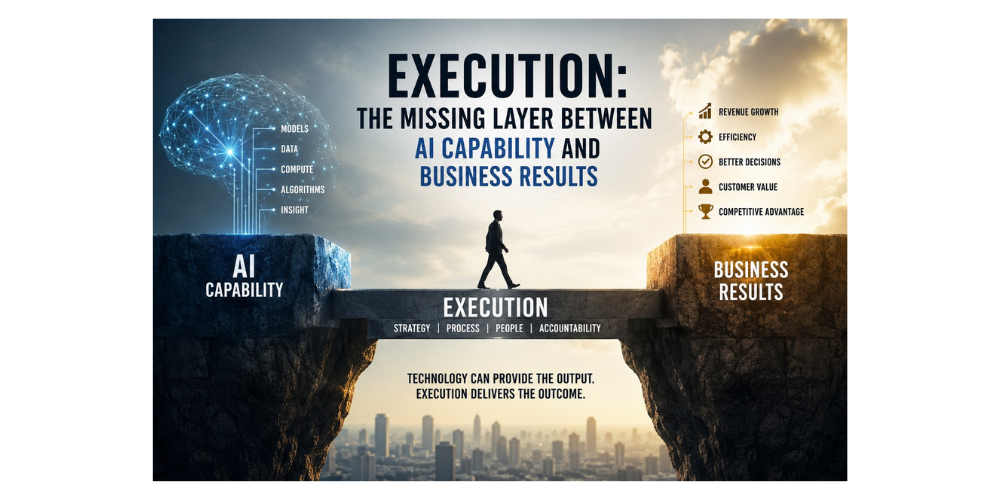
There are multiple reasons why AI capability is failing to translate into added value. Vendors and innovation teams are often too focused on what the models can do, not how they can create value through improving operational performance. It’s a familiar narrative. Companies carry out proof of concepts that rarely scale. They automate tasks that fail to positively impact day-to-day activities and create dashboards that don’t alter the decision-making process or the overall organisational direction. In all of these cases, structured execution is absent and businesses are missing the point that technology only matters when it changes operational reality.
The importance of mapping outputs to actions
Structured execution is the disciplined, repeatable and measurable process of transforming strategy into tangible business outcomes. A good strategy has numerous elements, all of which focus on embedding responsibility within the process to ensure actions are mapped to actual outcomes.
Clear ownership is, perhaps, the most straightforward element. Organisations need to ensure that a designated team or individual is accountable for adoption, performance and iteration. This will help to ensure that positive lessons learned are accurately reported and cascaded across future operations. And that mapping of AI outputs needs to be aligned to real-world workflows, not theoretical models, to ensure tangible operational benefits.
A readiness to change is also hugely important. Teams that will be impacted by implementing AI solutions need to trust in the process and have the confidence to deploy AI, secure in the knowledge that it will lead to improvements. It’s also critical to establish feedback loops that clearly illustrate where successes have been achieved and to underpin the belief that continuous improvements can be gained from strategic interventions. Okay, so it’s far from glamorous, but it’s simple steps like this that can consistently produce positive results!
Aligning incentives with operational realities
Effective execution is a disciplined, repeatable and measurable process of transforming strategy into tangible processes and outcomes. Poorly executed implementations often fail through misaligned incentives where AI outputs fail to correspond with operational realities, leading to disappointing outcomes and patchy adoption. Fragmented ownership, where data teams build solutions that operational teams are expected to adopt without a clear owner of the outcome, inevitably fall at the first hurdle due to lacking a single source of truth to illustrate what the implementation has achieved in real-world, operational terms.
There’s often a lack of integration in relation to AI implementations. When AI solutions sit adjacent to workflows, rather than being integral to them, they can create friction and disruption instead of adding value and improving the process. Effective execution should be viewed as the essential connective tissue that brings everything together if deployed correctly.
Successful AI deployments are built on a disciplined approach
Organisations that have successfully deployed AI solutions aren’t more innovative or smarter, they’re just more disciplined in how they deploy them. For instance, IBM redesigned core enterprise functions, including legal, IT, procurement and human resources (HR) and unlocked roughly $3.5 billion in cost savings and a 50% increase in enterprise operations productivity, according to Boston Consulting Group.
Successful implementations begin with the business problem, not a theoretical model. AI deployments should be designed for organisation-wide adoption from the outset and effort put into measuring value in operational terms through highlighting errors reduced, throughput increased and time saved. And as each new lesson is taken on board, successful organisations rapidly iterate to build trust and capture tangible process improvements.
While AI capability may be accelerating rapidly, organisations that chase capability and fail to execute AI deployments without clarity, clear ownership and operational rigour, will continue to see their investment underdeliver. Ultimately, ensuring the organisation is properly prepared for the AI deployment, knows what to expect and what needs to be done from an operational perspective is much more important than technological sophistication promising vague potential benefits.