
Why the most important AI decision leaders make will not be which model they deploy, but what kind of economy their systems are built to create
Artificial intelligence is usually discussed as though its economic effects are a weather system approaching from the horizon.
Jobs will be displaced. Productivity will rise. New professions will emerge. Inequality may widen. Governments and businesses must somehow prepare for whatever arrives.
But AI is not weather.
Its economic impact will be shaped by millions of design decisions made inside companies: which tasks are automated, which decisions remain human, how productivity gains are distributed, whether junior employees are still hired, and whether AI makes workers more capable or simply makes fewer workers necessary.
That is why the recent statement published by WeMustActNow.ai deserves attention. Signed by an extraordinary group of economists, technologists and public thinkers, it warns that AI could transform the economy more profoundly than the Industrial Revolution, but over a much shorter period. Its most important message is not that disruption is inevitable. It is that leaders still have agency over the direction of that disruption.
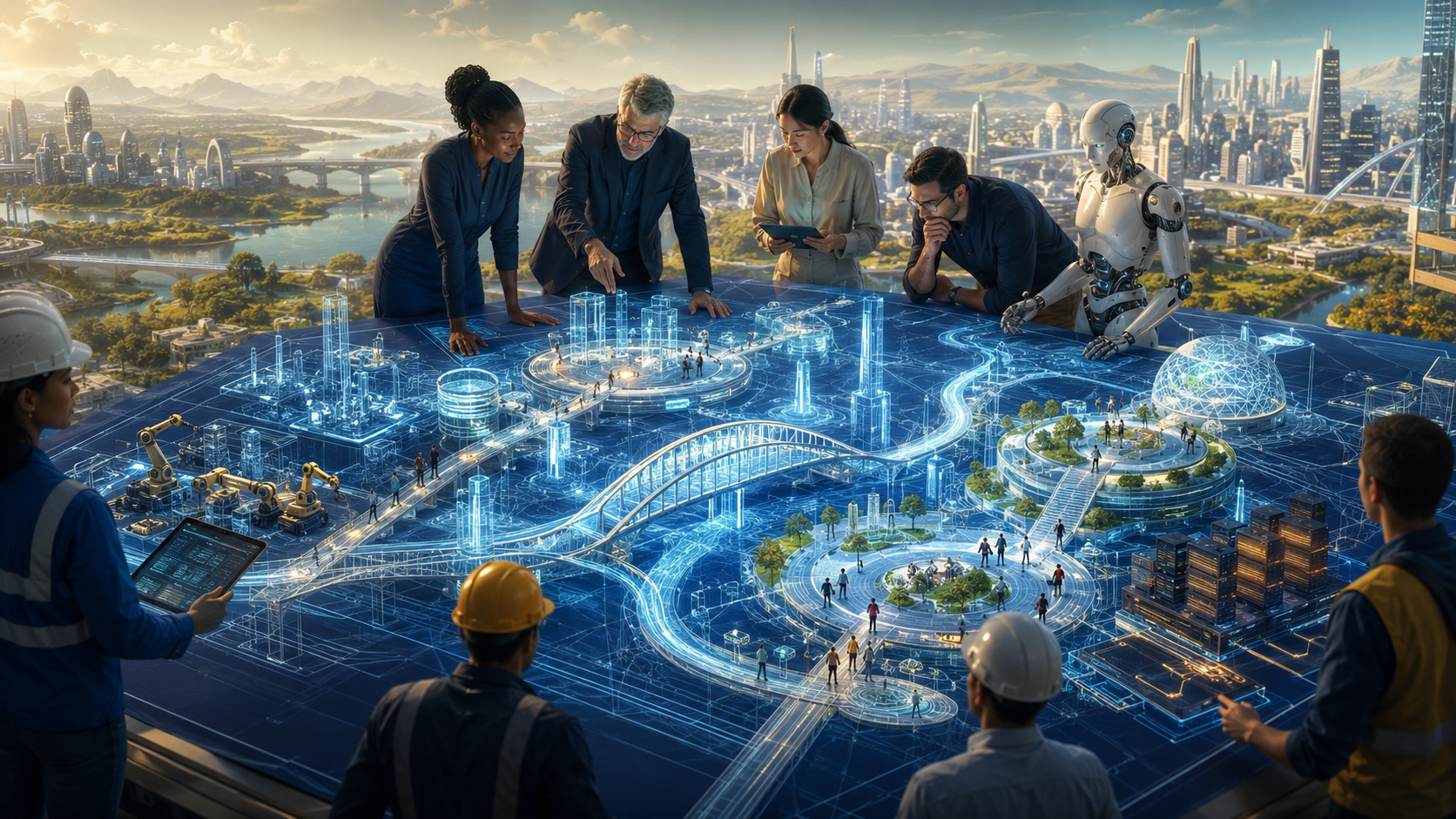
The next economy will not simply emerge from more capable models. It will be designed through the incentives surrounding their deployment.
Productivity Is Not a Sufficient Goal
The traditional business case for technology is straightforward: produce more output with fewer inputs.
For earlier generations of software, that often meant eliminating paperwork, reducing errors or accelerating communication. AI reaches further. It can participate in activities that organizations previously treated as distinctly human: writing, analysis, software development, customer interaction, planning and decision support.
This creates enormous opportunities. But it also creates a dangerous simplification.
If companies evaluate AI primarily according to labor hours eliminated, the technology will naturally be deployed as a substitute for employees. If they evaluate it according to the value created by better employees, it will be deployed as a complement.
Both approaches may initially appear productive. Their long-term consequences are very different.
An organization can reduce its junior workforce, automate routine analysis and report an immediate improvement in output per employee. But junior work is not only a source of output. It is also how people develop judgment, acquire institutional knowledge and become senior contributors.
Automating the bottom of the career ladder without redesigning the path upward may improve this quarter’s efficiency while weakening the organization’s future supply of expertise.
This is the distinction business leaders must understand: a company can increase measured productivity while reducing its capacity to produce capable humans.
AI Changes the Apprenticeship Model
Many knowledge professions rely on an implicit apprenticeship system.
Junior software engineers learn by debugging relatively contained issues before designing critical systems. Analysts begin with data collection and basic models before advising executives. Lawyers review documents before leading negotiations. Financial professionals reconcile records before managing risk.
AI is particularly effective at many of these entry-level tasks.
That does not automatically mean entry-level jobs must disappear. It means organizations must stop assuming that learning will remain an accidental byproduct of routine work.
In an AI-enabled company, apprenticeship must become intentional.
A junior engineer may write less boilerplate code but spend more time reviewing generated implementations, testing assumptions and understanding system architecture. An analyst may perform less manual data preparation but take greater responsibility for questioning model outputs and explaining uncertainty. A customer-service employee may handle fewer repetitive requests but become responsible for complex exceptions and relationship recovery.
These redesigned roles can be better than the ones they replace. They can accelerate learning and move people toward higher-value work earlier.
But that outcome will not happen merely because employees receive access to an AI assistant. It requires leaders to design workflows in which people retain responsibility, receive feedback, and progressively develop more sophisticated judgment.
Otherwise, AI becomes a machine for consuming expertise without replenishing it.
Measure Human Capability Creation
Most organizations track the economics of AI using metrics such as cost reduction, response time, automation rate, throughput and revenue generated.
Those metrics matter. They are also incomplete.
Companies should add another category: human capability creation.
The purpose is not to resist automation or preserve every existing task. It is to determine whether AI deployment leaves the organization’s people more capable than they were before.
Leaders can begin with several practical questions:
– Are employees becoming able to solve more complex problems, or merely approving machine-generated work?
– Can junior employees explain why an AI-produced answer is correct?
– Is the organization developing more independent decision-makers or creating greater dependence on a small number of experts and external models?
– Are productivity gains being reinvested in experimentation, training and new products?
– When the AI fails, does the team still possess enough underlying knowledge to recover?
These questions turn the idea of “human-centered AI” from an ethical slogan into an operating discipline.
A company could even track a human capability balance sheet alongside its AI productivity metrics: the number of employees progressing into higher-complexity responsibilities, the time required to develop independent judgment, the proportion of workflows employees can complete without AI, and the number of new products or services created because AI expanded the team’s capacity.
The point is not to prove that humans can outperform AI at every task. They will not.
The point is to ensure that the organization continues producing the judgment, creativity, accountability and institutional resilience it will need when today’s systems and assumptions change.
From Copilots to Economic Architecture
The word “copilot” has become one of the technology industry’s favorite descriptions of AI. It sounds reassuring: the human remains in control while the machine provides assistance.
But adding a chat interface beside an existing workflow does not guarantee meaningful human control.
A system may technically require a person to approve its decisions while giving that person neither the time nor the information needed to evaluate them. In such a workflow, human oversight becomes ceremonial.
True complementarity has to be designed at three levels.
At the task level, AI should remove friction while preserving opportunities to understand the work.
At the workflow level, humans must have clear authority to question, redirect and override automated decisions.
At the organizational level, some portion of the value produced by AI should be directed toward developing people, creating new offerings and expanding demand—not solely toward reducing headcount.
This is where individual product decisions become economic architecture.
When thousands of companies make the same choice – to treat AI primarily as a labor-reduction mechanism – the aggregate result may be weaker consumer demand, narrower career pathways and greater concentration of economic power.
No individual chief executive intends to produce that economy. Yet rational decisions made independently can still generate an irrational collective outcome.
That is why AI’s transition cannot be delegated entirely to market forces or government policy. Businesses are not passive participants awaiting regulation. They are where the future of work is being implemented, one workflow at a time.
The Companies That Complement Humans May Ultimately Win
Designing AI to strengthen human capability is not only a social responsibility. It may become a competitive advantage.
Models will increasingly be available to everyone. Access to intelligence will become cheaper, and many technical capabilities will be commoditized.
What will remain scarce is organizational judgment: knowing which problems matter, understanding customers deeply, coordinating across functions, learning from failure and making responsible decisions under uncertainty.
Companies that use AI only to reduce labor may gain a temporary cost advantage. Companies that use it to multiply the capabilities of employees can build something more durable: an organization that learns faster.
The strongest AI-native companies will therefore not necessarily be those with the fewest people. They will be those that generate the most value, learning and innovation per person while continually creating the next generation of capable contributors.
This requires a shift in leadership language.
Instead of asking, “How many roles can this system replace?” leaders should ask, “What becomes possible when every person in this organization can operate at a higher level?”
Instead of asking only, “How quickly does the investment pay for itself?” they should also ask, “What capabilities will this investment create inside the company?”
And instead of treating workers as a cost that AI can minimize, they should recognize human talent as an asset AI can compound.
The Window for Intentional Design Is Now
There is still substantial uncertainty about the speed and scale of AI’s economic impact. Current evidence shows rapid growth in AI use, but a more complicated labor-market picture than either extreme of the debate suggests. AI is already reshaping tasks and hiring patterns, yet the full macroeconomic productivity effect remains difficult to measure.
Waiting for certainty, however, is itself a decision.
Organizational structures, career pathways and technical infrastructure are being established now. Once companies redesign departments around aggressive substitution, rebuilding lost expertise and training systems will be difficult. Once workers conclude that AI adoption is something being done to them rather than with them, institutional trust will be harder to recover.
The leaders signing WeMustActNow.ai are right that economists, policymakers and technologists must begin preparing before the transformation is complete.
But action must also begin inside product teams, boardrooms and engineering organizations.
The future of AI will not be determined solely by how intelligent models become. It will be determined by what companies reward those models for doing.
We can build systems optimized to remove humans from economic activity.
Or we can build systems that make human ambition, judgment, and creativity more economically powerful.
Both futures are technologically possible.
Only one is worth designing.