
A new generation of tools claims to read how an audience’s brain responds to an advertisement and, increasingly, to predict that response before a single unit of media is bought. The implications reach well beyond the testing lab, reshaping what marketing leaders are actually being asked to do.
Every media plan rests on a quiet act of faith. A team builds a creative, argues about which version is strongest, picks one, and then commits a budget to push it in front of millions of people. Only afterwards, through clicks, views, and conversions, does anyone learn whether the bet was sound. By then the money is gone.
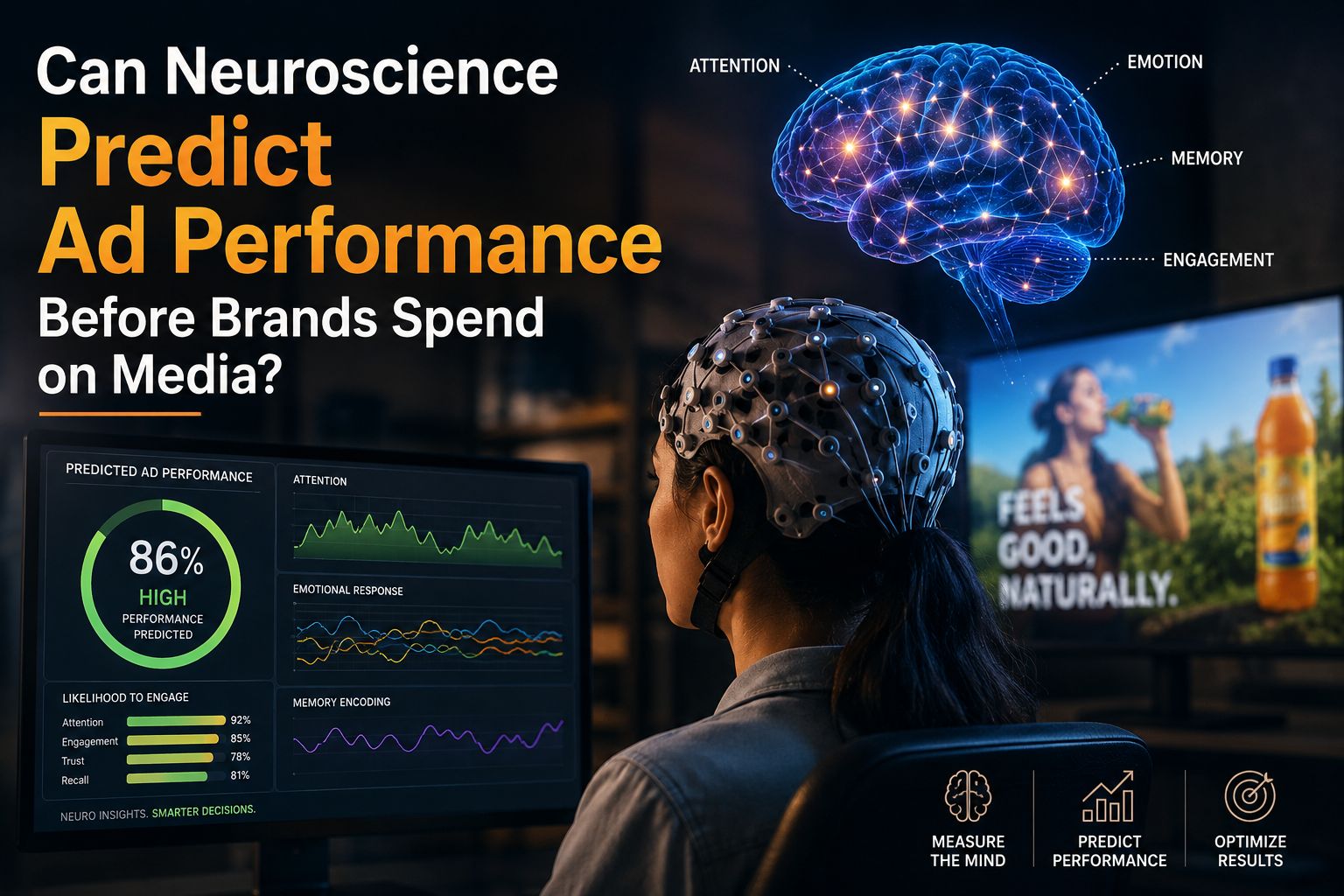
That sequence has defined advertising for a century. A growing body of work in neuroscience and artificial intelligence now poses a disruptive question: what if creative effectiveness could be tested on the human brain before any media spend is committed? Not guessed at in a focus group, but measured, or even simulated, at the level of attention, emotion, and memory.
The rise of neuroscience-powered marketing tools
Neuromarketing sits at the intersection of brain science and consumer research. Instead of asking people what they think of an advertisement, a method distorted by faulty memory and the wish to give a flattering answer, it observes what the body does involuntarily. A foundational premise of the field, often associated with Harvard’s Gerald Zaltman, is that the great majority of decision-making happens beneath conscious awareness, where surveys cannot reach.
The toolkit has matured into several established techniques. Functional magnetic resonance imaging (fMRI) maps deep brain activity tied to reward and valuation. Electroencephalography (EEG) tracks electrical brainwave patterns in real time and is far cheaper than fMRI, which has made it the workhorse for testing attention and engagement second by second through an advertisement. Eye-tracking shows exactly where a viewer looks and for how long. Facial coding reads micro-expressions of emotion, and biometric measures such as electrodermal activity register arousal that the viewer never consciously reports.
Used together, these methods reveal which moments of an advertisement capture interest, which trigger emotion, and which cause boredom or cognitive overload. This insight is something traditional surveys simply cannot supply. The practical promise is sharper creative and less wasted spend because weak elements can be identified and fixed before launch rather than after.
From measuring the brain to simulating it
The more consequential shift is what artificial intelligence is doing to this data. Once enough real brain and body responses have been recorded, machine learning models can learn the patterns that separate advertisements that resonate from those that fall flat, and then forecast the response to a brand-new creative it has never tested on a live audience.
The predictive results are already striking. One widely reported approach combining facial expression and skin-conductance data with machine learning predicted which advertisements would resonate with roughly 81 percent accuracy before launch. A peer-reviewed study that fed neuroscience-based metrics into a neural network classified the appeal of Super Bowl commercials with about 83 percent average accuracy and even estimated their eventual online view counts. Commercial platforms now market still higher figures, though vendor-reported accuracy should be read with appropriate caution.
The frontier goes further still, toward what some researchers call “in-silico neuroscience.” AI models simulate a human brain’s response rather than recording a real one. In early 2026, Meta detailed research on a model designed to predict patterns of brain activity provoked by elements such as colour, motion, tone of voice, facial expression, and scene composition, and to generalise to new content and new people without retraining. In principle, this could act as a pre-testing layer that estimates whether a creative will hold attention before it is ever shown to a real viewer. Meta has framed the work as neuroscience research rather than an advertising product, and independent coverage stresses that ad performance still depends on pricing, targeting, and many factors no brain model captures.
Even so, the direction is unmistakable. Advertising has been overwhelmingly reactive. Launch, measure, optimise. Brain-informed prediction reverses the order, moving judgement to the moment before money is spent.
The CMO’s changing job: from managing tools to directing systems
These capabilities arrive just as the role of the marketing leader is being rewritten. The chief marketing officer of the recent past managed a stack of tools and a calendar of campaigns. The emerging job is closer to directing a fleet of semi-autonomous systems.
The scale of the shift is documented. In a 2026 survey of 300 global CMOs, the Boston Consulting Group found that 96 percent said AI is driving an end-to-end transformation of their function, yet only about a third had actually built it. Forty-two percent still used generative AI only to assist humans with discrete tasks. Fewer than a third had moved to agent-led workflows, and just 8 percent ran campaigns in which multiple agents operate autonomously. The ambition is near-universal; the execution is not.
McKinsey describes the same trajectory in plainer terms. The CMO is expanding from steward of brand and demand to orchestrator of data, technology, and AI-enabled execution. Its research likewise finds that nearly 90 percent of CMOs are experimenting with AI, while under 10 percent have captured value across complete, end-to-end workflows. EY frames the leadership change as a move away from approving individual pieces of work and toward setting goals, guardrails, and governance within which intelligent systems operate.
The destination is an operating model rather than a campaign calendar. Gartner has projected that by 2028 at least 15 percent of day-to-day work decisions will be made autonomously through agentic AI, and HubSpot’s 2026 research reports that a majority of marketers already regard this as the industry’s biggest disruption in two decades. In that world, brain-tested creative is not a novelty bought from a specialist agency. It becomes one signal that an autonomous system weighs while deciding what to make, what to run, and what to retire.
What “brain-tested” advertising could mean for brands
If prediction becomes reliable enough, three changes follow for brands.
The first is a new pre-flight standard. Just as no aircraft leaves the ground without checks, high-stakes creative may not earn a media budget without a brain-informed assessment of whether it captures attention, carries emotion, and is likely to be remembered. The cost of a weak advertisement shifts from the market back to the lab.
The second change concerns the audience itself. Discovery is moving inside AI assistants and agents that interpret, summarise, and rank brands on a person’s behalf. In BCG’s survey, 90 percent of CMOs agreed generative AI is already reshaping how consumers find and evaluate brands, and EY has projected a meaningful decline in traditional search volume as chatbots absorb that activity. As more content is read first by machines and only later, if at all, by humans, brands face a dual audience. Creative must be legible to the human nervous system and interpretable by the AI systems that increasingly mediate attention.
The third change is competitive. When the cost of testing a variation collapses from weeks of live experimentation to minutes of prediction, the brands that iterate fastest pull ahead. Advantage migrates from those with the biggest media budgets toward those with the sharpest learning loops.
The cautions that keep this honest
None of this removes the need for judgement. In some ways, it raises the stakes. Predictive accuracy is bounded by the quality and representativeness of the data a model was trained on, and a forecast of attention is not a forecast of sales. Attention is necessary for an advertisement to work, but it is not sufficient.
There is also a subtler trap. Research published through the American Marketing Association suggests the brain may penalise content that feels almost but not quite human, an “uncanny valley” effect in which valuation and social-cognition systems detect subtle artificiality even when a viewer cannot articulate what feels off. As AI both generates and grades creative, brands risk optimising toward outputs that score well on a model yet ring false to a person.
Finally, reading and simulating human responses raises real questions of consent, privacy, and manipulation. McKinsey notes that marketing leaders rank brand and legal governance among their foremost concerns about agentic AI, and that insights teams will need new mechanisms to validate AI-generated findings before they drive major decisions. The discipline that endures will pair these tools with clear ethical lines and human accountability for what ships.
The shift worth watching
The question that opened this piece, whether creative could be tested on the brain before the media budget is committed, is no longer hypothetical. The measurement tools exist, the predictive models are improving quickly, and the leadership role is reorganising around directing systems rather than operating them.
What does not change is the part that was always hardest: deciding what is worth saying, to whom, and why. Brain-tested advertising can tell a brand whether a message will be noticed and felt. It cannot decide whether the message deserves to be made.
In the AI era, that judgement, not the dashboard, remains the marketer’s real work.