
According to the National Highway Traffic Safety Administration’s (NHTSA) forecasts, there would be 39,345 traffic fatalities across the US in 2024. That is a 3.8% drop from 40,901 fatalities the previous year in 2023. The fatality rate dropped as well to 1.20 fatalities per 100 million vehicle miles driven, it is important to note that the driving increased by 1%. Road safety is now increasingly linked with what happens inside a vehicle, and what has caused the decline in numbers is the quiet engineering change – vehicles now depend, not only on engines and metal structures, but on codes that are capable of seeing, thinking and reacting.
The name of this change is the software-defined vehicle (SDV), which is introducing changes in the way vehicles are designed, regulated and maintained. The features which previously demanded the installation of new hardware, now can be created, tested and improved through software, as regulations like NHTSA’s automatic emergency breaking regulation come with imposed deadlines. This article will define what specifically changes happen inside an SDV, how updates done from a distance change the ownership pattern, what makes a relevant architecture significant for developers and what engineering challenges need to be worked on.
What Actually Changes Inside the Vehicle
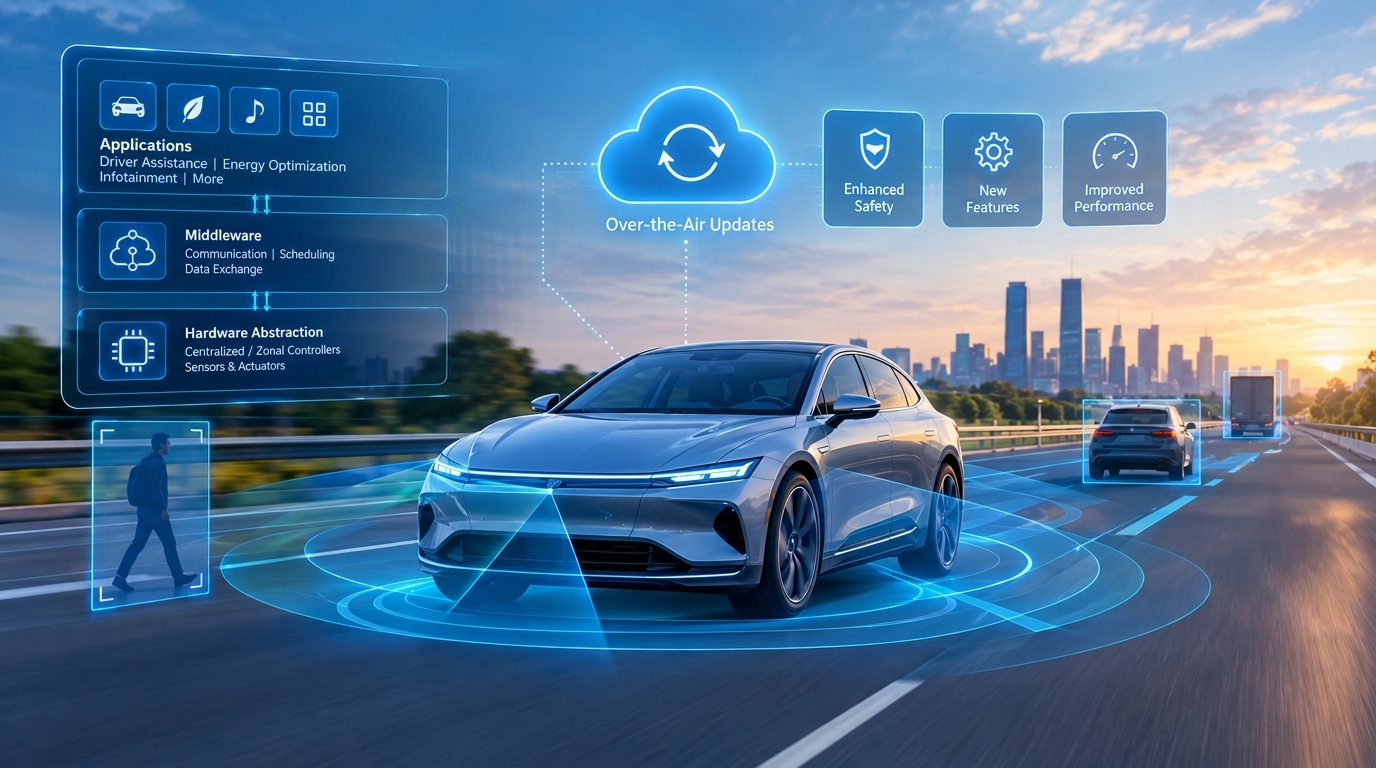
Traditional vehicles feature numerous electronic control modules, each executing its programming, in turn. The Software Defined Vehicle, on the other hand, eases this by consolidating the handling skill into a few powerful devices. In a typical implementation, three layers of cooperation are implemented:
- Hardware abstraction: centralized and/or zonal devices maintaining the processing of work independently from any particular sensor or actuator.
- Middleware: service responsible for establishing communications, scheduling, and data interchange between applications and hardware.
- Applications: features like driver assistance, energy optimization, and infotainment, developed, tested, and rolled out separately.
This matters because it means that functionality can be enhanced without changing the physical make of the vehicle. In a distributed configuration, the update of a feature will often require modification of several hardware modules, while in a centralized deployment this would usually be limited to software improvements validated once and introduced to the whole model range. Take Automatic Emergency Braking system, for instance. НТSА has put forward its final rule FMVSS No.127, stating that the AEB should be used in cars and light trucks of up to 10,000 lbs regarding its ability to detect and respond to both lead vehicles and pedestrians.
Safety Is the Proving Ground
According to NHTSA, this regulation is expected to save a minimum of 360 lives and prevent 24,000 injuries on average yearly, which equates to 67 injuries for each saved life. The software-controlled vehicles are important in helping achieve this because they perform all the processes of sensing, braking, and detecting pedestrians with the same computing technology, so the necessary features can be changed through software, without the need for new hardware.
Moreover, the general trend of road safety explains why these features are important. There is a decrease for three consecutive years according to the NHTSA statistics:
| Year | U.S. traffic deaths | Change from prior year |
| 2022 | 42,721 | Not applicable |
| 2023 | 40,901 | -4.3% |
| 2024 (early estimate) | 39,345 | -3.8% |
In 2024, the rate of fatalities fell to a level of 1.20 per 100 million vehicle miles even if there was an increase of 1% in driving. It should be noted that the NHTSA has registered the 11th quarterly decline in a row during the last quarter of the corresponding year. However, the progress is not even since there was a fall in fatalities in 35 states, while the numbers were anticipated to increase in 14 states. This variety provides useful background information for software teams who work in the automotive industry.
The Business Case for SDVs
Market research performed by Dataintelo captures the enormity of this transformation. The global Software-Defined Vehicle Platform market is going through remarkable development as car manufacturers are shifting to software-based vehicle architecture instead of hardware. The market is predicted to grow from $32 billion in 2025 to $199.7 billion in 2034 which means a reformative change in the way vehicles are engineered, produced, and upgraded. There are two mentioned figures which indicate a compound annual growth rate of approximately 22.5% during nine years or a value increase of nearly 6.2 times.
Over-the-Air Updates Change the Ownership Model
In the past, a safety improvement would necessitate a trip to the dealership. However, it is possible for car manufacturers to remotely enhance performance due to over-the-air delivery. The product has morphed from being merely finished to becoming more of a dynamic platform. Because of this, engineers are racing against time, and the AEB compliance deadline is scheduled for September 1, 2029, which is around 35 months ahead. The development team can utilize OTA systems to calibrate brakes, fine-tune detection algorithms, and processed data before that date approaches. What does this give them? Fast implementation of the improvements, which make it possible to release tested updates to the entire fleet at once.
Why the Architecture Matters for Developers
There is also a transformation regarding the individuals responsible for development within the software-defined context. The rationale here is that, thanks to the stability of the abstraction layer, the engineering teams have the ability to work at the same time, as well as suppliers being able to introduce their own modules without having to rewrite the entire system.
Challenges Engineers Are Solving
The move towards software entails three major engineering challenges every manufacturer must face:
- Validation: A law applicable to all passenger cars and light trucks of under 10,000 pounds requires a single software stack to work for multiple body types and weights and arrangements of sensors.
- Cybersecurity: A vehicle that is able to receive remote updates requires that its transmission channel be secure, encrypted, and audited.
- Data management: Sensors are continuously generating data that needs to be processed, filtered, and stored appropriately.
These problems are not impractical. For example, when AEB is supposed to help avoid 24,000 injuries each year, the faulty update will have severe repercussions, so discipline in testing becomes as important as the ability to innovate. This is the reason why simulation, hardware-in-the-loop testing, as well as staged rollouts have become a standard practice for this type of job.
Key Figures at a Glance
The federal verified statistics provide evidence as to why software is becoming the key part of vehicle engineering:
- 39,345 U.S. traffic deaths expected in 2024, down from 40,901 in 2023 by 3.8%;
- 1.20 deaths per 100 million vehicle miles traveled in 2024, with driving increasing by 1%;
- 360 lives and 24,000 injuries likely to be saved or prevented each year due to FMVSS No. 127;
- Compliance date for AEB for vehicles under 10,000 pounds is set for September 2029.
All figures show that a vehicle’s software design, assessment and support have an increasing impact on the safety results.
The Road Ahead
The notion that the software-defined vehicle is merely one component of an overarching philosophy can be made clear by the fact that an estimated 39,345 people are expected to die as a result of accidents in 2024, highlighting the need for continuous improvement in vehicle safety via software development. It is expected that the global automotive market will reach $199.7 billion within the next ten years which means that manufacturers must adapt their approach to software development if they want to remain competitive on the market of the future. Another important takeaway for those interested in automotive technologies is that vehicles’ overall safety and quality of operation, which will be determined by the amount of software updates and data received by the manufacturers, will be more important than horsepower and autonomy.