

Tencent says usage of its newly launched Hy3 preview model has climbed sharply in the two weeks since release, offering an early sign that the company’s rebuilt Hunyuan model stack may be attracting developer attention beyond its own ecosystem.
According to Tencent, total token calls for Hy3 preview have exceeded its previous-generation HY2 model by more than 10 times since launch, with particularly strong gains in coding and agent-related scenarios. Within Tencent’s own AI products — including WorkBuddy, CodeBuddy and QClaw — token usage has reportedly risen by more than 16.5 times.
Tencent is also pointing to public data from OpenRouter, a model-routing and API aggregation platform that developers use to test models across providers. According to OpenRouter rankings cited by Tencent, Hy3 preview led the platform over the past week in total token consumption and market share, while also ranking first in programming and tool-use categories. Launch-period free token incentives may have helped drive experimentation, but the ranking still gives Tencent an early external signal beyond its own product ecosystem.
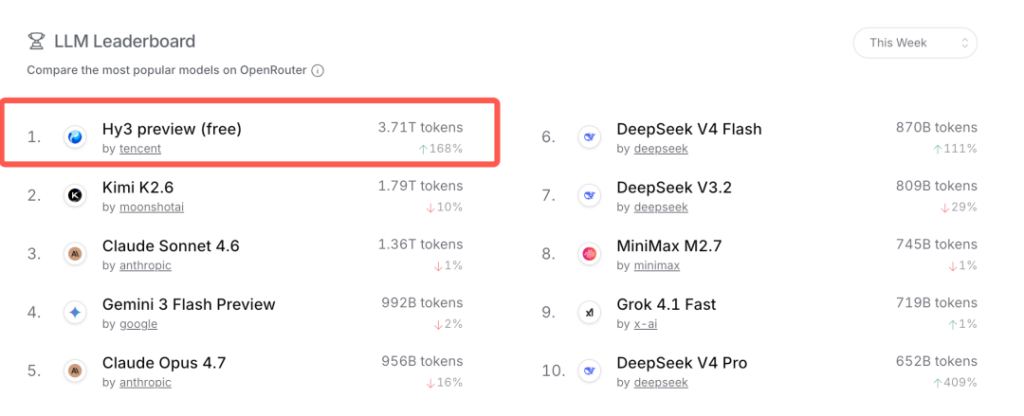
That distinction matters because Hy3 preview is not just another model release for Tencent. It is the first major model to emerge after the company rebuilt parts of its pre-training and reinforcement-learning infrastructure, a reset Tencent has framed as foundational to the next phase of Hunyuan’s development. Hy3 preview uses a 295 billion-parameter MoE architecture with 21 billion activated parameters, supports up to 256K context, and is being positioned around reasoning, coding, instruction-following and agentic workloads rather than sheer parameter scale alone.
In that context, token growth — especially in code generation and tool-calling — may be more strategically relevant than benchmark rankings by themselves. Across the AI sector, competition is increasingly shifting from model launches as isolated events toward whether developers actually integrate those systems into repeatable workflows. Tencent appears to be using Hy3 preview’s early rollout to test whether its latest model can function less as a showcase and more as infrastructure for practical software and agent ecosystems.
Tencent has said that broad launch-period availability, including free token access through OpenRouter, was designed in part to gather authentic feedback from developers and users. The company says both positive and negative responses are being used to guide iteration, suggesting Hy3 preview’s open release is serving not only as distribution, but also as a live market test.
Tencent’s internal product metrics support that broader positioning. Previous company testing said Hy3 preview improved first-response speed by 54% and reduced average task completion time by 47% in products such as CodeBuddy and WorkBuddy, while maintaining task success rates above 99.99%. Tencent Docs’ AI presentation tools also reportedly saw a 20% improvement in generation success after integration.
The larger question now is whether Hy3 preview’s early spike reflects temporary launch momentum or sustained adoption. For Tencent, the more meaningful milestone will be whether developers keep using the model after the initial trial window ends.