
There is a version of AI in payments that the industry has been selling for the past few years. It runs quietly in the background, makes decisions autonomously, and eliminates the need for human involvement in routine financial workflows. It sounds efficient. It also turns out to be exactly what most finance professionals do not want.
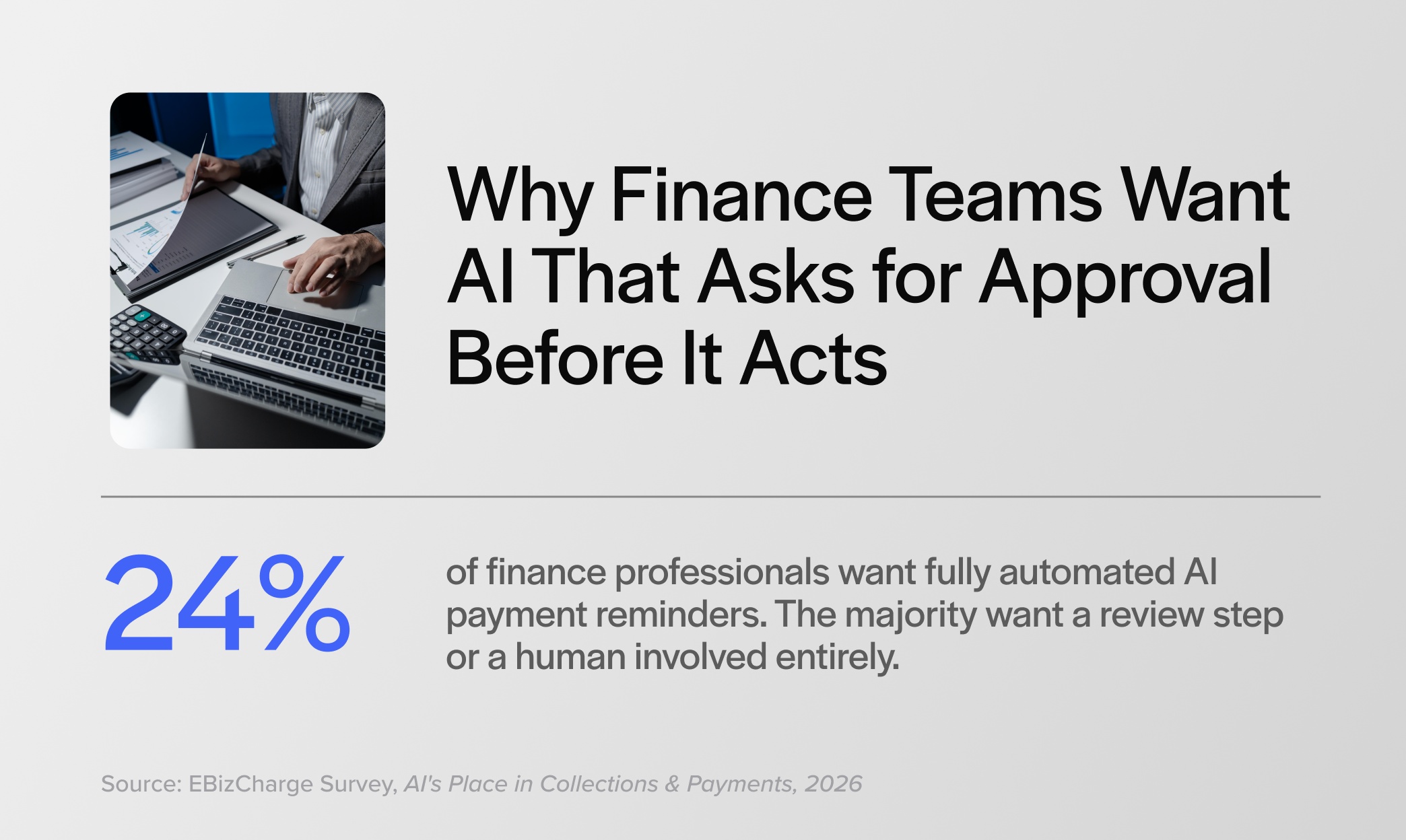
A survey of 1,001 financial decision-makers conducted by EBizCharge on AI in payment processing found that only 24.3% of respondents want fully automated AI payment reminders. The most common response, chosen by 31%, was willingness to use AI only if a human could review and approve messages before anything went out. Another 26.5% rejected automation for this task entirely.
The data points to something the payments industry has been slow to acknowledge. The version of AI that finance teams are actually willing to adopt looks less like autonomous operation and more like a capable assistant waiting for a sign-off.
What Supervised Automation Actually Means in Practice
Supervised automation is not a new concept in technology, but it has a specific meaning in the context of financial workflows. It refers to systems where AI handles the preparation, drafting, and queuing of actions while a human retains approval authority before those actions execute.
In an AR context, this might look like AI scanning open invoices each morning, drafting appropriate follow-up messages based on account history and days outstanding, and presenting a queue of pending outreach for a team member to review before sending. The AI does the time-consuming preparation work. The human makes the final call.
This model captures the efficiency gains of automation without removing human judgment from the decisions that carry real consequences.
Why B2B Collections Is Different From Consumer Collections
In consumer collections, the stakes of a poorly timed message are relatively low. The customer is largely anonymous, the relationship is transactional, and the communication is one of thousands going out that day. If the timing is off, it is annoying. It is rarely catastrophic.
B2B collections is a different situation entirely. The customer on the other end of that reminder is often a company your team has worked with for years, managed through contract renewals, navigated through disputes, and built real trust with over time. They may represent a meaningful slice of your annual revenue. The person reading that message is frequently a finance professional themselves, someone who will immediately notice if the tone is off, the timing is wrong, or the message contradicts something their sales rep said last week.
Now imagine an AI system sends that message autonomously, at the wrong moment, with the wrong tone, to the wrong contact at that account. There is no unsending it. The conversation that follows is awkward at best and damaging at worst. No efficiency gain covers the cost of losing a customer you have spent years building a relationship with.
The survey data reflects exactly this concern. 21.6% of respondents cited customer reaction and damaging relationships as their top concern with AI in payments, placing it ahead of data privacy and cost of implementation. That is not a fringe worry. It is the considered opinion of finance professionals who have seen what happens when collections communication goes wrong, and who are not willing to hand that risk to a system they cannot fully predict.
The Gap Between Rules-Based Automation and Genuine AI Judgment
Part of what makes this conversation complicated is that the term AI covers a wide range of actual capabilities. A significant portion of what gets marketed as AI-powered AR today is closer to conditional logic: send a reminder if an invoice is unpaid after 30 days, escalate if no response after 45. These workflows are useful. They are also not meaningfully different from automation that has existed in AR software for over a decade.
Genuine AI in collections introduces something rules-based systems cannot replicate. It notices that a specific customer always goes quiet in Q4 and adjusts outreach timing before the invoice ever goes overdue. It flags an account for human review because the payment history suddenly looks different, not because a 30-day rule fired. It learns which combination of timing, tone, and contact method actually gets a particular customer to pay, and it applies that knowledge every time without anyone having to remember it.
The supervised automation preference in the survey data makes more sense when viewed through this lens. Finance professionals are not rejecting AI capability. They are asking for transparency about what the system is actually doing and the ability to override it when context requires. That’s a reasonable request, and platforms that build oversight into their design rather than treating it as a limitation are better positioned to earn adoption.
How to Structure a Human-in-the-Loop Workflow for AR
For finance and operations teams evaluating supervised automation, a few structural principles are worth establishing before selecting a platform:
• Define approval tiers based on risk level. Not every AI action requires the same level of human review. Routine reminders for first-time late invoices carry lower relationship risk than escalation notices to high-value accounts. Tier your approval structure accordingly.
• Build exclusion logic from the start. One survey respondent put it well: “We have special rules and exceptions for each customer. I would only want it to send automatic dunning messages if I could have a checkbox on each invoice to exclude them.” The ability to flag specific accounts or time periods for human handling is not an edge case. It is a core requirement.
• Keep AI activity inside your existing systems. Supervised automation loses most of its value if the approval workflow lives in a separate tool. Embedded payment processingsolutions that operate inside your ERP keep the review process in the same environment as the underlying financial data.
• Establish a feedback loop. When a team member overrides an AI-drafted message or removes an account from a sequence, that signal should inform future behavior. Platforms that support this kind of feedback loop improve over time rather than staying static.
For teams ready to put these principles into practice, the platform you choose matters as much as the framework you build.
Where to Start With AR Automation
For most finance teams, the right entry point is not the most sophisticated AI tool on the market. It is the most reliable one that fits inside the workflow they already have. The fundamentals are a practical place to start. Focus on automated invoice delivery, payment reminders with human review controls, and reconciliation that posts directly back into your accounting system. Getting those right gives a team something concrete to build confidence around before expanding further.
The goal in the first phase is not automation for its own sake. It’s about building enough confidence in the system’s accuracy and reliability that the team is willing to extend it further over time. That trust is earned through consistent performance on low-risk tasks before anyone considers handing the system anything more consequential.
EBizCharge handles this foundational layer, covering invoice delivery, payment reminders, payment matching, and reconciliation natively inside the ERP and accounting systems finance teams already use. It connects to over 100 platforms including NetSuite, SAP Business One, Microsoft Dynamics, Sage, and QuickBooks. For teams looking to build the operational foundation that any future AI layer would need to work from, the EBizCharge payment solutionis a practical starting point.
What the Data Actually Tells Us About AI Adoption in Payments
The supervised automation preference is not a sign that finance teams are resistant to AI. It is a sign that they have thought carefully about where AI fits and where it does not. The teams closest to these processes know that customer relationships are not a variable to be optimized around. They are a constraint that any automation strategy has to work within.
The AI tools that earn adoption in finance over the next several years will not be the ones that promise the most autonomy. They will be the ones that demonstrate the most reliability and give finance professionals the control they need to extend trust incrementally over time.