
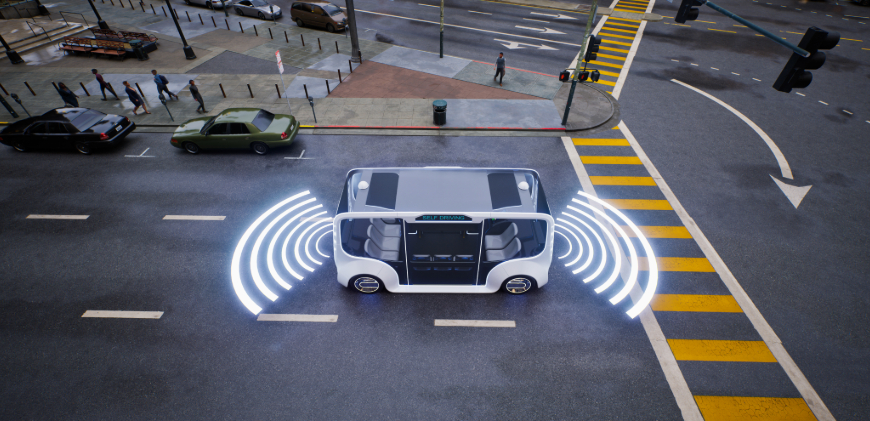
Fully driverless passenger car hailing services will soon be available in London, with companies including Waymo, Uber and Lyft preparing to launch pilots in the capital this year. A trial of fully driverless vehicles is already underway in Amsterdam too. Despite these signs of progress, public trust remains a significant barrier to driverless mobility in the UK and Europe, so can it be overcome?
Pilot schemes have an important role to play in improving and refining emerging technologies, but for many consumers it’s a case of seeing is believing. They need to witness some of the latest driverless technologies for themselves, before they would contemplate using a car with these features. Regulators also need to be assured that the right safety precautions are in place before allowing AVs to be trialled on public roads, even in confined areas, without a ‘safety driver’ on board.
A growing number of car manufacturers have adopted Level 3 autonomous vehicle (AV) technologies for new ranges and motorists are becoming more familiar with them. On motorways, the latest Level 3 technologies allow the driver to take their eyes off the road, and remove their hands from the wheel, when in a traffic jam with the AV performing the full driving tasks at low speeds and the driver is not required to supervise. Drivers are also familiar with Level 2 technologies, which are capable of controlling the AV but with the important distinction that the driver must supervise the vehicle. A common example of Level 2 AV technology is parking assist, where the car is capable of manoeuvring itself into a kerbside parking space and then applying the brakes. Whilst they are not new, these technological features are evolving, and a growing number of motorists regard them as aspirational.
Whilst Level 2 vehicles have been available in vehicles for a number of years, it is only recently that Level 3 AV technologies have been made available to consumers. This is in part due to increased certainty about regulatory and safety requirements. Eight years ago, when Audi launched its fourth generation Audi A8, its Level 3 Traffic Jam Pilot system was never enabled because European regulations at the time required active driver steering at speeds higher than 10 km/h, and liability issues linked to driverless motoring had not been resolved. Much has changed since then, and today, Germany is regarded as a European leader in terms of regulatory readiness allowing Level 3 and Level 4 AV technologies, with countries such as the Netherlands and France not far behind. The UK is also making progress and the Department of Transport has confirmed plans to have a full regulatory framework for autonomous driving in place by H2 2027.
Whilst AV technologies have been advancing rapidly, the lag in terms of clarity about the direction of travel for evolving safety and regulatory requirements, has slowed their introduction. For example, ‘full redundancy’ in AV technologies was formally established as a global standard for regulation in January this year. In the UK, a new ‘self-driving test’ for vehicles, due to be introduced next year under the Automated Vehicles Act 2024, will require the full redundancy of systems involved in steering, braking and sensing. Car makers must now respond to these changes to ensure their new ranges and onboard systems are compliant.
This emerging picture is encouraging developers and other tech innovators to consider novel ways to achieve full redundancy. Duplicating onboard AV systems to ensure there is always a backup mechanism in place is an obvious solution, but this can add significant complexity. For example, NVIDIA in EP3707572 developed a system comprising multiple systems on a chip, and an AI-enabled arbitrator to determine when false positives occur and when to switch systems.
There are many other complexities associated with the use of AV technologies in different environments, which are yet to be resolved. Learnings from existing, long-running trials, such as Waymo’s ‘rider-only’ robotaxi service in San Francisco, could be critical to inform future development in other locations. For example, we have learned about the importance of an assertive driving style and the role of enhanced visual perceptions systems in identifying and responding to physical hazards, such as wild animals or passing vehicles. US 9097800 from Google describes an innovative method of combining LIDAR and RADAR data to distinguish between solid objects and non-solid features, such as rain and fog, to increase detection and avoid false positives, which might otherwise occur.
Another barrier that has slowed the deployment of AVs is uncertainty about who or what would be responsible for the serious injury or death of a person in the event that a systems failure caused an accident. In the insurance sector, this issue is known as ‘subrogation’ or the process by which an insurer would be able to seek reimbursement from third parties after making a payout to a claimant. Driverless motoring has brought this particular issue to the fore because liability could rest with a piece of technology or an onboard system, rather than with a human driver.
To deal with the subrogation issue, tech innovators have been developing systems that can prove whether the vehicle was in fully autonomous mode at the time of an accident, and the degree of autonomy provided. This is particularly important in situations where driver takeover technologies are in place, some of which can be used remotely. For example, State Farm Mutual Automobile Insurance in US 9805423 has developed a system that is able to identify when a vehicle is operating in an autonomous mode and allocates faults between a vehicle operator, the autonomous features and any third parties in the event of a collision.
Another roadblock to driverless mobility is the increased cybersecurity threat, and the fact that AV systems are reliant on wireless connectivity, AI and software-based innovation. At a time of heightened geopolitical risk, it is essential that innovators develop cyber resilient systems, which are able to maintain safe operations even when compromised by an attack. For example, digital twin technology is being developed to improve the cyber resilience of connected AVs and fleets of connected AVs, by enabling remote cybersecurity diagnostics and checking software security patches and firmware updates for Electronic Control Units (ECUs).
With the technological, regulatory and risk landscape shifting at pace, vehicle manufacturers and innovators of AV technologies can’t afford to wait for greater certainty. Patenting early and staying at the forefront of the innovation curve could bring significant early-mover advantages as the market opens up, especially where there are licensing opportunities.
Diego Black is a partner and patent attorney at European IP firm, Withers & Rogers. He specialises in advising vehicle manufacturers as well as developers of AI systems and autonomous technologies, on all aspects of intellectual property protection.