
Organizations are generating more event data than ever before.
Application activity, customer interactions, operational alerts, IoT telemetry, and system notifications all produce streams of information that can be leveraged for analytics, machine learning, and business intelligence initiatives. Before this data can create value, however, it must first be captured reliably.
One of the most common challenges in cloud environments is ingesting event notifications from multiple systems and persisting them in a centralized location for downstream consumption. While event delivery may seem straightforward at first glance, organizations quickly encounter challenges involving scalability, reliability, operational overhead, and cost.
This article explores an architecture for capturing Amazon SNS notifications and storing them in Amazon S3 using Amazon SQS and AWS Lambda. The approach provides a reliable foundation for analytics platforms, AI pipelines, auditing systems, and large-scale data processing workloads.
Modern AI and analytics systems depend heavily on historical and real-time event data.
Examples include:
● Training recommendation models from user activity logs
● Building anomaly detection systems from operational events
● Creating customer behavior analytics platforms
● Supporting compliance and auditing requirements
● Generating features for machine learning models
The effectiveness of these initiatives depends on the quality and completeness of the underlying data.
If events are lost during ingestion, downstream analytics become inaccurate. If processing systems cannot keep up with traffic spikes, important business signals may never reach data consumers.
As a result, designing a resilient ingestion layer becomes a critical architectural decision.
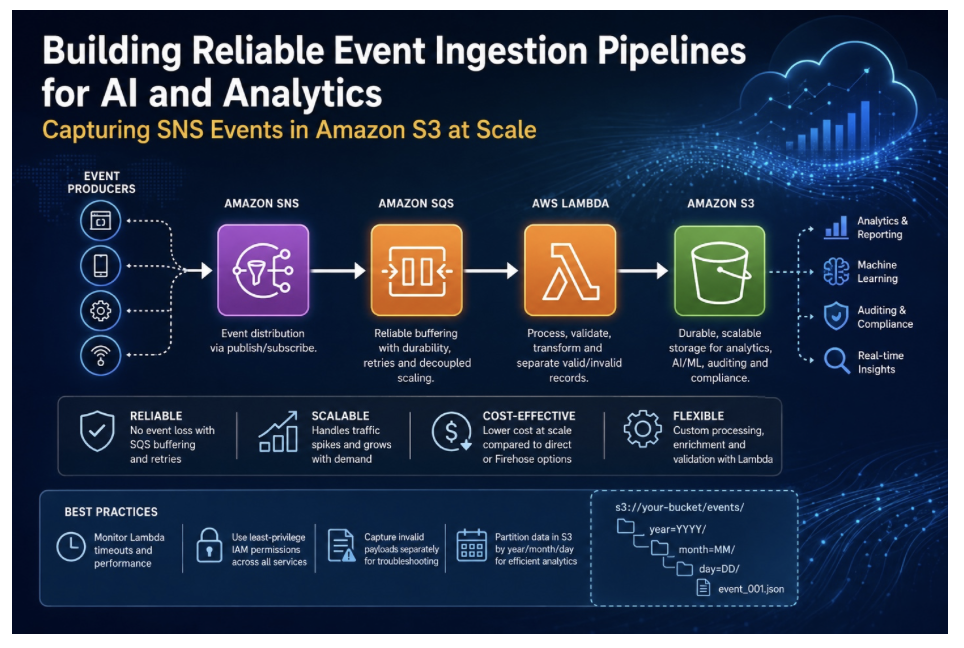
The proposed architecture follows a simple but highly reliable pattern:
Amazon SNS → Amazon SQS → AWS Lambda → Amazon S3
Each service performs a specific responsibility within the pipeline.
Amazon SNS: Event Distribution Layer
Amazon SNS acts as the event entry point.
External systems publish notifications to SNS topics, allowing multiple consumers to subscribe and receive the same events.
This publish-subscribe architecture decouples event producers from consumers and enables organizations to scale independently.
In many enterprise environments, SNS topics receive notifications from applications operating in different AWS accounts, making them a common integration mechanism across teams.
Amazon SQS: Reliability Buffer
A common mistake is connecting SNS directly to Lambda.
While this configuration appears simpler, it introduces operational risks.
Amazon SQS provides an important buffering layer between event generation and event processing.
Benefits include:
● Protection against traffic spikes
● Automatic retry behavior
● Message durability
● Decoupled scaling
● Reduced risk of event loss
By persisting events before processing, SQS ensures that temporary failures do not immediately result in data loss.
AWS Lambda performs the transformation and persistence logic.
When messages arrive in SQS, Lambda is triggered automatically and processes events without requiring dedicated infrastructure.
Within this architecture, Lambda performs several key functions:
● Reads SNS payloads
● Parses message contents
● Validates JSON structures
● Separates valid and invalid records
● Writes data to Amazon S3
This serverless model eliminates infrastructure management while allowing processing capacity to scale automatically based on workload demand.
Amazon S3: Persistent Storage Layer
Amazon S3 serves as the long-term storage destination.
Event data stored in S3 can later support:
● Data lake architectures
● Machine learning pipelines
● Business intelligence reporting
● Compliance requirements
● Historical auditing
By organizing files using date-based partitioning, teams can simplify downstream analytics and improve query performance.
A common partitioning strategy includes:
year=YYYY
month=MM
day=DD
This structure aligns naturally with many modern analytics platforms.
Why Not Write Directly From SNS to Lambda?
A frequently proposed alternative architecture is:
SNS → Lambda → S3
While functional, this design introduces limitations.
If Lambda encounters failures or throttling events, messages must be recovered through Dead Letter Queues or additional retry mechanisms.
Operationally, this creates more complexity.
By introducing SQS between SNS and Lambda, organizations gain durable message storage and significantly improve fault tolerance.
The architecture becomes more resilient without adding substantial complexity.
Alternative Architecture: Kinesis Data Firehose
Another option involves:
SNS → Kinesis Data Firehose → S3
Firehose provides managed delivery capabilities and simplifies certain ingestion scenarios.
However, there are trade-offs.
Firehose pricing is based primarily on data volume.
For high-frequency notification workloads, costs can increase significantly compared to Amazon SQS.
Organizations processing millions of small events often find SQS-based architectures more economical.
Firehose supports limited transformation capabilities.
Lambda-based processing provides substantially greater flexibility when implementing:
● Custom enrichment
● Schema validation
● Business logic
● Data normalization
● Error handling
For organizations expecting evolving requirements, Lambda offers greater adaptability.
Any production-grade ingestion pipeline must account for operational realities.
Lambda timeouts can interrupt processing.
Monitoring execution duration and configuring appropriate timeout settings helps prevent incomplete processing.
IAM permissions represent one of the most common causes of deployment issues.
Carefully validating access policies across:
● SNS
● SQS
● Lambda
● S3
helps ensure smooth operation.
Not every incoming message will conform to expected schemas.
Separating invalid payloads into dedicated storage locations simplifies troubleshooting while preserving potentially valuable data.
This approach supports both reliability and observability.
Supporting Future AI Initiatives
One of the strongest advantages of this architecture is that it creates a reusable data foundation.
Today, organizations may simply archive notifications.
Tomorrow, those same events may support:
● Predictive analytics
● Machine learning training datasets
● Real-time intelligence systems
● Feature engineering pipelines
● AI-powered anomaly detection
By persisting events reliably from the beginning, organizations avoid costly data reconstruction efforts later.
Reliable event ingestion is a foundational capability for modern analytics and AI ecosystems.
Although multiple architectures exist for moving SNS messages into Amazon S3, the combination of SNS, SQS, Lambda, and S3 offers a balanced solution that delivers scalability, reliability, flexibility, and cost efficiency.
By leveraging SQS as a durable buffer and Lambda as a processing layer, organizations can ensure that valuable event data reaches long-term storage consistently, even during traffic spikes or temporary system failures.
As AI and data-driven decision-making continue to expand across industries, architectures that prioritize durable event capture will become increasingly important. Building that foundation today enables organizations to unlock future analytics and machine learning opportunities with confidence.