
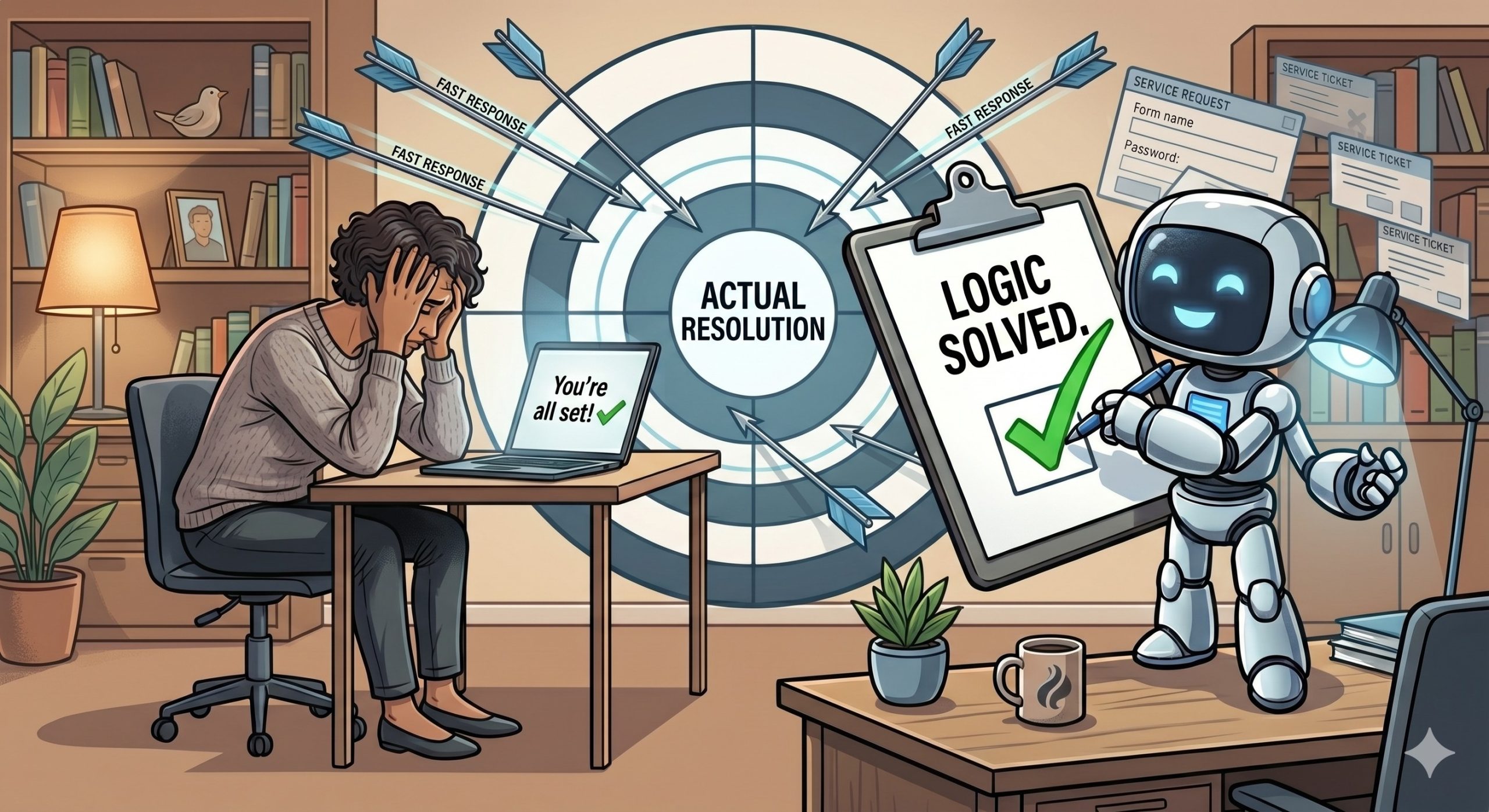
Most companies are proud of how quickly their AI responds. But speed isn’t solving the real problem. In many cases, it’s making the customer experience worse.
Recent data tells a clear story: nearly eight in ten customers say they’ve gotten “fast” support that still left them frustrated, and more than four in ten now say AI actually makes things harder, up eight points since our last survey. At the same time, over half say they’re unlikely to stay loyal to brands that remove human support altogether.
For years, companies have been told that faster equals better: faster responses, faster resolution times, faster automation. But in the rush to optimize for speed, many organizations have overlooked something more fundamental: whether the customer actually gets unstuck.
This isn’t just a user experience issue. It’s a loyalty and revenue problem. When customers can’t complete a task—whether it’s opening an account, resolving a billing issue, or finishing a purchase—they don’t just get frustrated. They leave.
The real problem: operating in the dark
The issue with today’s AI-driven support isn’t just automation. It’s context.
When customers get stuck in a digital journey and reach out for help, support agents are often forced to troubleshoot without seeing what the customer sees. It becomes a frustrating game of guesswork: “Do you see this button?” “What does your screen look like?” “Can you scroll down?”
One banking executive described this dynamic as “leading someone through the dark.” For customers, it feels exactly that way.
Speed doesn’t fix this. In fact, faster responses can amplify the frustration. A quick answer that doesn’t resolve the issue only gets the customer to the next dead end faster.
The AI “nudge” problem
There’s another layer emerging as AI becomes more embedded in work and customer journeys: models are mathematically designed to nudge things toward “done.”
Anyone who’s asked an AI model for help on a complex task has seen this. The system cheerfully declares, “You’re all set,” “Want me to send this now?” or “Ready to move on to the next step?” even when you know the work isn’t ready. Under the hood, the AI is a world-class pattern matcher, but it doesn’t actually know why you are doing the task. It is optimized to treat the problem as “solved” as soon as the core logic holds together, checking a box for statistical completion long before the human has reached emotional or actual resolution.
That might be fine for an internal draft. It’s dangerous when applied to real customers.
In support flows, the model is effectively checking a “logic solved” box—yes, this looks like the right answer based on the training data, long before the customer feels anything close to finished. The AI pushes toward closure not because the human has clarity, but because the system is optimized for session completion. It wants to “clean up” the conversation and move on.
The result is a growing mismatch: AI is confident the task is done based on internal parameters, while the customer is still stuck in the reality of the problem.
The gap between AI promise and customer reality
AI has fundamentally changed how companies approach customer experience. It has made it possible to handle high volumes of simple, linear interactions with impressive efficiency. But this shift has also exposed a growing gap between what companies promise and what customers actually experience.
Customers do want the benefits of AI: faster answers, easier access to information, and less friction for simple tasks. But when interactions become complex, high-stakes, or emotionally sensitive, expectations shift.
In those moments, customers don’t want another automated nudge or “you’re all set” message based on a probability curve. They want clarity, confidence, and the ability to get on the same page as a real person.
That’s where many current systems break down.
What actually works: speed plus shared understanding
The companies that are getting this right aren’t abandoning AI. They’re rethinking how and when it’s used.
Instead of optimizing for speed and “AI closure” alone, they’re focusing on what happens at the moment of friction—when a customer gets stuck and needs help to move forward.
When customers can transition into a shared digital space with a human at the right moment, the impact is significant. Tasks that once took close to an hour can be completed in minutes. Customer satisfaction and Net Promoter Scores increase. And average handle time for agents can drop by as much as 50%.
The difference isn’t just speed. It’s shared context.
When both the customer and the agent can see the same thing and work together in real time, the interaction shifts from guesswork to resolution—from frustration to progress.
A new standard for customer experience
We’re entering a new phase of customer experience—one where AI alone isn’t enough.
The next standard isn’t about replacing humans with automation. It’s about orchestrating both effectively. AI is exceptional at identifying patterns, surfacing insights, and handling routine throughput. Human expertise remains critical for navigating complexity, building trust, and guiding customers through high-stakes moments.
The companies that succeed in this environment won’t be the ones with the fastest bots or the most aggressive AI nudges. They’ll be the ones that design for seamless handoffs between automation and human support—and know when to take the AI’s “you’re done” with a grain of salt.
What leaders should do now
For business leaders, this shift requires a change in how success is defined and measured.
1. Identify high-stakes moments, not just high-volume ones
Not every interaction needs human support. But the moments that drive abandonment, frustration, or loss of trust do. Focus on where customers are most likely to get stuck—and where it matters most.
2. Treat “get me a human” as a signal, not a failure
When customers ask for help, it’s not a breakdown in the system. It’s an opportunity to build trust and move them forward.
3. Design for shared visibility, not just faster responses
Customers don’t just need answers; they need clarity. Creating ways for agents and customers to work from the same context can dramatically improve outcomes.
4. Measure last-mile success, not just AI efficiency
Speed metrics and AI resolution rates don’t tell the full story. Track whether customers actually complete their tasks, how satisfied they are, and whether they come back.
The future isn’t faster, it’s smarter
The push for speed in AI isn’t going away. But speed alone isn’t the answer.
The future of customer experience will be defined by how well companies combine automation with human expertise; how quickly they can recognize when a customer needs help; and how effectively they can deliver it.
The brands that get this right won’t just resolve issues faster. They’ll build stronger relationships, earn deeper trust, and create experiences customers actually want to return to.