
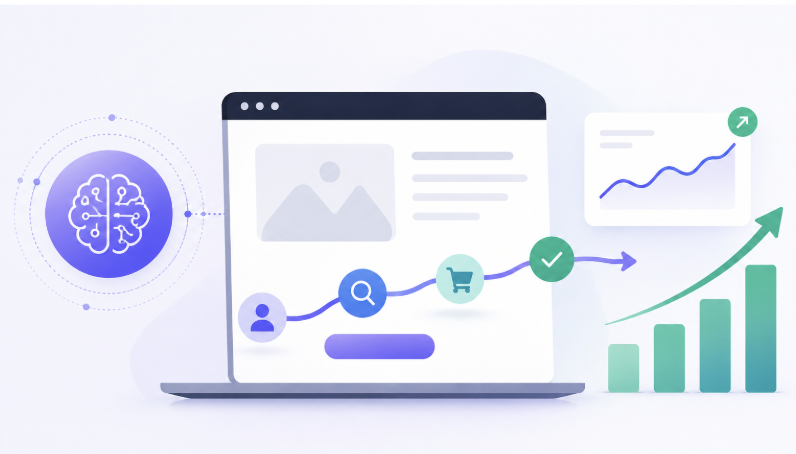
For a long time, conversion rate optimization (CRO) has relied on iteration and testing. Marketers build a hypothesis, launch variations, review the outcomes, and repeat the process. Although effective, the approach fails to keep pace with today’s customer journeys. This is where visitors arrive from multiple channels, use various devices, and expect personalized experiences.
Artificial Intelligence here has become a major game-changer. Instead of waiting for weeks on end for A/B test results, AI evaluates visitor behavior in real time. This helps in adapting to experiences. This shifts CRO from optimizing individual pages to consistently enhancing the overall customer journey. This enables businesses to increase their conversions more efficiently.
What Is Conversion Rate Optimization (CRO)?
Conversion Rate Optimization (CRO) is the process of enhancing a website or an application to encourage more visitors to complete their desired actions. Such actions might include:
- Purchasing a product
- Filling out a contact form
- Signing up for a newsletter
- Booking a demo
- Downloading an ebook
- Registering for a webinar
The primary objective of CRO is straightforward. It helps in maximizing the value of existing traffic without increasing marketing expenditure. Most businesses operate with a digital marketing agency to find better ways to convert visitors into potential customers and enhance performance.
Where AI Is Making the Biggest Difference
The following areas highlight the different ways the gap is closing, each promoting a seamless user journey and a direct path to revenue.
Predicting Drop-Off Before It Happens
AI enhances CRO by analyzing patterns in browsing history, time spent on a page, and click sequences to estimate what a visitor is most likely to do next. This enables businesses to identify problem areas in the user journey before a visitor abandons their cart completely. This turns lost sales into saved ones.
What Predictive Models Do
- Flag visitors at risk of leaving
- Estimate purchase likelihood early
- Surface on which products draw hesitation
- Rank pages by drop-off risk
Such models are enhanced with more data, helping high-traffic sites to witness immediate results. Their core value remains in helping teams to focus on better opportunities. The most effective CRO strategies for higher conversions start with predicting visitor behavior rather than redesigning pages.
Finding Revenue-Winning Variants Faster
AI enhances CRO by converting traffic to better-performing variants while testing is still underway instead of waiting for a fixed sample size and a defined waiting period for result confirmation.
Adaptive Testing Behaviors
- Reallocates traffic mid-test
- Detects early performance signals
- Reduces required sample size
- Limits exposure to weak variants
Immediate results carry a tradeoff since adaptive tests at times overcorrect on noisy early data when left uncalibrated. This is linked to a major change across enterprise tools, where AI agents reduce manual admin work that previously slowed teams in customer-centric systems.
Personalizing the Journey for Every Visitor
AI will enhance CRO by adjusting layout, messaging, and offers for each visitor in real time. This is based on specific behavior rather than broader demographic assumptions. Earlier, personalization meant presenting different banners to different audience groups. Today, AI can customize the experiences for every visitor.
How Personalization Adjusts
- Rewrites headlines per visitor
- Reorders product displays live
- Adjusts pricing display context
- Tailors calls to action
Personalization increases engagement before it leads to conversions because building trust takes time. According to Forrester Research, brands implementing AI-driven funnel personalization have raised average conversion rates of up to 6.8%. The strongest performers today are exceeding 14%.
Sharpening the Words That Drive Conversion
AI can enhance CRO by analyzing website copy, product descriptions, and support interactions to identify language associated with higher or lower conversion rates. CRO copywriting evolves from guesswork to measurable pattern recognition, so every word in the journey earns its place.
Where NLP Adds Value
- The headline is clear
- Difficult to understand
- Adjusts tone based on audience intent
- Word-level variations are assessed
NLP tools are excellent at flagging issues, but they can’t offer a perfect solution, so human judgment remains important at the final edit stage. As a result, it makes testing content easier by allowing writers to improve low-performing phrases rather than rewriting the entire page.
Removing Friction at the Final Step
AI boosts CRO by providing an answer to a visitor’s specific question in seconds, at a moment of friction, such as a complicated shipping policy or a confusing return process. Chat-oriented assistants intervene right where journeys typically break down, preventing visitors from leaving checkout to find answers elsewhere.
Common Checkout Interventions
- Delivers immediate responses regarding shipping
- Explicates the policy on returns
- Indicates guidance on size or fit
- Regains cart sessions
These helpers are most effective when there is an easy transition to a human being for complex or sensitive requests. The revenue impact of removing minor friction points during checkout tends to be greater than that of a major redesign.
Conclusion
CRO is gradually moving from static experiments to systems that respond in real time to behavior as it unfolds. A business that embraces a continuous learning approach to testing rather than periodic testing cycles will be better suited to respond as customer expectations evolve.
The next step in this evolution will probably be an even tighter integration of behavioral data and content in checkout. As a result, user journeys become more of a conversation and less of a funnel, with real-time recognition and adjustments.