The enterprise environment has shifted from individual productivity tools to collaborative autonomy. While standalone AI assistants offered early competitive advantages by summarizing documents or drafting responses, they inevitably hit a ceiling when confronted with complex, cross-departmental operations.
True scalable efficiency demands a transition toward systems that can independently orchestrate multi-step workflows. Organizations are actively deploying networked, specialized multi-agent systems to handle intricate enterprise operations, moving past simple automation into a completely new era of operational design.
The Limitations of Monolithic AI in Corporate Environments
Isolated language models or single-purpose chatbots frequently struggle when introduced to unstructured corporate environments. A single model tasked with managing customer onboarding, fraud mitigation, and technical troubleshooting all at once faces intense context fragmentation. It often hallucinates variables or misinterprets domain-specific logic.
In contrast, dividing a complex operational pipeline into specialized roles mimics an organization’s existing structure. Instead of a single system attempting to process every variable, enterprises are shifting to structured networks where distinct digital units manage individual pieces of a process under automated governance layers.
Understanding the Mechanics of Multi-Agent Systems
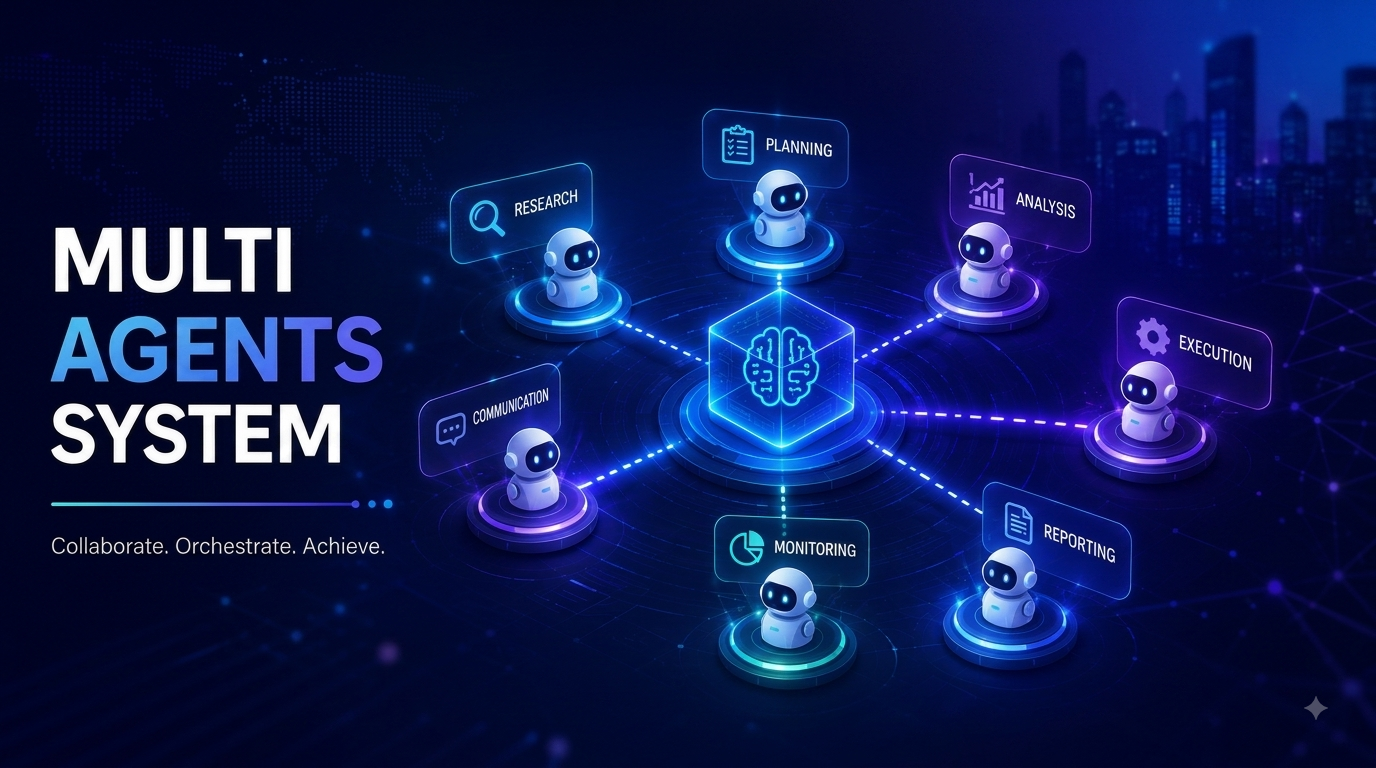
An intelligent architecture relies on coordination, specialization, and robust communication protocols. Within these frameworks, separate digital units are designed with distinct boundaries, memory access parameters, and tool sets.
By leveraging dedicated systems that collaborate via unified semantic protocols, corporations can construct an agile operational backbone. A common deployment strategy utilizes a clear architectural breakdown:
- The Orchestrator
This acts as the central coordinator, breaking down a high-level outcome into discrete, manageable sub-tasks and assigning them appropriately.
- The Domain Specialists
Individual entities fine-tuned with hyper-focused prompt structures, strict tool boundaries, and private vector databases tailored to specific functions like contract analysis, inventory tracking, or credit scoring.
- The Critic
An evaluation mechanism designed to challenge outputs, check calculations against deterministic business logic, and enforce corporate compliance rules before any external action occurs.
This structured division ensures no individual system is overwhelmed with excessive tools or data context, directly driving up overall execution accuracy.
The Operational Shift from Assistive to Collaborative Architecture
For several years, enterprise applications focused primarily on digital copilots. These tools functioned as reactive assistants, processing explicit commands, and relying heavily on constant human verification. While helpful, they created a cognitive bottleneck. Operational teams spent significant time reviewing data summaries rather than driving strategic decisions.
The current market introduces a more capable paradigm – autonomous orchestration. Instead of a single model attempting to handle complex corporate logic, enterprises deploy specialized networks. This approach divides complex operational goals into modular tasks handled by discrete digital entities.
The market trajectory reflects this operational reality. The global market value for AI agents is projected to reach approximately 10.9 billion dollars, representing a stark upward trend in corporate adoption. This structural evolution allows companies to move away from rigid, linear software platforms and adopt adaptive environments that handle scale without compounding administrative overhead.
Market Evolution: Moving from Pilots to Production
The rise of multi-agent systems for enterprise workflow automation has accelerated dramatically. The market has moved beyond experimental sandboxes into deep operational integration, fundamentally shifting how corporate software functions.
Ubiquitous Copilots (2024 – 2025)
Enterprises widely adopt inline text completion and basic retrieval-augmented generation (RAG) tools. These systems remain entirely passive, requiring constant human prompting and oversight for single tasks.
Task-Specific Autonomy (2025 – 2026)
Organizations transition to deploying independent digital entities with tool-calling capabilities. Systems begin executing structured workflows like IT incident response and automated customer support triage with minor human verification.
Orchestration & Interoperability (2026 – Beyond)
The default architecture becomes multi-agent systems. Standardized communication frameworks allow agents from diverse platforms to securely negotiate supply chains, manage cross-border finance compliance, and dynamically adjust enterprise software interfaces.
Driving Measurable Outcomes Across Core Business Units
Deploying tailored AI agents solutions across distinct organizational branches transforms how departments interact with data and execute workflows.
Supply Chain and Inventory Orchestration
Modern supply chain management involves juggling highly volatile external data. When a supplier delay occurs, a specialized multi-agent framework responds dynamically.
An ingestion agent flags the shipping anomaly, a logistics agent analyzes alternative transport corridors for cost and carbon impact, and a negotiation agent drafts procurement modifications based on preset historical contracts. The entire loop executes in minutes rather than days.
Financial Compliance and Risk Management
In high-stakes environments like banking or corporate finance, cross-referencing information against shifting international regulations requires extreme diligence.
Specialized systems can scan incoming unstructured transaction data, calculate exact debt-to-income ratios, and verify identity metrics simultaneously. If a risk boundary is crossed, an automated summary detailing the exact non-compliance markers is instantaneously generated for senior management overview.
Key Strategic Benefits for Modern Operations
Investing in sophisticated AI/ML services centered around multi-agent coordination yields long-term structural returns. Organizations that transition away from fragmented legacy software to cohesive agentic frameworks experience distinct operational advantages:
- Drastic Cost Reduction Per Task
By executing complex processes through optimized digital workflows, the overhead of standard operational transactions drops significantly compared to entirely manual processing.
- Granular System Observability
Because every decision, tool call, and internal validation step is logged via structured tracing protocols, debugging and auditing automated pipelines becomes completely transparent.
- Mitigated Hallucination Risks
Limiting individual components to narrow scopes and 5-8 highly relevant tools prevents the cognitive clutter that causes larger language models to fail during multi-step reasoning.
Navigating The Deployment Continuum
Transitioning toward intelligent, distributed computing networks requires clear strategic alignment. Success rests on precise engineering principles rather than simple software deployment.
- Establish Granular Data Integration
Autonomous networks are only as reliable as the underlying information architecture. Fragmented data structures result in poor decision-making. Siloed databases must be bridged into low-latency data pipelines.
- Implement Zero-Trust Security Architectures
As autonomous units interact with different corporate layers, security protocols must adapt. Every data handoff and tool invocation requires absolute validation and verifiable audit logs.
- Maintain Clear Human-in-the-Loop Safeguards
Autonomy does not mean complete isolation from human leadership. High-stakes financial approvals, client legal decisions, and structural policy changes must feature clear intervention thresholds where human logic finalizes the process.
Technical Protocols Driving Seamless Interoperability
Building an environment where independent digital units communicate effectively requires strict integration standards rather than fragmented custom code blocks. Recent industry developments focus on standardized communication frameworks.
Emerging architectural approaches, such as Anthropic’s Model Context Protocol, define how these autonomous entities interact with corporate data pipelines, software tools, and secure repositories. On a horizontal level, unified communication protocols enable different operational units to delegate tasks, negotiate processing priorities, and pass contextual variables without data loss.
This standardized ecosystem allows organizations to layer advanced AI agent solutions over legacy infrastructure without rewriting core foundational code. It ensures that investments made in enterprise resource planning systems or customer relationship management platforms remain functional while acquiring autonomous layers.
Conclusion
Successfully deploying coordinated autonomous architectures requires a deep understanding of machine learning nuances, integration engineering, and enterprise workflows. The custom AI solutions are designed to integrate seamlessly into existing corporate environments, modernizing legacy systems without disrupting current operational momentum.
Building bespoke, highly resilient multi-agent systems using machine learning models, help organizations automate intricate, high-stakes processes with absolute precision. Moving beyond static automation toward dynamic digital collaboration ensures enterprise remains highly adaptable, optimized, and prepared to scale in an increasingly automated economy.