
Abstract
As enterprises scale in complexity, managing operations across multiple systems, workflows, and business functions becomes increasingly challenging. Traditional enterprise platforms operate in silos, limiting visibility, slowing decision-making, and reducing operational efficiency.
The concept of an AI Command Center introduces a unified layer of intelligence that orchestrates workflows, monitors system activity, and enables real-time decision-making across the enterprise. By integrating artificial intelligence, automation, and centralized dashboards, organizations can transition from reactive operations to proactive, intelligence-driven management.
This article presents a vendor-neutral framework for building an AI-powered command center, demonstrating how centralized orchestration, predictive insights, and automated workflows can enhance enterprise agility, operational efficiency, and governance.
1. Introduction
Modern enterprises operate in an environment defined by complexity, scale, and constant change. Business processes span multiple systems, departments, and geographies, creating fragmented workflows and disconnected data streams. As a result, organizations often struggle with limited visibility into operations and delayed decision-making.
Traditional enterprise systems are designed to execute processes efficiently but lack the ability to provide a unified view of organizational activity. Teams rely on multiple dashboards, manual reporting, and reactive interventions to manage operations.
This fragmented approach introduces inefficiencies and increases the risk of operational failures.
The AI Command Center addresses this challenge by introducing a centralized intelligence layer that integrates data, workflows, and decision-making processes. Instead of managing operations in isolation, organizations can orchestrate activities through a single, unified platform powered by AI.
This shift represents a fundamental transformation in how enterprises operate—from distributed execution to centralized intelligence.
2. The Need for a Unified Command Center in Enterprise Operations
As organizations adopt digital transformation initiatives, the number of systems and processes increases significantly. While these systems improve functionality, they also create silos that hinder collaboration and visibility.
Operational teams often face challenges such as:
- Lack of real-time visibility across workflows
- Delayed identification of issues and bottlenecks
- Inefficient coordination between teams
- Reactive rather than proactive decision-making
These challenges highlight the need for a centralized system that provides a holistic view of enterprise operations.
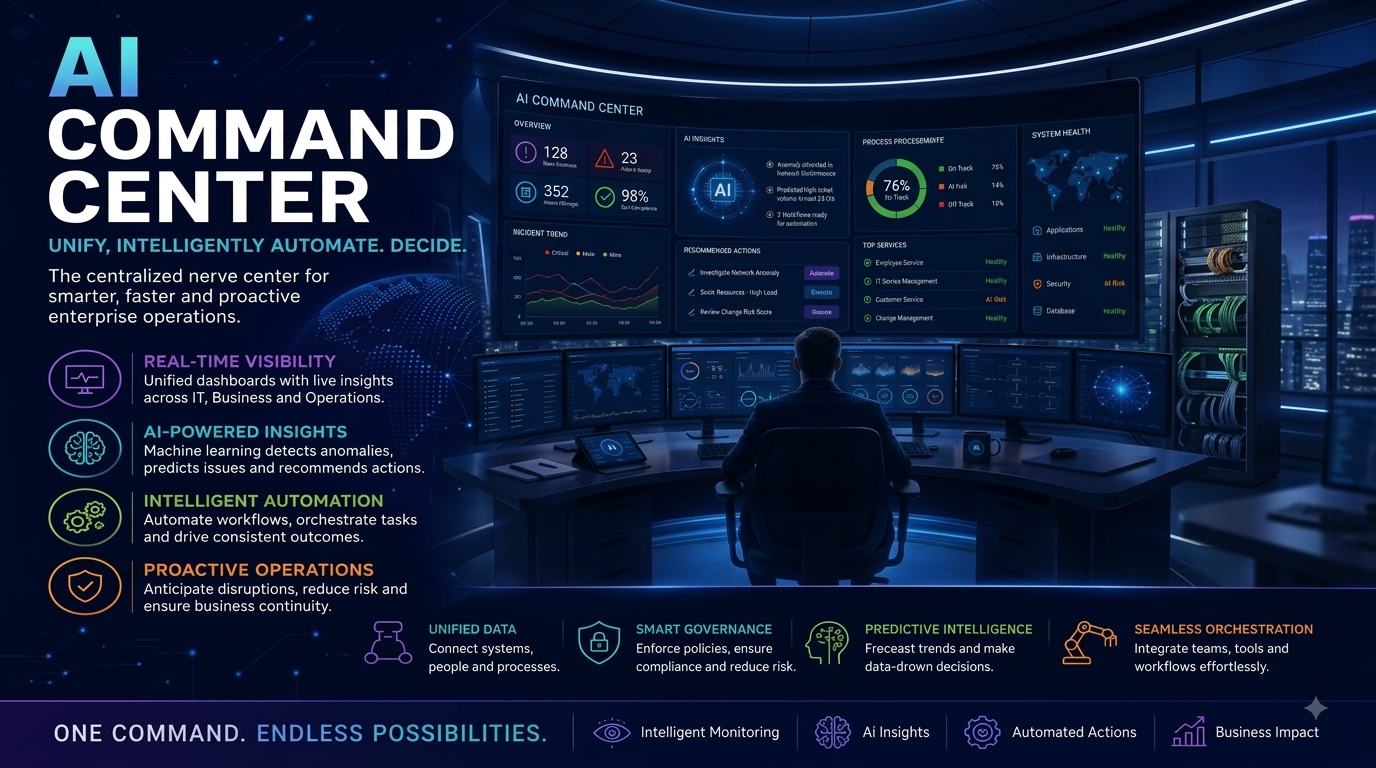
An AI Command Center serves as this central hub, aggregating data from multiple sources and presenting it through unified dashboards. More importantly, it applies intelligence to this data, enabling organizations to identify patterns, detect anomalies, and make informed decisions in real time.
3. Architecture of the AI Command Center
The AI Command Center is built on a multi-layered architecture that integrates data ingestion, intelligence, and orchestration.
At the foundation lies the data integration layer, which collects information from enterprise systems such as IT operations, customer service, HR workflows, and governance platforms. This layer ensures that data is unified and accessible in a centralized environment.
The intelligence layer processes this data using machine learning and analytics. It identifies patterns, detects anomalies, and generates insights that inform decision-making. Unlike traditional reporting systems, this layer operates in real time, providing continuous intelligence.
The orchestration layer enables automated workflows and decision execution. When specific conditions are met, the system can trigger actions such as alerts, escalations, or process adjustments.
Finally, the visualization layer presents insights through dashboards and interfaces that provide a comprehensive view of enterprise operations. These dashboards enable stakeholders to monitor performance, identify issues, and take action quickly.
This architecture transforms the enterprise into an intelligent system where data, insights, and actions are seamlessly connected.
4. Real-Time Monitoring and Intelligent Insights
One of the core capabilities of the AI Command Center is real-time monitoring. Instead of relying on periodic reports, organizations can continuously track system performance, workflow progress, and operational metrics.
AI enhances this capability by providing intelligent insights. The system analyzes data streams to identify trends, detect anomalies, and predict potential issues.
For example, a sudden increase in workflow delays may indicate a bottleneck, while unusual activity patterns may signal operational risks. By identifying these issues early, organizations can take corrective action before they escalate.
This shift from reactive monitoring to proactive intelligence significantly improves operational efficiency and reduces risk.
5. Workflow Orchestration and Automation
Beyond monitoring, the AI Command Center enables advanced workflow orchestration. Processes that previously required manual coordination can be automated and optimized.
When the system detects specific conditions, it can trigger predefined workflows, such as:
- Escalating critical incidents
- Assigning tasks to appropriate teams
- Initiating remediation processes
- Adjusting operational priorities
This automation ensures that responses are consistent, timely, and aligned with organizational objectives.
Additionally, AI-driven orchestration allows workflows to adapt dynamically. Instead of following static rules, processes can evolve based on real-time data and changing conditions.
6. Decision Intelligence and Predictive Operations
A key differentiator of the AI Command Center is its ability to support decision intelligence. Rather than simply presenting data, the system provides actionable insights that guide decision-making.
Predictive analytics plays a crucial role in this process. By analyzing historical data and current trends, the system can forecast potential outcomes and recommend actions.
For example, the system may predict an increase in service demand and suggest resource allocation adjustments. Similarly, it may identify patterns that indicate potential compliance risks or operational disruptions.
This capability enables organizations to move from reactive decision-making to predictive operations, where decisions are informed by data and supported by AI.
7. Organizational Impact of the AI Command Center
The implementation of an AI Command Center delivers significant benefits across the enterprise.
Operational efficiency improves as processes are streamlined and automated. Teams can focus on strategic initiatives rather than routine tasks.
Visibility is enhanced through centralized dashboards, enabling stakeholders to monitor operations in real time. This improves coordination and reduces delays.
Risk management is strengthened through continuous monitoring and early detection of issues. Organizations can address problems proactively, reducing the likelihood of disruptions.
Decision-making becomes faster and more informed, supported by real-time insights and predictive analytics.
Ultimately, the AI Command Center fosters a culture of agility and responsiveness, where organizations can adapt quickly to changing conditions.
8. Ethical and Governance Considerations
As with any AI-driven system, ethical considerations are critical. The AI Command Center must ensure data privacy, security, and compliance with regulatory requirements.
Transparency is essential to build trust among stakeholders. Users should understand how insights are generated and how decisions are made.
Bias mitigation is also important, particularly when AI models influence operational decisions. Systems must be designed to ensure fairness and accuracy.
Human oversight remains a key component. While AI provides powerful capabilities, final decisions should involve human judgment to ensure appropriate outcomes.
9. Future Directions of Enterprise Command Centers
The future of AI Command Centers lies in deeper integration and advanced intelligence.
Multi-agent systems will enable coordination across different domains, such as IT, HR, and governance. These systems will work collaboratively to optimize operations.
Real-time decision engines will provide instant recommendations and automated responses, further reducing delays.
Integration with emerging technologies such as digital twins and advanced analytics will enhance predictive capabilities and enable more sophisticated simulations.
As these advancements evolve, the AI Command Center will become the central nervous system of the enterprise, driving innovation, efficiency, and resilience.
10. Conclusion
The AI Command Center represents a transformative approach to enterprise operations. By integrating data, intelligence, and automation into a unified platform, organizations can achieve unprecedented levels of visibility, efficiency, and agility.
In an increasingly complex and dynamic environment, the ability to orchestrate operations through a centralized intelligence layer is no longer a luxury—it is a necessity.
Organizations that adopt AI-driven command centers will be better positioned to navigate challenges, optimize performance, and achieve sustainable growth.