
A prototype demo and a production system are judged by different standards, and most teams don’t notice the gap until it’s expensive. The prototype has to convince a room. The production system has to survive real users, real load, and months of drift nobody is watching for. That’s the exact gap companies close when they hire AI engineers who have shipped production systems, not just prototypes. Three failure patterns show up again and again once enterprise AI systems leave the demo and meet actual usage: permissions that were never really tested, costs that scale in ways nobody modeled, and accuracy that degrades so quietly no one notices until the damage is done.
None of these are exotic failure modes. They’re the predictable result of building for a demo audience of one and shipping to an audience of thousands.
The Permission Problem Nobody Tests For
Most AI prototypes run with far more access than they need, because giving a demo broad access is the fastest way to make it look impressive. A prototype connected to a company’s internal systems will often use a single service account with wide-reaching permissions, since scoping access properly takes real engineering time that a two-week proof of concept doesn’t have. Nobody notices this shortcut in a demo, because a demo only ever does what it’s told to do in front of an audience.
Production is different. Once an AI agent has persistent memory, tool access, and the ability to act on file systems or APIs on its own, the same broad permissions that made the demo easy become the actual attack surface. This shift is visible in how the security industry itself is re-ranking the risk: in the 2026 OWASP Top 10 for LLM Applications, “Excessive Agency” jumped from sixth place to third, reflecting how agentic systems have moved from generating responses to taking direct action inside real infrastructure (ReversingLabs). As one security engineer quoted in that analysis put it, the core issue is that “the model is not just returning a response. It is taking action, which presents a qualitatively different attack surface.”
The fix isn’t complicated in theory: scope every tool an AI system can call to the minimum required, and require a human in the loop before any consequential action. What’s hard is that this work is invisible in a demo and only shows its value the first time something goes wrong. Teams that build permission scoping in from the start rarely think of it as a special project. Teams that skip it usually find out why it mattered from an incident report, not a code review.
The Bill Nobody Saw Coming
The second failure pattern is financial, and it tends to surprise finance teams more than engineering ones. A pilot handling a few hundred requests a day looks cheap because per-token inference pricing keeps falling, and a small monthly bill doesn’t trigger anyone’s attention. The problem is that falling unit price and rising total cost can happen at the same time, and usually do, once a system moves from pilot to production scale.
Industry benchmarking backs this up directly. CloudZero’s State of AI Costs research found that average monthly AI spend rose from roughly $62,964 in 2024 to a projected $85,521 in 2025 — and, more tellingly, only 51% of organizations said they could confidently evaluate the return on that spend (CloudZero). That gap between spending and visibility is the actual failure mode. It’s not that AI got more expensive to run; it’s that most teams don’t have a clear model of what drives their own costs until the bill forces the conversation.
Multi-step reasoning, retrieval-augmented generation, and longer context windows all compound token usage in ways that are easy to approve individually and hard to add up in advance. A single added reasoning step might look negligible in a code review. Multiplied across production traffic, it’s the difference between a bill that scales with usage and one that scales faster than anyone modeled.
The Failure That Doesn’t Throw an Error
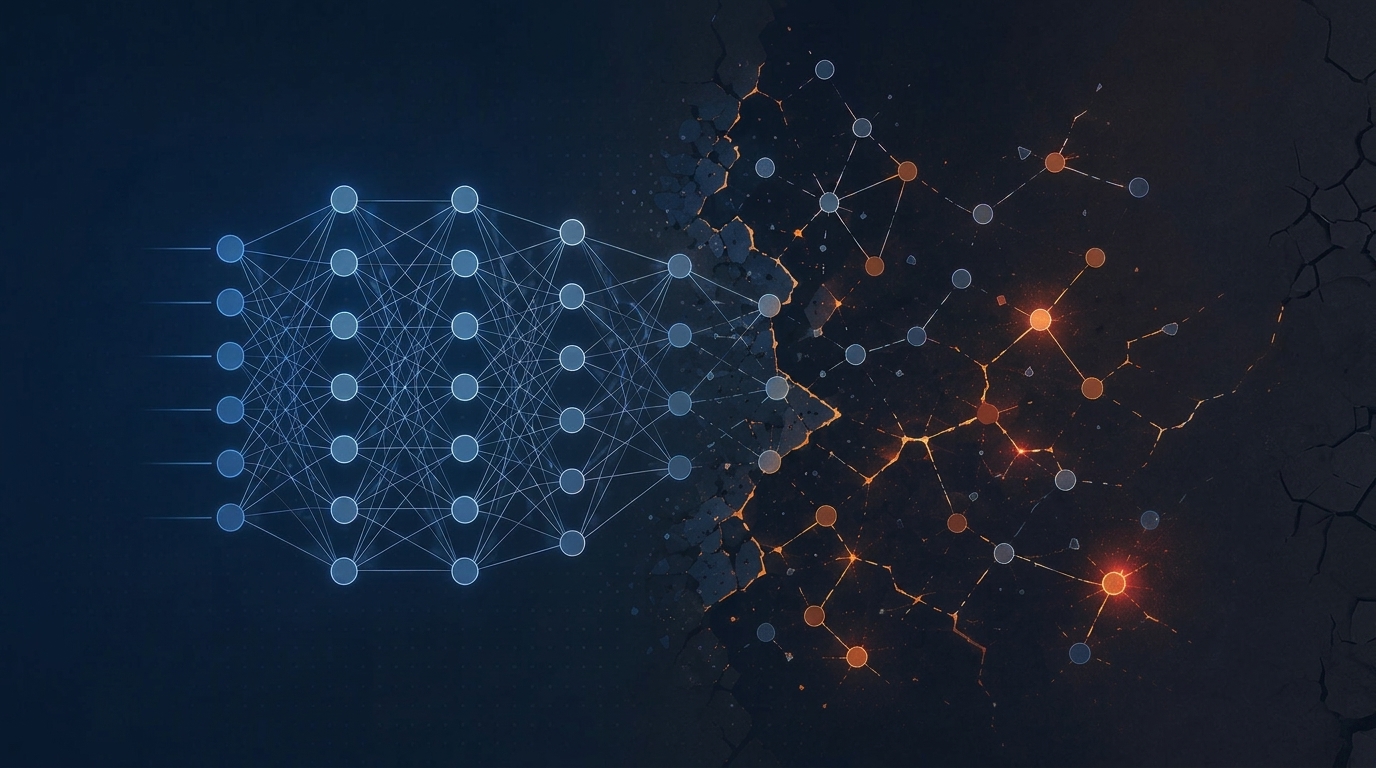
The third pattern is the hardest to catch, because unlike a permissions incident or a budget alert, it never announces itself. Traditional software fails loudly — it throws an exception, a request times out, someone gets paged. A model that has quietly drifted away from the data it was trained on keeps producing outputs that look structurally correct while becoming progressively less reliable, and there’s no error message for “this answer is subtly worse than it used to be.”
This isn’t a rare edge case. A peer-reviewed study published in Nature’s Scientific Reports tested 128 model-dataset combinations across healthcare, finance, transportation, and weather domains, and found measurable temporal degradation — researchers called it “AI aging” — in 91% of them (Lumenova AI). The domains that drift fastest tend to be the ones where the underlying reality changes fastest: user behavior, market conditions, fraud patterns. A model trained on last year’s normal is quietly grading against a normal that no longer exists.
The practical problem this creates is that nobody owns catching it. Engineering teams monitor uptime and latency, both of which stay perfectly healthy while a model drifts. Product teams notice user complaints eventually, but by the time complaints add up to a pattern, the drift has often been compounding for months. Closing that gap requires treating model accuracy as something that needs ongoing monitoring against real outcomes, not a metric that gets checked once at launch and assumed to hold.
What This Actually Means for Teams Shipping AI
None of these three failure patterns are about the underlying models being unreliable. They’re about the distance between what a demo needs to prove and what a production system needs to survive. A demo needs to work once, in front of people who already want to be convinced. Production needs to keep working correctly for users who have no reason to be forgiving, under conditions nobody fully modeled in advance.
The teams that avoid these failures tend to share one habit: they treat the move from prototype to production as a distinct phase with its own engineering requirements, not a scaling exercise where the same code just runs more often. Permission scoping, cost modeling, and drift monitoring all need to be designed in before the system carries real load, because retrofitting them after an incident is a far more expensive way to learn the same lesson.