
AI projects rarely fail because of a bad idea. They fail when companies pick the wrong partner, hire the wrong developers, or launch without a clear plan. I’ve watched this same pattern play out in fintech, healthcare, and manufacturing teams across the world.
Treating AI as purely a data science problem rather than an end-to-end software engineering challenge.
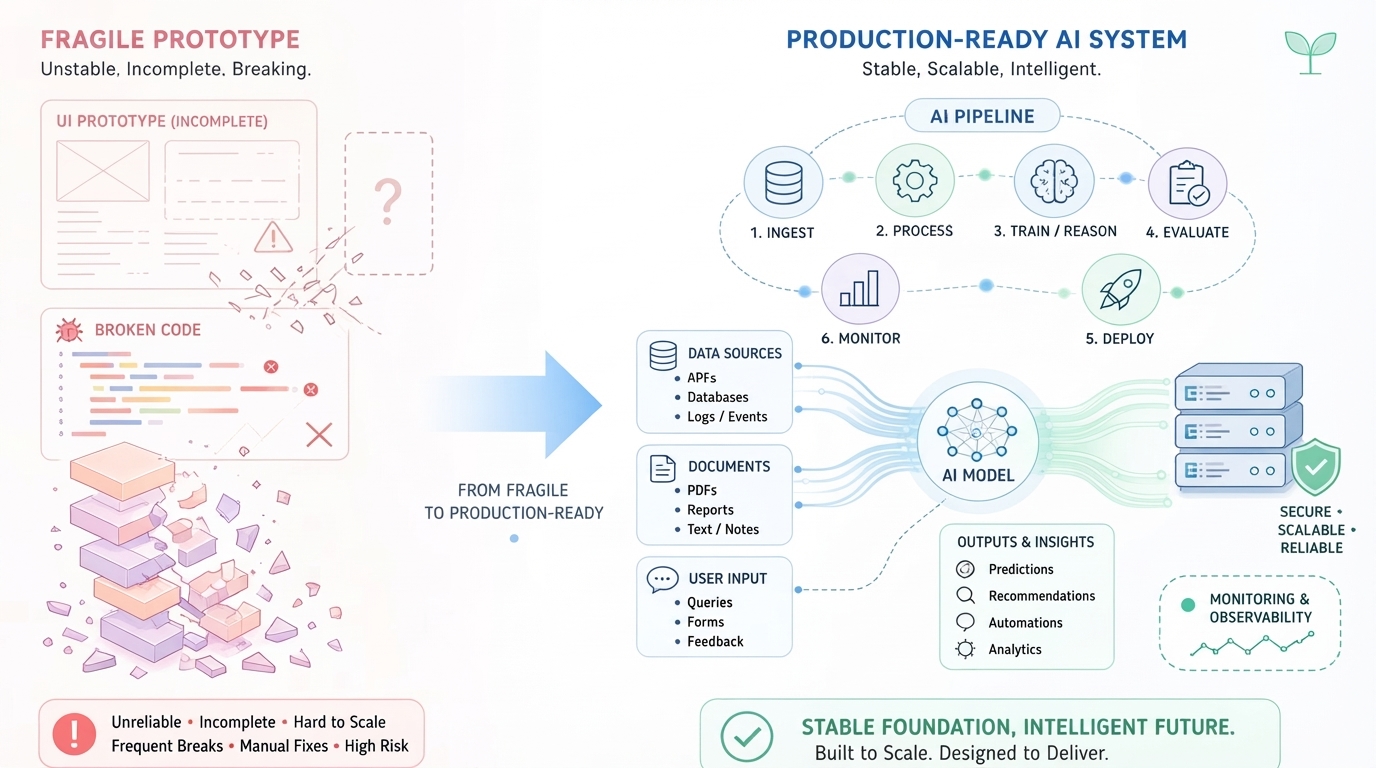
A brilliant model is useless if users can’t interact with it. Here is what actually works—and why hiring full stack developers is the difference between a stuck AI prototype and a revenue-generating product.
Why UK, US, and UAE Businesses Are Getting AI Sourcing Wrong
The demand for custom AI has accelerated sharply since 2023.
But not every vendor calling itself a custom AI developers has genuine enterprise delivery experience. Many are resellers. Some are solo operators packaging a third-party API with a polished proposal.
Enterprises in the UK, US, and UAE — particularly those in regulated sectors — need vendors who can handle the full engineering stack: model development, API integration, data pipelines, and production deployment.
That is not a freelancer’s job. It is a structured engineering problem.
When evaluating AI vendors, look for:
- Proven delivery history — 6,000+ projects delivered is a real signal, not a marketing claim
- Enterprise-grade certifications — CMMI, ISO, and SOC 2 matter considerably in regulated markets
- Diverse client base — a portfolio spanning Fortune 500 names across multiple verticals signals genuine enterprise readiness
Good Read: Why Most Enterprise AI Strategies Skip Readiness (Silicon Valleys Journal)
What Does a Full Stack Developer for Hire Actually Deliver in an AI Build?
This is where many organisations get confused.
AI is not solely a data science problem. It is a full-stack engineering problem.
When you hire a full stack developer, you need someone who can:
- Build the user-facing interface that surfaces AI outputs clearly
- Design backend APIs that serve model predictions in real time
- Structure databases for training data, logs, and inference history
- Manage cloud deployments across AWS, Azure, or GCP
A data scientist alone cannot ship a production-ready AI product.
A UI developer alone cannot either.
The full stack developer is what connects the AI model to the real-world application your users actually touch and rely on.
For businesses operating in the UAE and KSA — where regional data compliance and Arabic localisation often apply — this full-stack capability is not optional. It is a core requirement from day one.
Explore More: Enterprise AI Solutions: What Actually Works in Practice (The AI Journal)
Should You Hire a Dedicated Development Team or Go Project-Based?
It depends on scope. But for any AI build beyond a proof of concept, my recommendation is clear: hire a dedicated development team.
Here is why it performs better.
A dedicated team gives you:
- Continuity — the same developers from kickoff through to launch
- Domain depth — they learn your business, not just your codebase
- Speed — no onboarding lag at every sprint cycle
- IP security — full ownership of code, models, and proprietary data
Freelancers and project-based setups are fine for quick, minor fixes.
However, on a six-month AI build, you waste far more money in lost time re-explaining context to revolving contractors than you ever save on hourly rates.
Working with a custom AI development company using a dedicated team eliminates that drag, keeping one team fully accountable from start to finish.
From Strategy to Deployment: The Five-Step Path That Works
Whether you’re a UK scale-up moving out of stealth or a US enterprise launching your first model, this sequence works:
- Audit your data — no AI model performs well without clean, structured input
- Define your AI objective — prediction, automation, recommendation, or generation
- Choose a custom AI development company with genuine full-stack delivery capabilities
- Hire a dedicated development team for continuity across the entire build
- Stage before production — never push a live AI model without a proper validation environment
Most teams stumble at step one. They skip the data audit, proceed directly to model development, and then wonder why performance is poor three months into production.
The five-step path above is not complicated. But it requires the right partner to execute it properly — one with the engineering depth, delivery track record, and team structure to see it through.