
Abstract
Configuration Management Databases have long served as foundational repositories for understanding enterprise technology assets and their relationships. Yet the value of a CMDB depends on something more fundamental than the number of configuration items it contains: whether decision-makers can trust the data and understand the operational consequences represented by that data.
A configuration record may exist while critical attributes remain incomplete. A server may be documented while its relationship to a business service is missing. An application may appear healthy in isolation while the infrastructure supporting it creates a hidden dependency risk. When these gaps remain invisible, organizations can possess large amounts of configuration data without possessing reliable operational intelligence.
This article explores a trust-aware and impact-aware approach to configuration management. The model combines automated data-quality evaluation, dynamic trust scoring, dependency mapping, and real-time impact analysis to transform configuration data into actionable intelligence. Instead of asking only whether a configuration item exists, the model asks two more consequential questions: How much confidence should we place in this information, and what could happen if this component fails?
A practical implementation demonstrates how these principles can be incorporated into an enterprise CMDB through automated validation, relationship traversal, and user-triggered impact simulation. The broader objective is not to label conventional CMDB logic as artificial intelligence, but to establish the data-quality and dependency foundations required for increasingly intelligent operations, predictive risk analysis, and AI-assisted decision support.
1. The CMDB Trust Problem
Modern enterprises depend on a complex web of applications, databases, infrastructure components, cloud services, integrations, network devices, and business services. Configuration management attempts to create a structured representation of this environment by maintaining configuration items and the relationships connecting them.
The challenge is that recording an asset does not automatically make the record reliable.
Configuration data can gradually deteriorate as infrastructure changes. New components are introduced, services migrate, ownership changes, applications are retired, and dependencies evolve. Some changes are reflected accurately in the CMDB; others are captured only partially or not at all. Over time, the difference between the modeled environment and the actual environment can become operationally significant.
This creates a trust problem.
When an engineer investigates an incident, can the listed dependencies be trusted? When a change manager assesses a planned infrastructure modification, does the relationship map contain enough information to identify affected services? When leadership evaluates technology risk, are decisions being made from complete configuration information or from records that merely appear complete?
A CMDB that cannot communicate the reliability of its own information forces users to make an implicit assumption: every record is equally trustworthy.
In practice, that assumption is rarely justified.
The next generation of configuration management therefore needs to move beyond inventory accuracy toward measurable configuration trust.
2. From Data Completeness to Configuration Trust
Trust should not be treated as an abstract property of configuration data. It can be represented as an operational signal derived from observable conditions.
Consider a configuration item containing valid descriptive attributes but no documented relationship to another component. From a database perspective, the record exists. From an operational perspective, however, the record may be incomplete because its role within the technology ecosystem is unknown.
A trust-aware model evaluates configuration items continuously and translates identifiable weaknesses into a comprehensible trust indicator.
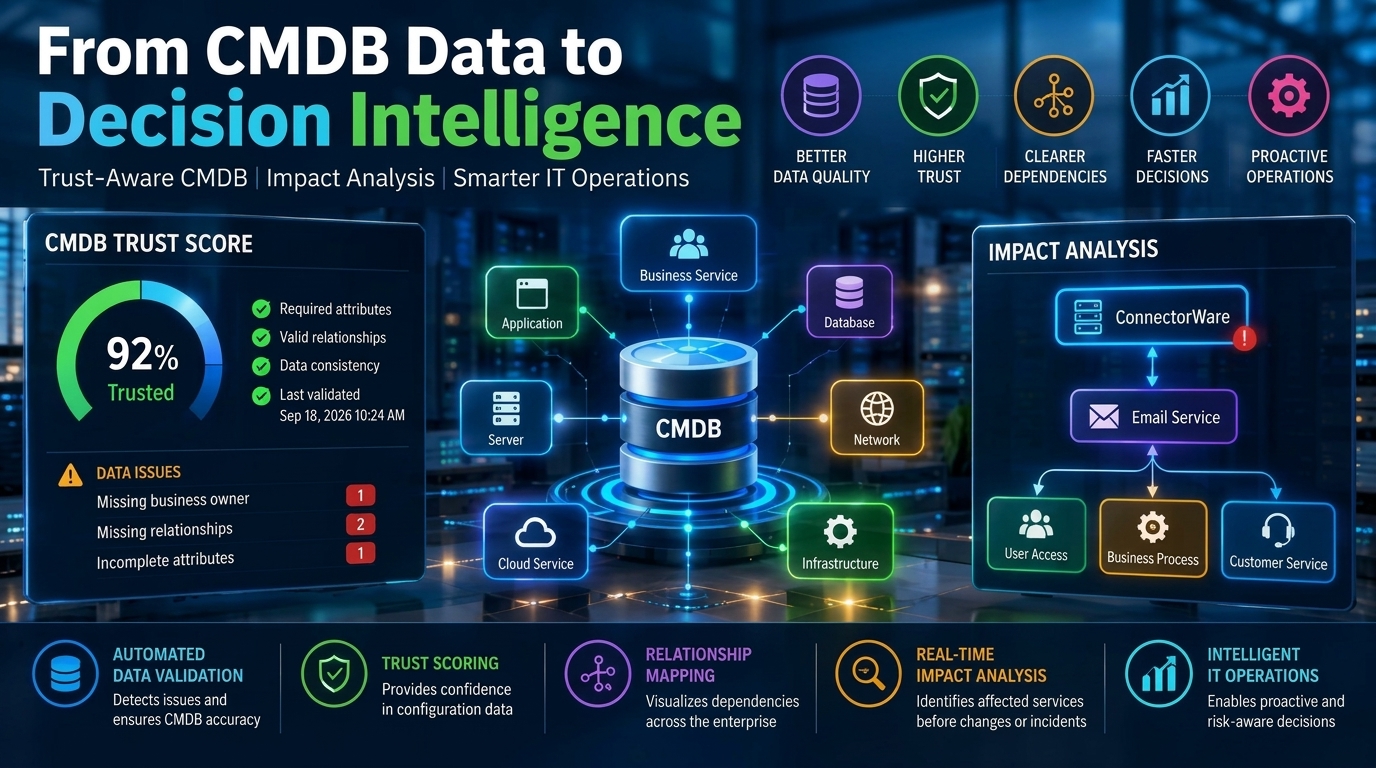
The project underpinning this article demonstrates this concept through a score ranging from zero to one hundred. The validation logic examines conditions such as missing relationships and incomplete information, records detected data issues, updates the calculated trust value, and maintains a timestamp indicating when the configuration item was last validated.
The significance of the score is not the mathematical sophistication of the calculation. Its importance lies in converting hidden uncertainty into visible information.
Instead of presenting two configuration records as equally reliable simply because both exist, the system can communicate that one has stronger supporting information than another.
This distinction can materially improve operational judgment.
A high trust score can indicate that a record satisfies the defined validation criteria and has sufficient relationship information for the current model. A lower score can prompt users to examine the record more carefully before relying on it for incident analysis, change assessment, or operational decisions.
Trust scoring therefore becomes a bridge between CMDB data quality and operational confidence.
3. Making Data Quality Actionable
Traditional data-quality initiatives frequently depend on dashboards, scheduled reports, or periodic cleanup exercises. These mechanisms are valuable, but they can separate the discovery of a problem from the point at which the data is actually being used.
A more effective approach is to make quality visible in operational context.
If an engineer opens a configuration item while investigating an outage, information about missing relationships should be available at that moment. If a change analyst examines an infrastructure component, the system should indicate whether the configuration information has known weaknesses before that data is used to assess risk.
This is where automated issue detection becomes particularly valuable.
The implemented model evaluates configuration information, identifies missing relationships or inconsistencies, and exposes the detected problem directly against the configuration item. Validation metadata can then show when the record was last assessed.
This creates an important behavioral change.
Data quality stops being solely the responsibility of a periodic CMDB governance exercise. It becomes part of everyday operational decision-making.
Rather than discovering months later that dependency information was incomplete, users can encounter the warning when the information is relevant.
The result is not simply a cleaner CMDB. It is a CMDB that communicates uncertainty instead of hiding it.
4. Relationships Are Where Configuration Data Becomes Operational Intelligence
Individual configuration records describe components. Relationships describe systems.
This distinction is fundamental.
An email service, database, integration service, application server, and network component may each appear as independent configuration items. Their true operational significance emerges only when the relationships between them are understood.
Dependency mapping converts a collection of records into a representation of how technology supports technology—and ultimately how technology supports the business.
The practical implementation uses parent-child relationship information to establish dependencies between configuration items. This relationship data then becomes the foundation for impact analysis.
Imagine a component called ConnectorWare supporting an email capability. Looking at the ConnectorWare record alone tells an operator little about the consequence of its failure. Once the relationship between ConnectorWare and Email is represented, the question becomes much more meaningful: If ConnectorWare fails, what else is affected?
The project demonstrates the answer through relationship traversal. The engine examines the configuration relationship data and returns the downstream system associated with the selected component.
This seemingly simple capability illustrates a much larger architectural principle.
CMDB value increases dramatically when organizations stop treating relationships as documentation and begin treating them as computable operational knowledge.
5. From Relationship Mapping to Real-Time Impact Analysis
Impact analysis is traditionally associated with incident management and change management, but its effectiveness depends heavily on the accuracy and accessibility of dependency information.
A static dependency diagram may help an engineer understand architecture. An executable relationship model can help an engineer make a decision.
The impact-analysis capability developed in the project follows this second approach.
A user selects a configuration item and initiates an impact check directly from the interface. The request invokes server-side analysis, which queries the configuration relationship data and evaluates the relevant dependencies. The result is then returned to the interface without requiring the user to manually inspect relationship records.
For example, if the selected component is ConnectorWare and its modeled dependency points to Email, the system can immediately communicate that Email is an impacted system.
The architecture can be understood as a short intelligence pipeline:
User Interaction -> Impact Request -> Relationship Analysis -> Dependency Traversal -> Impact Result
This design reduces the distance between configuration information and operational action.
An engineer does not need to know how relationship records are stored. The engineer asks an operational question and receives an operational answer.
That distinction is central to the evolution of enterprise platforms. Users increasingly need systems that interpret structured information rather than merely expose database records.
6. Why Trust and Impact Should Be Evaluated Together
Trust scoring and impact analysis are individually useful. Their combination is considerably more powerful.
Impact analysis implicitly assumes that dependency data is accurate. If the relationships themselves are incomplete, an apparently precise impact result can create false confidence.
A trust-aware impact model can address this limitation.
Consider two configuration items that both appear to affect critical services. The first has complete attributes, validated relationships, and recent validation history. The second contains incomplete information and missing dependency records.
The system should not necessarily communicate the two impact assessments with the same degree of confidence.
This leads to an important principle for intelligent operations: Impact without trust can be misleading, while trust without impact lacks operational context.
Bringing the two together creates a richer decision model.
The organization can begin evaluating not only the potential blast radius of a component failure but also the reliability of the information used to calculate that blast radius.
This becomes particularly valuable in change management. A planned modification affecting a configuration item with strong dependency information can be assessed differently from a modification involving a poorly documented component.
Similarly, during incident response, low-confidence configuration data can itself become a signal. If an outage occurs around a configuration item whose relationships are known to be incomplete, responders know that the visible dependency map may not represent the entire impact.
The CMDB consequently moves from answering what is connected? toward answering what is connected, what could be affected, and how much should we trust that conclusion?
7. Building the Foundation for AI-Powered Operations
There is an important distinction between AI-inspired operational logic and genuine machine-learning inference.
The current implementation uses deterministic validation and relationship-processing logic. It does not require a trained machine-learning model to calculate its trust score or traverse dependencies. Describing those deterministic mechanisms accurately matters, particularly as enterprises increasingly attach the term “AI” to conventional automation.
Yet this does not diminish the project’s relevance to AI.
In fact, trustworthy configuration data and dependency models are prerequisites for many advanced AI and AIOps use cases.
A predictive model attempting to estimate incident impact requires dependable topology information. An AI assistant recommending remediation needs accurate knowledge of affected services. A change-risk model needs configuration quality, historical behavior, and relationship context. Automated root-cause analysis becomes significantly more useful when dependency data reflects reality.
The trust and impact engine therefore provides something foundational: structured operational context that future AI systems can reason over.
Machine learning can subsequently extend the model in several directions.
Historical CMDB quality patterns could contribute to predictive trust scoring. Incident history could enrich dependency risk. Multi-level relationship traversal could estimate broader blast radius. A recommendation engine could suggest missing relationships or remediation steps. AIOps signals could continuously update the operational significance of configuration items.
In that architecture, AI is not used merely because it is available. It is introduced where prediction, pattern recognition, or recommendation adds value beyond deterministic validation.
That is a healthier path toward intelligent operations.
8. Enterprise Scenario: A Change That Looks Small
Consider a planned update to an integration component.
In a conventional environment, the change team may inspect the component record, review documented attributes, check known relationships, and determine whether the change appears safe.
Suppose, however, that the integration component supports a communication service used by several business processes.
The configuration item itself may appear ordinary. Its business significance exists in its dependencies.
A trust-aware CMDB first provides an indication of whether the configuration information meets expected quality conditions. If relationships are missing, the user is warned that the available impact picture may be incomplete.
The impact engine can then traverse documented dependencies and identify the immediately affected service.
The decision changes.
The question is no longer: “Can we change this component?”
It becomes: “What services depend on this component, what could be disrupted, and how confident are we that our dependency information is complete?”
That is a materially better governance question.
It connects configuration management directly with operational risk.
9. From Static Repository to Decision-Support Layer
The strategic opportunity is to reconsider what a CMDB is supposed to be.
If its purpose is only to store configuration records, success can be measured largely through population and completeness metrics.
If its purpose is to support enterprise decisions, a different set of questions emerges.
Can the CMDB expose uncertainty? Can it identify weak records before those records influence operational decisions? Can relationships be traversed programmatically? Can users understand downstream consequences without manually interpreting topology? Can the platform provide the contextual foundation required by automation and AI?
These questions reposition configuration management from an administrative discipline to an intelligence capability.
A trust score becomes more than a quality metric. It becomes a confidence signal.
A relationship becomes more than a database association. It becomes a path through which operational impact can propagate.
A user-triggered impact check becomes more than a convenience. It becomes a mechanism for translating complex relationship data into an immediate decision-support result.
Together, these capabilities demonstrate how incremental enhancements can substantially change the role of the CMDB.
10. Governance and the Limits of Automated Trust
Automated scoring should not create the impression that configuration truth can be reduced perfectly to a single number.
A trust score represents the validation criteria encoded into the system. If those criteria are incomplete, the score will also be incomplete. A configuration item could satisfy every programmed rule while still containing an undocumented dependency that the system has no way to discover.
For this reason, trust indicators should support human judgment rather than replace it.
Organizations implementing similar models should make scoring logic understandable, define ownership for correcting identified issues, maintain validation history, and periodically reassess whether the criteria remain appropriate as the technology environment changes.
The same principle applies to impact analysis.
A relationship engine can only reason over relationships it knows about. Missing topology creates missing impact.
This makes governance and automation mutually reinforcing rather than competing concepts. Automated validation identifies weaknesses at scale; governance processes ensure those weaknesses are investigated and corrected.
The objective is not a CMDB that claims certainty.
The objective is a CMDB that makes its confidence and limitations visible.
11. The Next Evolution: Predictive Configuration Intelligence
The natural progression of this architecture is from descriptive configuration management to predictive configuration intelligence.
Multi-level dependency traversal can extend immediate impact analysis into broader blast-radius estimation. Historical incident patterns can identify configuration items repeatedly associated with disruption. Predictive scoring can combine trust, criticality, change frequency, incident history, and relationship density to identify components that deserve additional scrutiny.
A dedicated health dashboard could aggregate trust across the configuration estate, enabling teams to identify clusters of low-confidence data rather than investigating records individually.
Integration with AIOps can connect live operational signals with topology and trust information. Instead of merely reporting that an infrastructure component is experiencing anomalous behavior, an intelligent system could identify the dependent services, evaluate the reliability of those dependencies, estimate business impact, and recommend the next investigative action.
Automated remediation could eventually close the loop by suggesting or executing corrective actions where confidence and governance policies permit.
At that stage, the CMDB is no longer merely documenting the enterprise.
It is participating in how the enterprise understands risk and makes decisions.
12. Conclusion
The longstanding challenge with configuration management is not simply collecting enough data. It is establishing whether that data deserves to be trusted and making its operational meaning accessible when decisions must be made.
A trust-aware and impact-aware CMDB addresses both problems.
Automated validation exposes weaknesses in configuration information. Trust scoring turns those weaknesses into visible confidence signals. Relationship mapping provides structural context. Real-time impact analysis converts those relationships into actionable insight.
The practical implementation behind this article demonstrates these concepts through dynamic trust scoring, issue detection, configuration relationships, server-side impact analysis, and real-time user interaction. More importantly, it illustrates a broader direction for enterprise operations: moving from systems that store operational information toward systems that interpret it.
The future CMDB will not be valuable because it contains the largest inventory of configuration items.
It will be valuable because organizations can ask it better questions—and trust the context behind its answers.