
The problem is not whether AI can produce an answer
AI systems are increasingly useful for organising complex information, comparing explanations and helping researchers identify questions that deserve closer attention. Their fluency, however, creates a basic methodological risk: a plausible explanation can sound more certain than the evidence that supports it.
That distinction matters most when research concerns a physical object. A language model can propose mechanisms, identify patterns in descriptions and help structure competing hypotheses, but it cannot turn an interpretation into a measurement. The practical challenge is therefore not to make AI infallible. It is to design a workflow in which AI can contribute while remaining open to correction by evidence that exists independently of the model.
A nineteenth century coin became a useful test case
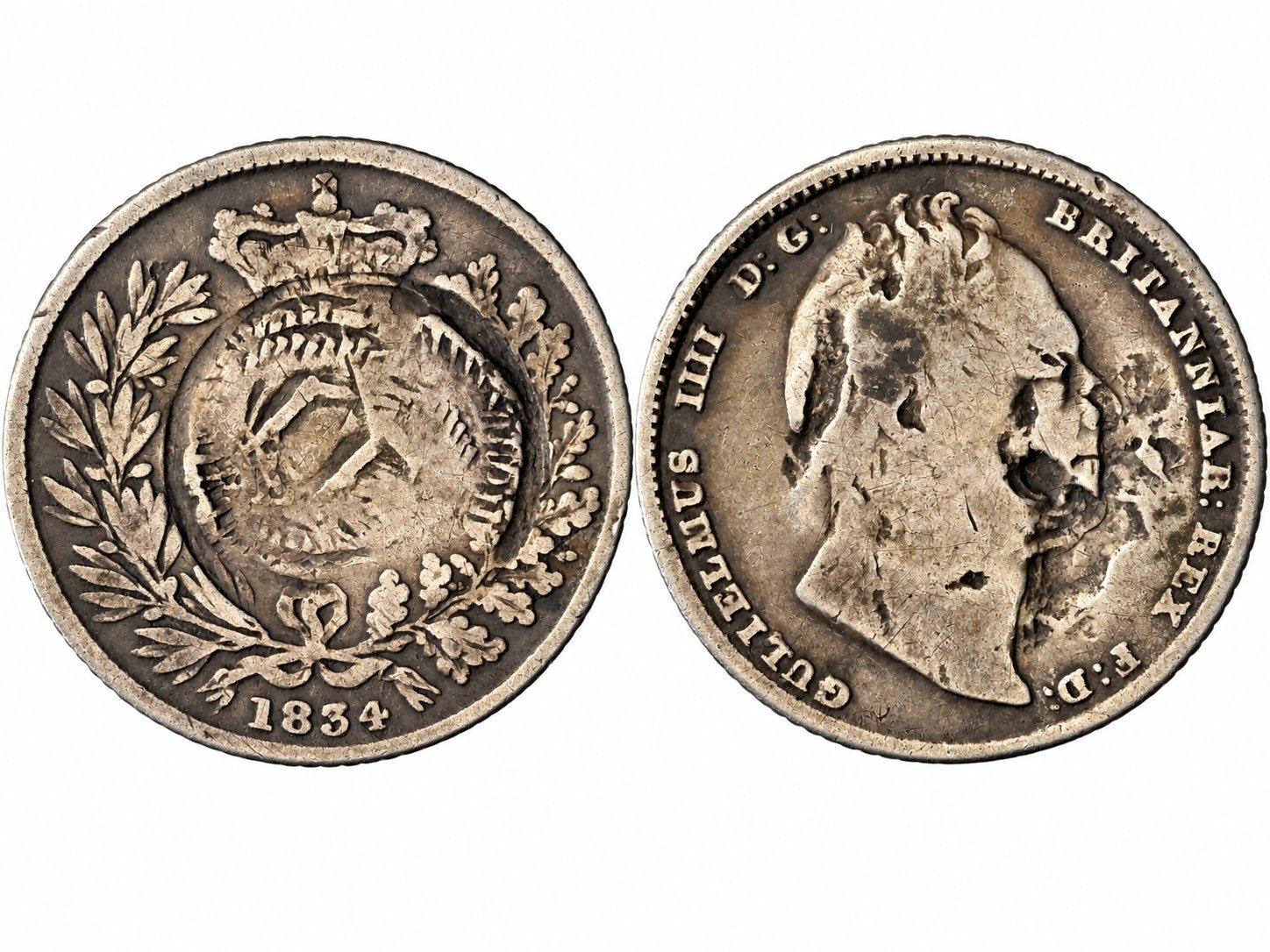
Project 001 began with a severely deformed 1834 William IV sixpence. Visual examination alone produced competing explanations for its condition, including ordinary wear, corrosion, later damage and a possible mint stage anomaly. The ambiguity was useful because it exposed the limits of interpretation from appearance alone.
Instead of treating the most persuasive visual explanation as the conclusion, the investigation moved toward independently produced physical measurements. SEM-EDX analysis was commissioned through the Experimental Techniques Centre at Brunel University London, while optical surface profilometry was carried out through the University of Oxford Materials Characterisation Service. The completed study was published in npj Heritage Science in September 2026.
The published paper concluded that the combined evidence was most consistent with a severe mint stage striking anomaly involving constrained compressive deformation. It also retained an important limitation: the surviving evidence does not permit a unique reconstruction of every mechanical step, and later constrained compression cannot be excluded absolutely. That qualification is not a weakness. It is an example of evidence setting the boundary of a claim.
What AI contributed
AI assisted tools were used under human supervision during the research process. Their role included organising observations, comparing alternative explanations, structuring questions, supporting comparative reasoning and helping prepare analytical material. Some of that work occurred before the independent laboratory measurements were available, which meant that early hypotheses could later be tested against evidence that had not been generated by the same reasoning process.
This is where AI was most useful. It increased the speed and breadth with which possibilities could be explored, but it did not need to be correct at every stage. A working hypothesis could be retained, narrowed or rejected as stronger evidence emerged. The value was not in protecting an initial answer. It was in making the reasoning easier to inspect and revise.
What AI did not do
The limits are as important as the contribution. AI did not generate the SEM-EDX measurements. It did not perform the optical profilometry. It did not conduct peer review, classify the specimen independently or determine the scientific conclusion. Those boundaries were explicit in the published study.
The laboratory datasets remained the primary empirical basis for interpretation. The researcher remained responsible for commissioning the analyses, integrating the results, judging the strength of competing explanations and deciding what level of certainty the evidence justified. In other words, computational assistance could influence the route through the problem without becoming the evidence that settled it.
This separation also improves traceability. A reader should be able to ask where a claim came from: was it measured, documented historically, proposed computationally or concluded through human interpretation? Those categories can interact, but they should not be allowed to blur into one another. Making the provenance of a claim visible is especially important when an AI system can generate polished language that may otherwise give an interpretive suggestion the appearance of established fact.
Independent evidence must be able to overrule the working hypothesis
A useful AI research workflow should therefore be designed around the possibility of error. If the process only works when the model’s early reasoning is correct, it is fragile. A stronger design assumes that some suggestions will be incomplete, misleading or simply wrong and creates a route by which independent evidence can expose that weakness.
For object based research, this means separating observation, measurement and interpretation as far as practical. A measurement should not become more or less important because it agrees with an attractive computational explanation. Where suitable physical measurements are available, they should constrain the range of interpretations that remain plausible.
This approach also makes uncertainty easier to preserve. The goal is not always to produce a single confident narrative. Sometimes the most defensible outcome is to narrow the possibilities, identify what the evidence strongly disfavors and state clearly what cannot yet be resolved.
From one case to a structured framework
The procedural lessons from Project 001 later informed the IA STUDIO Hybrid Reasoning Framework, formalised as Edition 1.1. The framework separates four roles: empirical measurement, documentary evidence, computational interpretive support and final human interpretation.
The separation is deliberate. Empirical measurements describe properties of the object that are produced through observation or instrumentation. Documentary evidence provides historical or contextual information. Computational systems can help organise, compare and challenge interpretations of those materials. Final interpretation remains a human responsibility because it involves judgement about relevance, uncertainty, limitations and the strength of the resulting claim.
The framework is model independent. It is not built around the assumption that one particular AI system is reliable enough to deserve evidential authority. The same principle should continue to apply as models change: computational outputs are useful inputs to reasoning, but their usefulness does not convert them into empirical observations.
The limitations matter
Project 001 is a single case study. Edition 1.1 of the framework has not undergone separate peer reviewed methodological validation across multiple investigations. That distinction should remain visible. A method that emerges from one well documented case may be promising, but its broader value has to be tested through further applications, failures and revisions.
There are also limits within the coin investigation itself. The study did not use destructive metallography or cross sectioning, and the available evidence could not reconstruct the full mechanical history of the specimen with certainty. Those limits shaped the published conclusion rather than being hidden behind it.
For me, that is the wider lesson. Responsible use of AI in research does not require pretending that the model is neutral, authoritative or consistently correct. It requires a process in which different forms of evidence retain different roles, claims remain proportionate to what can actually be demonstrated, and computational reasoning can be challenged without collapsing the workflow.
AI becomes more useful when being wrong is an expected possibility rather than an embarrassment to be concealed. The aim is not to make the model the final judge. It is to build a research process strong enough to correct it.