Silicon Valleys Journal
  • Finance & Investments
    • Angel Investing
    • Financial Planning
    • Fundraising
    • IPO Watch
    • Market Opinion
    • Mergers & Acquisitions
    • Portfolio Strategies
    • Private Markets
    • Public Markets
    • Startups
    • VC & PE
  • Leadership & Perspective
    • Boardroom & Governance
    • C-Suite Perspective
    • Career Advice
    • Events & Conferences
    • Founder Stories
    • Future of Silicon Valley
    • Incubators & Accelerators
    • Innovation Spotlight
    • Investor Voices
    • Leadership Vision
    • Policy & Regulation
    • Strategic Partnerships
  • Technology & Industry
    • AI
    • Big Tech
    • Blockchain
    • Case Studies
    • Cloud Computing
    • Consumer Tech
    • Cybersecurity
    • Enterprise Tech
    • Fintech
    • Greentech & Sustainability
    • Hardware
    • Healthtech
    • Innovation & Breakthroughs
    • Interviews
    • Machine Learning
    • Product Launches
    • Research & Development
    • Robotics
    • SaaS
No Result
View All Result
  • Finance & Investments
    • Angel Investing
    • Financial Planning
    • Fundraising
    • IPO Watch
    • Market Opinion
    • Mergers & Acquisitions
    • Portfolio Strategies
    • Private Markets
    • Public Markets
    • Startups
    • VC & PE
  • Leadership & Perspective
    • Boardroom & Governance
    • C-Suite Perspective
    • Career Advice
    • Events & Conferences
    • Founder Stories
    • Future of Silicon Valley
    • Incubators & Accelerators
    • Innovation Spotlight
    • Investor Voices
    • Leadership Vision
    • Policy & Regulation
    • Strategic Partnerships
  • Technology & Industry
    • AI
    • Big Tech
    • Blockchain
    • Case Studies
    • Cloud Computing
    • Consumer Tech
    • Cybersecurity
    • Enterprise Tech
    • Fintech
    • Greentech & Sustainability
    • Hardware
    • Healthtech
    • Innovation & Breakthroughs
    • Interviews
    • Machine Learning
    • Product Launches
    • Research & Development
    • Robotics
    • SaaS
No Result
View All Result
Silicon Valleys Journal
No Result
View All Result
Home Technology & Industry AI

A Multi‑Layer Open Source AI Agent Architecture for Enterprise Workflow Automation

By Srikanth Madabhushi, AI Automation & Workflow Specialist, MS in Artificial Intelligence

SVJ Writing Staff by SVJ Writing Staff
December 10, 2025
in AI
0
A Multi‑Layer Open Source AI Agent Architecture for Enterprise Workflow Automation

Abstract

This paper proposes a vendor‑neutral, open‑source, multi‑layer AI agent architecture designed to unify enterprise workflows through natural language understanding, structured intent modeling, automated execution, generative communication, and autonomous reasoning. As organizations adopt AI‑driven automation across technical support, operations, HR, governance, customer service, and risk management, traditional siloed structures create bottlenecks. The architecture discussed here presents a scalable and academically grounded framework that allows AI agents to interpret human language, map intents to actions, generate high‑quality documentation, and orchestrate complex workflows with minimal human intervention.

1. Introduction

Enterprises increasingly rely on AI‑enabled systems to manage service operations across technology, HR, customer service, risk, and compliance domains. Despite widespread adoption of workflow platforms, most organizational processes still require human interpretation at the intake level. Analysts manually classify requests, evaluate urgency, map actions, and document outcomes. This dependency slows operations and introduces variability.

The emergence of large language models (LLMs) and agentic reasoning frameworks presents an opportunity to unify enterprise workflows under a single cognitive architecture. Instead of routing requests manually, AI agents can autonomously:
• interpret user intent
• extract structured meaning
• execute context‑aware actions
• generate readable insights and summaries
• maintain memory for multi‑step planning

This article proposes a multi‑layer AI agent model that integrates these functions while preserving transparency, auditability, and platform independence.

2. Multi‑Layer AI Agent Architecture

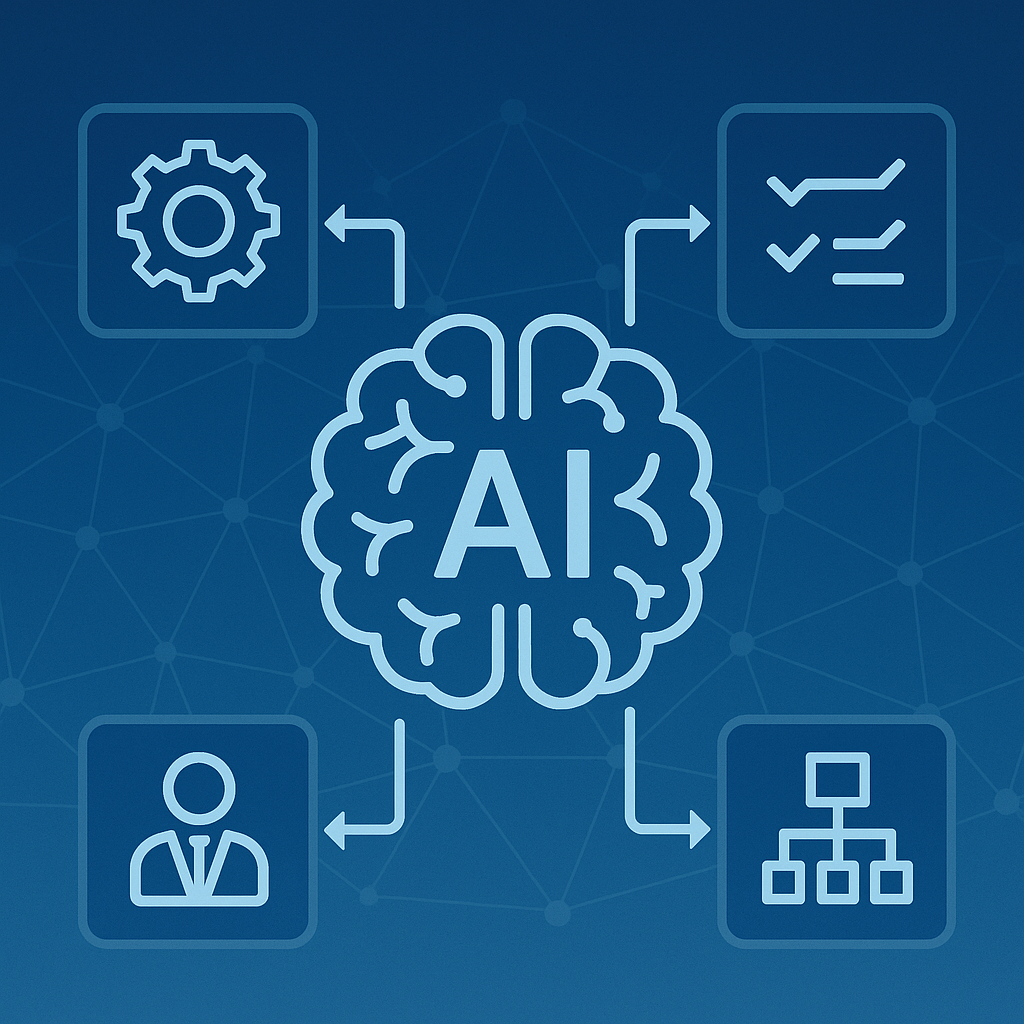
The architecture comprises four layers, each representing a distinct stage of cognitive processing. Together, these layers transform natural language into automated enterprise workflow execution. This modular approach ensures the system remains adaptable, extensible, and aligned with academic agent‑system design principles.

2.1 Domain‑Specific Language Understanding Layer

This foundation layer uses prompt‑engineering, taxonomic modeling, and contextual interpretation to convert unstructured language into structured representations. The output typically includes module detection, action classification, field extraction, priority assessment, and confidence scoring.

2.2 Tool‑Calling / Execution Layer

This layer bridges the structured intent with an execution framework. It selects the correct workflow based on the intent model and executes the corresponding system action. Examples include creating records, retrieving data, updating statuses, or triggering alerts.

The execution layer ensures parameter integrity, error handling, and compliance alignment.

2.3 Generative Communication Layer

After action execution, enterprises must maintain clean audit trails, analyst notes, and stakeholder communication. This layer produces narrative, domain‑specific outputs that adhere to enterprise writing standards. It ensures that knowledge transfer remainsconsistent regardless of who executes the workflow.

2.4 Autonomous Agentic Layer

The topmost cognitive layer enables autonomous multi‑step workflows. It incorporates
• planning
• reflection
• memory formation
• adaptive decisioning

This elevates the system from simple task automation to advanced agent‑driven orchestration.

3. Expanded Enterprise Use Cases

The multi‑layer architecture supports a wide range of enterprise workflows:
• Technical operations: alert processing, incident summarization, RCA generation
• HR services: onboarding workflows, case management, policy inquiries
• Customer service: intelligent ticket routing, sentiment‑aware responses
• Governance & compliance: risk statements, audit trails, documentation automation
• Cybersecurity: threat triage, impact estimation, evidence summarization
• Operations: multi‑step workflow scheduling, monitoring, and escalation

4. Benefits of Vendor‑Neutral Architecture

Vendor neutrality ensures the design remains platform‑agnostic, portable, and adaptable. Open architectures allow organizations to avoid lock‑in, integrate diverse tools, and gain full transparency over processing logic. This is crucial for audit readiness, compliance, and system governance.

5. Challenges and Considerations

Adopting such architectures requires consideration of:
• reliability and accuracy of interpretations
• governance and risk controls
• human‑in‑the‑loop checkpoints
• error‑handling and fail‑safe recovery
• model drift and periodic retraining
• ethical and fairness considerations

6. Future Enhancements

Future research directions include:
• multi‑agent ecosystems
• autonomous knowledge generation
• predictive intervention models
• dynamic policy adaptation
• self‑healing workflows
• reinforcement‑learning‑driven decision orchestration

7. Conclusion

A multi‑layer AI agent architecture provides a foundation for unified enterprise automation. By combining language understanding, structured intent modeling, autonomous reasoning, and generative communication, organizations can operate with greater intelligence, efficiency, and consistency across diverse domains.


Previous Post

Energy Services of America Reports Fourth Quarter and Full Year Fiscal 2025 Results

Next Post

The Analyst of 2030: A New Career Path Shaped by AI

SVJ Writing Staff

SVJ Writing Staff

Next Post

The Analyst of 2030: A New Career Path Shaped by AI

Leave a Reply Cancel reply

Your email address will not be published. Required fields are marked *

  • Trending
  • Comments
  • Latest
Faith and the Digital Transformation of Religion: How One Person Began Helping Faith Communities and People of Faith

Faith and the Digital Transformation of Religion: How One Person Began Helping Faith Communities and People of Faith

December 30, 2025
AI’s Most Underrated Role: Giving Enterprise Architects Back Their Focus

AI’s Most Underrated Role: Giving Enterprise Architects Back Their Focus

November 26, 2025
Your customers are talking, but are you listening? How AI Conversational Intelligence is rewriting the rules of customer experience

Your customers are talking, but are you listening? How AI Conversational Intelligence is rewriting the rules of customer experience

November 13, 2025

HOW BUSINESSES CAN BUILD TRUST IN THE AGE OF INTELLIGENT AUTOMATION

November 3, 2025
The Human-AI Collaboration Model: How Leaders Can Embrace AI to Reshape Work, Not Replace Workers

The Human-AI Collaboration Model: How Leaders Can Embrace AI to Reshape Work, Not Replace Workers

1

50 Key Stats on Finance Startups in 2025: Funding, Valuation Multiples, Naming Trends & Domain Patterns

0
CelerData Opens StarOS, Debuts StarRocks 4.0 at First Global StarRocks Summit

CelerData Opens StarOS, Debuts StarRocks 4.0 at First Global StarRocks Summit

0
Clarity Is the New Cyber Superpower

Clarity Is the New Cyber Superpower

0
Brand visibility and salience in the age of AI-generated answers 

Brand visibility and salience in the age of AI-generated answers 

January 29, 2026
AI Will Drive ERP Stack to Adapt or Die in 2026 

AI Will Drive ERP Stack to Adapt or Die in 2026 

January 29, 2026
Beyond the CRM: The Three-Layer Architecture for a 2026 Revenue Engine

Beyond the CRM: The Three-Layer Architecture for a 2026 Revenue Engine

January 29, 2026

Arya Health Announces Acquisition of HippoAI to Accelerate AI-Driven Clinical Decision Support

January 29, 2026

Recent News

Brand visibility and salience in the age of AI-generated answers 

Brand visibility and salience in the age of AI-generated answers 

January 29, 2026
AI Will Drive ERP Stack to Adapt or Die in 2026 

AI Will Drive ERP Stack to Adapt or Die in 2026 

January 29, 2026
Beyond the CRM: The Three-Layer Architecture for a 2026 Revenue Engine

Beyond the CRM: The Three-Layer Architecture for a 2026 Revenue Engine

January 29, 2026

Arya Health Announces Acquisition of HippoAI to Accelerate AI-Driven Clinical Decision Support

January 29, 2026
Silicon Valleys Journal

Bringing you all the insights from the VC world, startups, and Silicon Valley.

Content Categories

  • Agentic
  • AI
  • C-Suite Perspective
  • Cloud Computing
  • Cybersecurity
  • Enterprise Tech
  • Events & Conferences
  • Finance & Investments
  • Financial Planning
  • Fintech
  • Founder Stories
  • Future of Silicon Valley
  • Healthtech
  • Interview
  • Leadership & Perspective
  • Leadership Vision
  • Press Release
  • Product Launches
  • Robotics
  • SaaS
  • Technology & Industry
  • Uncategorized
  • About
  • Privacy & Policy
  • Contact

© 2025 Silicon Valleys Journal.

No Result
View All Result

© 2025 Silicon Valleys Journal.