By Vishi Singh Bhatia, IT Consultant, Healthcare – AI/Cloud Specialist
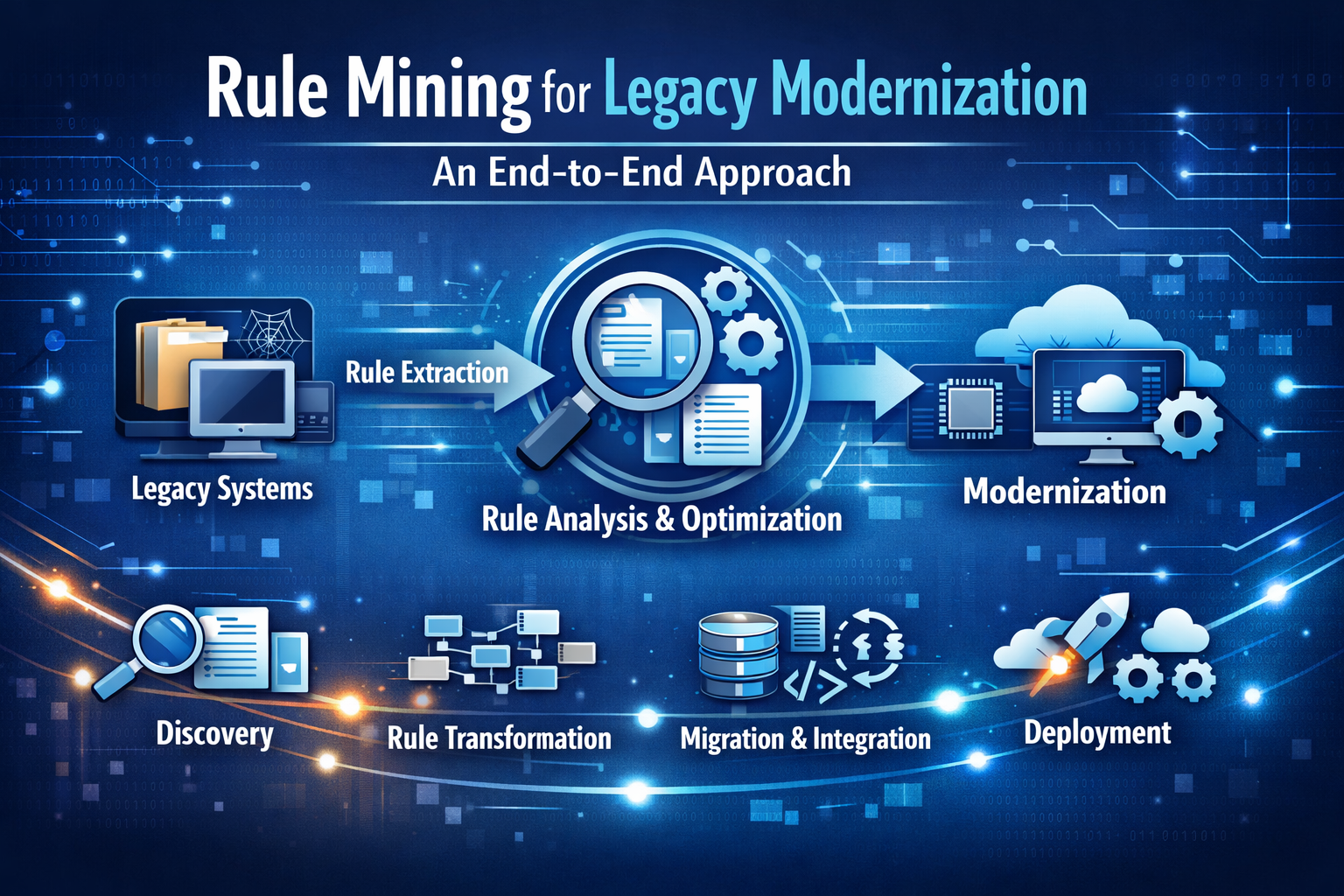
Legacy systems are the hidden heroes of many enterprises. They’ve been reliably running core business processes for years, sometimes even decades. But as technology progresses, these older systems become speed bumps to agility, innovation, and scalability. Legacy modernization is the answer, and at the heart of modernization lies a technique called rule mining — the process of extracting the business rules encoded in legacy applications in preparation for intelligent modernization.
In this article, we’ll demystify what rule mining is, why it matters, and share an end-to-end approach to leveraging rule mining in your legacy modernization strategy.
What Is Rule Mining?
Rule mining is the process of uncovering, extracting, and documenting the business rules that are hardcoded in the codebase of legacy applications.
Business rules drive decision-making for all kinds of processes: billing, eligibility, risk scoring, compliance checks, content personalization, underwriting, fraud prevention, and more. The challenge? Many of these business rules are not visible or well-documented in most legacy systems.
Instead, they’re buried in mounds of COBOL or RPG code. They may be duplicated in multiple places. Updated inconsistently. Never meant to be shared or even be found.
The purpose of rule mining is to unearth these rules, making them visible and understandable. Documenting these rules also makes them reusable and ready to be re-implemented in a modern application.
Rule mining is a critical step in understanding the functional requirements of legacy systems before moving to the cloud or other modern platforms. Any missing or incorrect business rules could lead to compliance or process failures once the system is moved.
Legacy system modernization without rule mining can feel like rebuilding a house of cards on top of an invisible foundation. Even worse, legacy modernization without rule mining risks “modernizing” the code itself instead of properly externalizing and transforming the business rules.
Rule mining: A critical first step to legacy modernization
Why Rule Mining Is Critical for Legacy Modernization
Legacy systems can be complex beasts. Neglecting to mine the rules before modernization can lead to data loss, compliance risks, and other serious operational issues. Here are some key reasons why rule mining is a critical first step to legacy modernization.
• Business Continuity: Business logic, rules, and decisions should never be lost in translation from legacy to modern. Preserving core rules is essential to maintain continuity and avoid compliance or process failures.
• Efficiency: Rule mining streamlines the process of migration itself by surfacing redundant or legacy logic.
• Transparency: Business rules are no longer hidden in spaghetti code and spaghetti structures.
• Agility: Documented rules can be moved into a modern rule engine or low-code platform for agile updates, scalability, and business-IT collaboration.
Steps and Deliverables for Rule Mining in Legacy Modernization
There is no one-size-fits-all approach to legacy modernization. Successful rule mining projects typically follow a structured, end-to-end process.
Here’s a typical step-by-step approach for a legacy modernization effort using rule mining.
1. Assessment and Scoping
• Before even touching the code, it’s important to gain an understanding of what you are looking at.
• Identify the applications, services, and modules to be included in the modernization effort.
• Consult with business and technical stakeholders to determine which areas of functionality are the most critical.
• Assess the size of the legacy source code (number of lines, complexity, etc. ), as well as documentation, training materials, and team knowledge.
• Deliverable: A modernization roadmap with a prioritized list of rule-heavy components/modules.
2. Tool Selection and Setup
• Manual rule mining from legacy source code is possible — but tedious and error-prone.
• Automated rule mining tools can help. Look for a tool that has support for:
• Static and dynamic code analysis
• Dependency mapping
• Business logic pattern recognition
• Multi-language support for legacy (COBOL, PL/I, Natural, RPG, etc.) and modern languages
• IBM ADDI and Modern Systems (Rocket) both have commercial rule mining tools. A few open source parsers also work.
• Deliverable: Installed, configured tools with access to legacy codebase.
3. Automated Rule Extraction
• Run tools to scan the codebase, looking for structures like if-then-else statements, case logic, and so on.
• Mark the identified candidate rules and map the execution path and dependency.
• The output will typically be:
• Candidate rules with code references
• Frequency of use
• Rule groupings by business process or domain
• Deliverable: Initial inventory of rules with technical metadata.
4. Business Validation and Enrichment
• This is where your SMEs (subject matter experts) come in.
• Verify the identified rules with SMEs, and explain and document what each rule does.
• Translate the rules into business language, rather than technical jargon.
• Tag active rules, redundant rules, rules that are no longer needed, and rules that may conflict.
• Rules may still be cryptic to business users at this stage, but should now be understandable:“If a customer is over 65 and has an account balance under $500, apply a senior discount.”
• Deliverable: Business Rule Catalogue.
5. Rule Optimization and Consolidation
• Cleaning up is one of the most important steps in the whole process.
• Identify duplicate, conflicting, or redundant rules.
• Remove any obsolete or irrelevant logic (rarely used, no longer applicable).
• Consolidate similar rules.
• Rule consolidation is important when moving a rule from a system, as it prevents migration teams from inadvertently bringing legacy baggage to a modern platform.
• Deliverable: Optimized and deduplicated rule set.
6. Rule Externalization and Migration
• The goal here is to move the business logic to a modern rule engine or integrate with a Business Process Management (BPM) tool.
• Modern rule engines like Drools, IBM ODM, or Red Hat Decision Manager enable:
• Rule updates without source code changes
• Rule versioning and auditing
• Rule integration into microservices/cloud-native architectures
• Deliverable: Rules deployed in a modernized and decoupled platform.
7. Testing and Validation
• This is your safety net.
• Build test cases around business scenarios.
• Compare results between the legacy and modern platform.
• Involve end users in acceptance testing.
• Rule testing is the only way to ensure the logical translation is both technically and functionally correct.
• Deliverable: Validated rule logic with acceptance sign-off from business and IT.
8. Ongoing Governance
• Rules are never done.
• Setup a rule governance process to manage rule changes going forward.
• Assign owners to business and technical rule maintenance and management.
• Monitor rule performance and usage via dashboards.
• Deliverable: Rule governance framework.
Final Thoughts
Legacy modernization is more than just a technical refresh. It’s a strategic business initiative to future-proof your most important systems and processes.
Rule mining is key to success in this process. By methodically mining business rules, it is possible to make them visible and understandable, documented and accessible, and future-proofed for more agile changes. Following a disciplined, end-to-end approach to rule mining is the most reliable way to ensure business knowledge is preserved during modernization and technical debt is kept to a minimum.
Rule mining, therefore, is not just a preface to modernization, but the solid foundation legacy modernization is built upon.