
Global trade reached a record $33 trillion in 2024, yet for most small businesses, tapping into it still feels out of reach. A founder who sees customer demand in one market, and knows the right product or factory exists in another, still has to bridge a wide gap to connect the two. The usual assumption is that the gap is about finding products. Having spent years working on B2B commerce, I have come to see it differently. Finding products was rarely the hard part. The hard part is almost everything that happens after the search.
The Real Friction in Cross-Border Sourcing
When a small business sources from overseas, the catalog is seldom the obstacle. Millions of products and suppliers sit a few clicks away. The difficulty is matching a specific business need to the right manufacturing capability. A buyer usually does not want a standard item pulled off a list. They need a factory that can work to a particular design, material, target price, quality standard, packaging, and delivery timeline. That is a matching problem, and keyword search was never built to solve it.
Trust makes it harder. A buyer evaluating an unfamiliar supplier on the other side of the world has to judge credibility, production capacity, and reliability from limited information. Communication adds another layer, because both sides must align on technical and commercial requirements across languages, time zones, and trade conventions. Any one of these steps can stall a promising order, and for a lean team without procurement specialists, any one of them can end it.
Why Search and Browse Falls Short
Traditional marketplaces run on a search-and-browse model that places the full analytical burden on the buyer. That works if you have a procurement department. Most small businesses do not. A founder importing for the first time often has to learn trade terms such as Incoterms, FOB, and HS codes, work out the certification and compliance rules for their category, and know which questions to ask a supplier before committing capital. None of that shows up in a product listing.
This is the gap that the first generation of AI sourcing tools began to close. That wave focused on specific, high-friction moments in the buyer journey. Image search let buyers find a product by uploading a picture instead of guessing at keywords. Tools that help structure a request for quotation made buyer inquiries clearer and more complete, which in turn made suppliers more willing to respond. Real-time assistance answered the trade and category questions that used to require an experienced procurement manager. When Alibaba.com expanded its Smart Assistant features at CES 2024, the common thread across them was practical: put the expertise next to the buyer at the moment they need it.
From Smarter Search to AI Agents
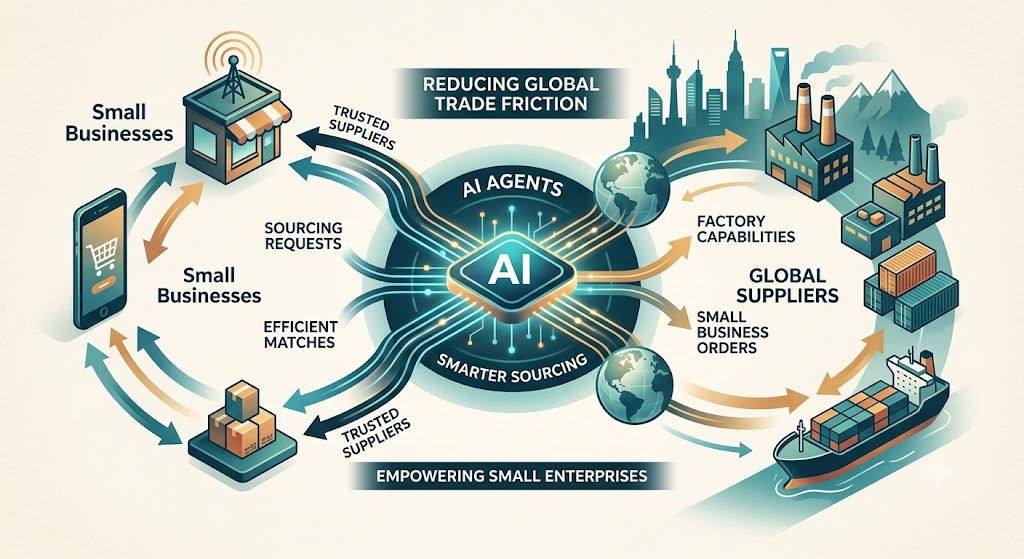
The larger shift is happening now, as sourcing tools move from assisting the buyer to acting on the buyer’s behalf. Alibaba.com’s AI sourcing engine, Accio, passed two million users within nine months of launch and more than ten million monthly active users by early 2026, a sign of how quickly buyers are folding AI into their sourcing workflow. Its agent layer can take a product concept and return a development plan covering market analysis, supplier vetting, compliance guidance, and bulk requests for quotation, compressing work that once took weeks into minutes.
What matters here is not the size of the model. It is the data these systems learn from. Because they are trained on the actual mechanics of trade, drawing on roughly a billion product listings and tens of millions of supplier profiles, their output is built to be commercially specific instead of generically plausible. An agent that automates a large share of the manual sourcing workflow is only useful if what it produces holds up against a real supplier and a real order.
What This Means for Small Businesses
For a small business, the effect is a lower barrier to entry. International sourcing used to favor large companies with dedicated procurement teams, supply chain experience, and deep category knowledge. A solo founder could not realistically match that. AI-assisted sourcing narrows the distance. It lets a small buyer express a need clearly, surface suitable suppliers, ask the right questions, and move toward an order without first becoming a sourcing expert.
That carries real weight for North America, where a growing share of small businesses now run extremely lean. By Alibaba’s own survey, about 40% of small and medium-sized businesses globally are operated by solo entrepreneurs working under tight limits on time and staff. For a buyer in that position, an AI agent can do much of the work of the procurement team they were never able to hire.
What AI Will Not Do
It would be a mistake to read this as AI taking over human judgment in trade. The decisions that carry the most weight, such as choosing a long-term manufacturing partner, negotiating terms that affect margin for years, or accepting the risk of a large first order, still belong to people. What AI changes is how much friction sits in front of those decisions. It clears the repetitive analysis and the knowledge gaps so a buyer can spend attention on the calls that actually require it. The strongest sourcing outcomes I have seen still come out of human relationships. AI helps by getting buyers to that conversation faster and far better prepared.
The Takeaway
The market is moving in this direction regardless of any single platform, and the value of AI tools in commerce is projected to grow several times over by the early 2030s. The practical lesson for small businesses is to start building the habit now. Companies that learn to source with AI today will operate from a higher baseline as these tools mature, and they will reach global suppliers that were, until recently, the preserve of much larger competitors. The promise of global trade was always access. For the first time, the tools are beginning to deliver that access to the businesses that need it most.